Alexis Yushin
The Great API Debate: REST, GraphQL, or gRPC?
#1about 4 minutes
Defining developer productivity as the ultimate software metric
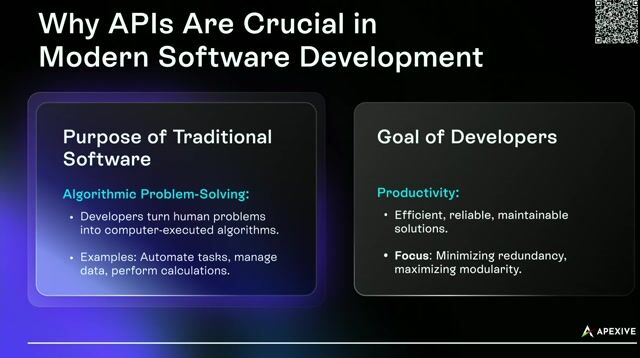
Developer productivity, measured by customer satisfaction and future-proof code, is the key metric for building traditional software.
#2about 2 minutes
Using APIs to compartmentalize complexity and enable scalability
APIs act as firewalls between software modules, enabling interoperability and scalability by allowing independent system growth.
#3about 3 minutes
Tracing the evolution of APIs from RPC to GraphQL
The history of APIs shows a progression from low-level RPC and verbose SOAP to structured REST, interactive WebSockets, and modern gRPC and GraphQL.
#4about 3 minutes
Understanding API users and common application use cases
APIs serve various roles like developers and architects across use cases including mobile backends, third-party integrations, and microservices.
#5about 4 minutes
Leveraging APIs as a tool for clean architecture
A well-designed, domain-driven API enforces clean architecture by separating concerns and firewalling business logic from the presentation layer.
#6about 2 minutes
Architectural differences between REST, GraphQL, and gRPC
REST is resource-oriented, GraphQL offers flexible data queries similar to SQL, and gRPC provides a low-level, efficient data serialization format.
#7about 4 minutes
Evaluating the pros and cons of REST, GraphQL, and gRPC
REST offers self-documentation via OpenAPI but struggles with data fetching, while GraphQL is flexible but can break architectural separation, and gRPC is performant but complex to debug.
#8about 1 minute
Case study: Accelerating development with REST and OpenAPI
Using a REST API with OpenAPI allows for automatic client generation, which significantly speeds up front-end development for Django applications.
#9about 2 minutes
Choosing the right API for different project needs
Select REST for simple CRUD operations, consider GraphQL for complex front-end data needs, and use gRPC for high-performance microservices.
#10about 2 minutes
Q&A: GraphQL bombs and gRPC for microservices
The best defense against recursive GraphQL queries is a solid architecture, and gRPC is recommended for microservices due to its performance and control.
Related jobs
Jobs that call for the skills explored in this talk.
Matching moments
01:32 MIN
Organizing a developer conference for 15,000 attendees
Cat Herding with Lions and Tigers - Christian Heilmann
04:57 MIN
Increasing the value of talk recordings post-event
Cat Herding with Lions and Tigers - Christian Heilmann
03:17 MIN
Selecting strategic partners and essential event tools
Cat Herding with Lions and Tigers - Christian Heilmann
04:49 MIN
Using content channels to build an event community
Cat Herding with Lions and Tigers - Christian Heilmann
02:39 MIN
Establishing a single source of truth for all data
Cat Herding with Lions and Tigers - Christian Heilmann
02:44 MIN
Rapid-fire thoughts on the future of work
What 2025 Taught Us: A Year-End Special with Hung Lee
03:39 MIN
Breaking down silos between HR, tech, and business
What 2025 Taught Us: A Year-End Special with Hung Lee
04:22 MIN
Why HR struggles with technology implementation and adoption
What 2025 Taught Us: A Year-End Special with Hung Lee
Featured Partners
Related Videos
REST in Peace? What does the API protocol of the future look like? Or do we have it already?
Simon Auer
GraphQL: Does it replace SQL, REST or Something Else?
Gregor Bauer
API = Some REST and HTTP, right? RIGHT?!
Rustam Mehmandarov
Designing gRPC APIs - The things they don't tell you
Bastian Eicher
Awful APIs: A History Lesson in Industry Mistakes and Mishaps
James Seconde
Rapid GraphQL API Development with PostGraphile
Ruwan Xaviour Fernando
Build your backend using FastAPI
Ashmi Banerjee
Specifications as the better way of software development
Artem Manchenkov
Related Articles
View all articles


From learning to earning
Jobs that call for the skills explored in this talk.


RoomPriceGenie
Remote
Intermediate
NumPy
SciPy
React
Django
+5


Yuma AI (YC W23)
Barcelona, Spain
API
Redis
React
Next.js
PostgreSQL
+2


UNITY AG
Lippstadt, Germany
Azure
Julia
Python
FastAPI
Amazon Web Services (AWS)
