
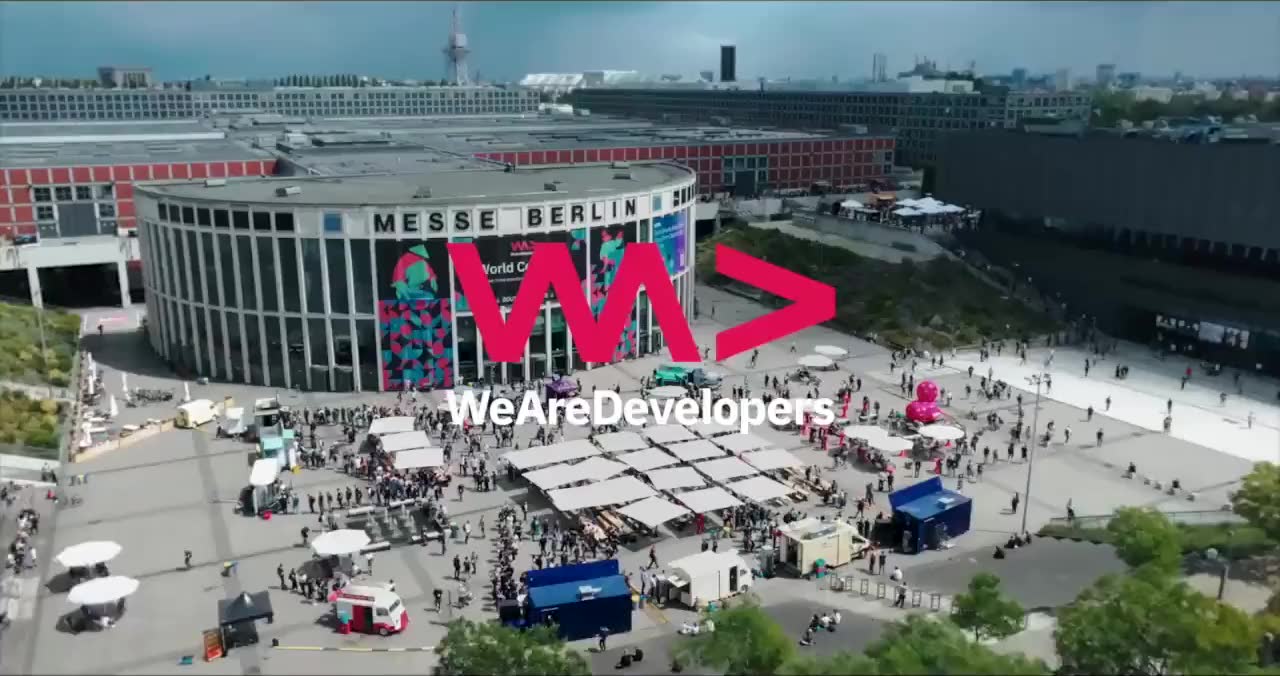
Inspiration
Learn faster. Build smarter. Lead with AI.
The World’s Largest Event for Developers, AI Builders & Tech Leaders
14–16 July 2027Berlin, Germany
- 15,000+Builders
- 8,000+Companies
- 2,000+Decision-makers
- 500+Speakers
- 20+Stages
- 40k+sqm Tech Expo
14–16 July 2027 · Berlin
Speakers
The Speakers Who Took the Stage in 2026
2026 Edition
The people who shaped the program
Engineering leaders, practitioners, and builders who took the stage in 2026. Stay tuned — the 2027 lineup is on its way.

Werner Vogels
CTO
Amazon.com

Michael Kagan
CTO
NVIDIA

Thomas Dohmke
CEO and Co-founder
Entire

Malte Ubl
CTO
Vercel

Dana Lawson
CTO
Netlify

Des Traynor
Co-Founder and Chief Strategy Officer
Fin

David Soria Parra
Co-creator of MCP, Member of Technical Staff
Anthropic

Victor Savkin
CTO and Co-founder
Nx

Milin Desai
CEO
Sentry

Taroon Mandhana
CTO AI and Teamwork
Atlassian
Jeff Atwood
Community Wizard
Stack Overflow and Discourse

Dr. Ramin Hasani
CEO and Co-founder
Liquid AI
Where Tech Meets Strategy
Executives and policy leaders driving technology strategy across industries.

Karsten Wildberger
Federal Minister for Digital Transformation and Government Modernisation

Markus Blume
Bavarian State Minister for Science and the Arts

Thomas Jarzombek
Parliamentary State Secretary to the Federal Minister for Digital Transformation and Government Modernisation

Gülnaz Öneş
Group CIO
RWE

Michael Ameling
President SAP Business Technology Platform, Member of the Extended Board
SAP

Markus Rautert
CTO
adidas
On the record
What Attendees Say.
From the icons who built the industry to the engineers shipping in it today — here’s what the community keeps saying about WeAreDevelopers.
WeAreDevelopers is my favorite conference. It's the best event you can go to if you are a developer!
Joel Spolsky
Co-founder · Stack Overflow
This is a conference you do not want to miss.
Romano Roth
Global Chief DevOps · Zühlke Group
The energy was unreal - from cutting-edge tech talks to deep dives into AI, all powered by a vibrant and diverse tech community.
Sebastian Sax
Enterprise Architect · Wiener Netze
Hard to believe! This is the largest group I've ever been in front of. Honored to be here. All the people I'm meeting just remind me of myself!
Steve Wozniak
Co-founder · Apple
One of the best damn conferences. A truly impressive community. You'll never regret the experience.
Ryan J. Salva
Sr. Director Product · Google
Good experience, top notch speakers, lot to learn and good for networking.
Mariam Reba Alexander
Software Engineer · Maersk
How amazing can a conference be? #WeAreDevs: yes! 🙌
Luise Freese
Azure Architect
WeAreDevelopers is the place where you meet everyone else in the industry and learn about the latest things.
David Singleton
CEO of /dev/agents
WeAreDevelopers World Congress was a thrilling ride through everything that’s driving tech right now.
Nicolai Gruber
Agentic AI Lead · Mercedes-Benz
Absolutely mind-blowing! WeAreDevelopers was simply NEXT LEVEL. So much inspiration, energy, and a truly world-class organization.
David Tielke
Tech Consultant
Such a vibrant, inspiring community!
Katrin Lehmann
CIO · Mercedes-Benz
A must-attend for tech professionals!
Ettore Zotarelli
Senior Product Manager · Mews
Feeling the Vibe and the family of fellow techies and coding nerds made me love my job again.
Robert Keller
Senior Software Engineer · Assist Digital
I truly enjoyed the conference, gaining a lot from the workshops and making many new connections.
Pavlo Maksymov
Lead Software Engineer
Unique opportunity to network, learn, discover and trace new paths to your software and career.
Alberto Lazzaris
Specialist QA Engineer · Hero Software
If you are part of the world of programming, this is the place to go.
John Romero
Legendary Game Creator
I’m still processing it. What an amazing event my friends!
Erick Wendel
Staff Software Engineer · Nodesource
The people here are shaping the future of technology and humanity.
Garry Kasparov
AI Pioneer · World Chess Champion
Why Attend.
AI is already inside the development workflow. The hard questions are still open: how to build, what to automate, what to trust, what to secure, what to buy, how to operate it in production. WeAreDevelopers World Congress is where developers, platform teams, security teams, and engineering leaders discuss what actually works.
01
Learn what's actually working in production
Talks from people building and operating real systems: AI-assisted development, agents, cloud platforms, observability, data pipelines, security, developer tools, and delivery workflows. What broke, what scaled, and what teams would not do again.
You leave withpatterns to copy, mistakes to avoid, and a sharper view of what is production-ready.02
Get hands-on with tools and patterns
Workshops, masterclasses, and live coding sessions where you actually try the tools, break things, and understand the details. Not just slides. Not just inspiration. Practical sessions you can bring back to your own codebase and workflows.
You leave withmuscle memory, working examples, and techniques your team can adapt immediately.03
Get AI-ready as an engineer
Traditional engineering practices are changing fast: coding assistants, agents, evals, context engineering, AI-assisted testing, security reviews, and new delivery patterns are becoming part of how modern teams build software. The question is no longer whether AI belongs in the workflow. The question is how to use it well without lowering quality, security, or engineering judgment.
You leave witha practical AI workflow, a clearer sense of where AI helps or hurts, and more confidence using it in real engineering work.04
Build the skills that keep you relevant
The strongest developers are not just learning another framework. They understand systems, trade-offs, security, reliability, AI-assisted delivery, developer experience, and how to make better technical decisions. Use the event to learn which skills are becoming more valuable, which habits are becoming outdated, and where to invest your learning time next.
You leave withclearer skill priorities, stronger technical judgment, and a better view of where your career should move next.05
Compare architectures, tools, and trade-offs
Use the event to test your assumptions before the next platform or tooling decision. Open source vs managed service. Build vs buy. Central platform vs team-level tooling. Agent workflows vs classic automation. Vendor claims vs practitioner reality.
You leave witha shortlist, real trade-offs, and fewer decisions made from hype or incomplete information.06
Benchmark your AI, engineering, and security practices
Find out how other teams are handling the decisions you are making now: AI coding policies, agent governance, security reviews, platform ownership, observability, cloud cost, compliance, and developer productivity. Not best-practice theory, but what teams are actually shipping.
You leave witha reality check on where you are ahead, behind, or solving the wrong problem.07
Bring your team and align faster
Use the event as a three-day engineering offsite. Split across tracks, compare notes over coffee, challenge assumptions, and turn scattered opinions into a shared direction. This is especially useful when your team is making decisions around AI adoption, platform architecture, security rules, developer productivity, or tooling.
You leave witha shared mental model, clearer priorities, and fewer decisions re-litigated in the next sprint.08
Meet the builders behind the tools you use
Maintainers, founders, CTOs, SREs, security leaders, and product teams from the tools your company already uses are in the same place. Ask the questions that do not fit into documentation, GitHub issues, sales calls, or webinar Q&A.
You leave withdirect answers, better context, and contacts you can still reach after the event.09
Understand where the stack is going
Agents, evals, MCP, AI-assisted coding, platform engineering, cloud-native infrastructure, observability, and security are moving fast. The point is not to chase every trend. The point is to know what is real, what is early, and what is not worth your time yet.
You leave witha clearer view of what to adopt, what to watch, and what to ignore.10
Get unstuck on problems you are solving now
Every developer has questions that are hard to answer from documentation, blog posts, vendor pages, or internal Slack threads. At the event, you can bring those questions into talks, workshops, hallway conversations, and Q&A sessions with people who have solved similar problems before.
You leave withbetter answers, better questions, and practical next steps for the work waiting back at your desk.
On-site
Three Days, Many Ways to Spend Them.
Tech Talks
Live Coding
Workshops
Tech Expo
Challenges
Community
Music & Vibes
Topics in focus
What You Will Learn.
AI is no longer a side topic. It is changing how teams design, code, test, ship, secure, operate, and lead software. The conference program covers the full modern software lifecycle - from everyday engineering craft to agentic systems, platforms, security, quality, and engineering leadership.
- Build
- Ship
- Run
- Secure
- Test
- Lead
01
Building with AI as a craft
- Backend engineers
- Frontend engineers
- ML engineers
- Full-stack builders
What we cover
- Coding agents in your IDE: what to delegate, what to keep.
- Architecture decisions that compound when AI writes code alongside you.
- Prompt design and context engineering as real engineering disciplines.
- Retrieval, latency, and shipping software that survives users.
- Evals and feedback loops you can actually trust against real traffic.
- Refactoring legacy code with agents — what works, what blows up.
02
Agentic systems in production
- ML engineers
- Backend engineers
- Platform engineers
- AI engineers
- Tech leads
What we cover
- Multi-agent architectures, MCP, and tool orchestration patterns that hold up.
- Agent memory, long-running agents, and what breaks after six months in front of users.
- Guardrails, fallbacks, and the boring plumbing that keeps agents from going sideways.
- Cost, latency, and throughput trade-offs once agents are on the critical path.
- Honest post-mortems from teams who shipped agentic systems.
03
Modern languages and runtimes
- Backend engineers
- Systems engineers
- Full-stack builders
- Tech leads
What we cover
- Rust, Go, modern Java, Kotlin, and TypeScript at scale.
- WebAssembly moving from edge experiment to mainstream runtime.
- Architectural calls that compound when AI agents start writing code too.
- Interop, FFI, and polyglot stacks when no single language wins anymore.
- Performance tuning, memory models, and concurrency in real production code.
04
Platforms, pipelines and developer experience
- Platform engineers
- DevOps
- SRE
- Frontend engineers
- Engineering managers
- Tech leads
What we cover
- Internal developer platforms treated as products, with golden paths that people actually use.
- CI/CD that does not flake, and release flows when AI agents open PRs alongside humans.
- Self-service infra and paved roads that scale across dozens of teams.
- Build times, caching, and the small wins that change how engineers feel about your platform.
- Developer experience as a measurable outcome, not a vibe.
05
Cloud, scale and reliability
- Backend engineers
- Cloud engineers
- SRE
- DevOps
- Frontend engineers
- Platform engineers
What we cover
- Capacity planning, multi-region deployment, and observability that answers questions.
- GPU-heavy workloads next to classic services, and nondeterministic latency on call.
- SLOs and agent telemetry when half your critical path is a model you do not own.
- Incident response and on-call in a stack that mixes deterministic and probabilistic systems.
- Cost, capacity, and the reliability trade-offs of running models in production.
06
Data, analytics and the AI training stack
- Data engineers
- ML engineers
- Analytics engineers
- Backend engineers
- Platform teams
What we cover
- Pipelines, lakehouses, and streaming systems that hold up under real load.
- Vector databases sitting next to OLAP, and training-data quality as model quality.
- Data contracts, lineage, and freshness when AI features depend on the same plumbing as dashboards.
- Training data, evaluation sets, and the feedback loop between product and pipeline.
- Analytics engineering between raw events and product decisions.
07
Security and trust
- Security engineers
- Backend engineers
- Platform engineers
- CISOs
- Tech leads
What we cover
- Supply-chain security, dependency hygiene, and identity wired into builder workflows.
- Prompt injection, agent boundaries, and sensitive-data exfiltration in AI features.
- Authn, authz, and secrets management when agents act on behalf of users.
- Compliance, audit, and the new evidence you need for AI-powered features.
- Threat modeling for a dual-use world where defenders and attackers share tools.
08
Quality and testing in a non-deterministic world
- QA engineers
- SDETs
- Backend engineers
- Frontend engineers
- ML engineers
What we cover
- Testing for distributed systems: contract tests, deterministic CI, observability-driven QA.
- Evals, guardrails, and regression suites for LLM-powered features and agents.
- Synthetic data and replay traffic for testing nondeterministic systems.
- Shift-left vs shift-right when half the failures only show up in production.
- Metrics that actually correlate with users trusting your AI feature.
09
Engineering leadership in a shifting stack
- CTOs
- VPEs
- Engineering managers
- Tech leads
- Staff+ engineers
What we cover
- Team design, hiring, and training in a world where AI touches most engineering work but only a slice is genuinely delegated.
- Build vs buy, platform choices, and governance for tools that change every quarter.
- Budget, headcount, and ROI conversations when half the tooling is changing under you.
- Leading through ambiguity when neither vendors nor benchmarks have caught up yet.
- Architectural decisions that compound across the next two years.
What You'll Do
Builders Zone
A floor for the people who'd rather be building.
The part of the event built around the work itself, not the watching. Time and room to actually open the laptop, a place to pair on something gnarly, and a crowd of developers deep in the same problems you are.
- 01
Build.
Sit down, open the laptop, work on the thing you came in with. Pair on it with someone who's solved it before, or figure out where it's stuck with someone who hasn't.
- 02
Show.
Demo what you've made to a room of developers who'll actually try to break it. Useful, weird, or broken-but-interesting — all of it.
- 03
Trade.
Compare stacks, prompts, configs, and review loops with the people doing the work. The unscheduled half of the value of being here.
Moments
Where Big News Happens First.
Product launch
GitHub Copilot Launch
GitHub CEO Thomas Dohmke took the WeAreDevelopers stage for not only his first public appearance, but also to unveil the first public demo of GitHub Copilot.
Product launch
OverflowAI Launch
Stack Overflow CEO Prashanth Chandrasekar revealed OverflowAI - Stack Overflow's answer to Copilot live on the WeAreDevelopers stage.
Keynote
Sir Tim's Vision
The inventor of the Web, Sir Tim Berners-Lee, outlined his vision for the future of the web, where people regain control of their data.
Announcement
Death of IE
Microsoft's Amanda Silver, Scott Hanselman, Chris Heilmann, and Torsten Stiller announced the end of Internet Explorer and unveiled a bold vision for the future of browsers.
Partner moment
A Trip to Space
A trip to space (literally) was offered to two lucky developers by WeAreDevelopers partner Rapyd, as they launched an out-of-this-world coding challenge!
After-dark
Tiësto at the Party
Legendary DJ Tiësto took center stage at the biggest developer party ever, proving that they not only work hard but also play hard.
Keynote
Insights from Woz
Apple co-founder Steve Wozniak captivated the audience by sharing his insights and sparking discussions about tech's next disruptors.
Keynote
Spolsky about GenAI
Founder of Stack Overflow and Trello, Joel Spolsky, announced the next big era of the web: Generative AI.
Sponsorship
Become a Partner
WeAreDevelopers brings together the engineers, architects, and decision-makers building software for the AI era. Put your brand, product, and roles in front of an audience that actually evaluates, adopts, and ships.
From the floor
WeAreDevelopers is probably the most authentic and largest developer conference out there. Never have we met so many interesting, top caliber people that are driven by passion for their work. If you can only go to one conference, go there!
- + many more
Covered By
Tickets
Pick Your Ticket. Prices Go Up as We Get Closer.
Congress Pass
Most popular€339
Regular price: €799
Three days, every stage, the expo, the after-party, on-demand recordings.
Congress Pass Plus
€689
Regular price: €1,199
Everything in Congress Pass, plus fast lane entry and access to the catered Plus lounge.
VIP Pass
€1,289
Regular price: €2,499
All-access. Tech Leaders Summit, Tech Leaders Night, private lounges, dedicated entry.
Startup Pass
€299
Affordable rate for early-stage startups. Full Congress Pass access.
Student Pass
€120
Affordable rate for full-time students. Full Congress Pass access.
Attending with a team?
Bring developers, platform engineers, security leads, DevOps/SREs, and engineering managers. Split across sessions, compare notes daily, and return with a shared view on what to adopt, what to test, and what to avoid.
Group discounts are applied automatically based on group size, and shown per ticket on the pricing page when you add multiple seats.
A Personal Message
Explore What Makes WeAreDevelopers Unique
We created WeAreDevelopers to be more than just another conference. It’s a place where the global developer community comes together to learn from each other, to discover new tools and ideas, and to celebrate the craft of building software. Every year, thousands of developers, engineers, and tech professionals join us to exchange knowledge, challenge assumptions, and push technology forward — together.
What makes WeAreDevelopers special is the atmosphere. It’s professional and ambitious, but also personal, inspiring, and fun. You’ll find world-class tech talks and workshops next to live coding sessions, a buzzing expo floor, and moments that remind you why you started building in the first place.
It’s the energy, the people, and the shared belief that technology can make the world better — that’s what defines WeAreDevelopers.
Sincerely,
Sead Ahmetovic
CEO, WeAreDevelopers
Be the First to Know
Stay in the Loop
Get updates about speakers, agenda, and price changes — straight to your inbox.