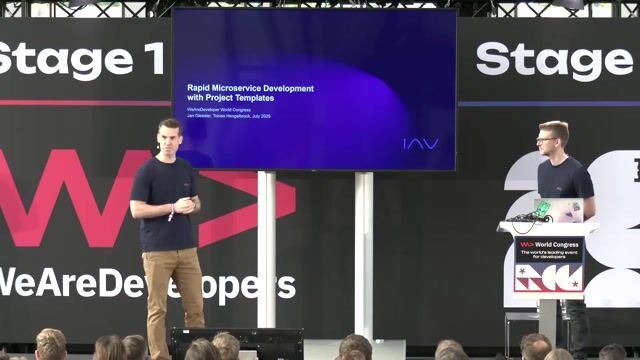
Rapid Microservice Development with Project Templates
What if you could build a production-ready microservice in minutes, not days? This talk shows you how to template away the 80% of boilerplate slowing your team down.
#1about 3 minutes
Overview of a modern microservice architecture
A high-level look at a typical software architecture using microservices for backend tasks and interacting with external services.
#2about 3 minutes
Separating core functionality from boilerplate code
Microservices consist of unique business logic and common boilerplate elements like CI/CD, deployment, and monitoring, which can be abstracted into a template.
#3about 5 minutes
Creating a new microservice from a template
A live demonstration shows how to use the `craft` command-line tool and a questionnaire to rapidly generate a new microservice project.
#4about 2 minutes
Reviewing the generated project and CI/CD pipeline
An exploration of the pre-configured project structure, including semantic versioning, Helm charts, and a full CI/CD pipeline for linting, building, and testing.
#5about 2 minutes
The challenge of keeping microservices up to date
As the base template evolves with new best practices, a mechanism is needed to propagate these updates to existing microservices without overwriting custom logic.
#6about 3 minutes
Applying template updates to an existing service
A demonstration of the `craft update` command, which merges changes from the latest template version into an existing microservice project.
#7about 4 minutes
Key benefits of using project templates
Project templates reduce repetitive work, serve as living documentation for best practices, and centralize infrastructure improvements while allowing services to remain decoupled.
Related jobs
Jobs that call for the skills explored in this talk.
Why You Shouldn’t Build a Microservice ArchitectureWelcome to this issue of the WeAreDevelopers Live Talk series. This article recaps an interesting talk by Michael Eisenbart who talks about the pros and cons of microservice architecture.About the speaker:Michael has been working for Bosch as a sof...
Micro Components - a different approach to a simpler component-based webThere has been a lot of heated discussion lately in the web community about component based development. One side argued that Web Components are a standard we should follow whereas others complained that they still lag behind in what frameworks offer...