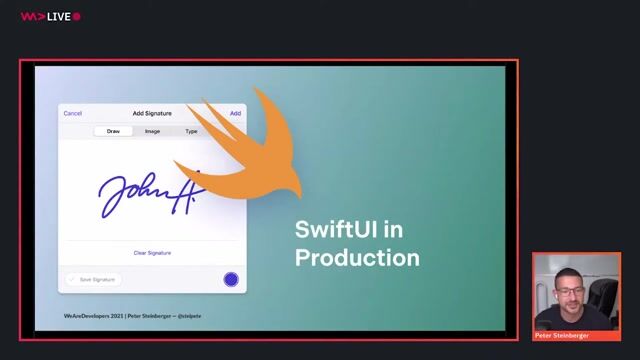
Can you ship SwiftUI in production while supporting iOS 12? See the clever workarounds and necessary 'hacks' that made it possible.
#1about 3 minutes
The state of SwiftUI and its production readiness
SwiftUI presents a new way to build UIs but is still new and risky, prompting an exploration of its use in a production SDK.
#2about 3 minutes
A first experiment rewriting settings with SwiftUI
The initial test involved rewriting an existing settings screen in a free app to gain experience and control before tackling a major feature.
#3about 4 minutes
Why SwiftUI was chosen for a new feature
SwiftUI was selected for a new electronic signature feature because it simplifies view updates, aligns with a UI-as-code philosophy, and integrates well with existing high-performance UIKit components.
#4about 4 minutes
Integrating SwiftUI into an existing Objective-C codebase
The new SwiftUI feature is encapsulated within a UIHostingController to maintain an Objective-C API and provide a fallback for older iOS versions.
#5about 7 minutes
Presenting a true popover on iPhone with UIKit
A custom anchor button embedding a UIView is used to access a view controller and present a UIKit popover, bypassing SwiftUI's default sheet presentation on iPhone.
#6about 3 minutes
Centering items in the navigation toolbar
The SwiftUIX library provides a solution for centering toolbar items on iOS 13, while the native .toolbar modifier is used for iOS 14 and newer.
#7about 3 minutes
Debugging and avoiding attributed graph crashes
Attributed graph crashes are difficult to debug, but one common cause is nested GeometryReaders, which can be avoided with conditional logic for specific OS versions.
#8about 1 minute
Fixing ObservableObject for NSObject subclasses
To support Objective-C compatibility on iOS 13, the objectWillChange publisher must be manually implemented for ObservableObject classes that inherit from NSObject.
#9about 4 minutes
Programmatically setting the first responder
View introspection is used to find the underlying UITextField within a SwiftUI view hierarchy to programmatically call becomeFirstResponder and show the keyboard.
#10about 3 minutes
Wrapping UIKit views and bridging to Combine
Custom UIKit views are wrapped using UIViewRepresentable, and legacy notification patterns like KVO and NotificationCenter are bridged to Combine publishers for seamless state management.
#11about 4 minutes
Implementing manual keyboard avoidance for iOS 13
A custom, invisible view is added to the layout, which resizes based on keyboard notifications to manually implement keyboard avoidance on older iOS versions.
#12about 1 minute
Key takeaways from shipping SwiftUI in production
The experiment was a success, providing a robust set of workarounds and increasing team confidence in using SwiftUI for future features despite the initial challenges.
Related jobs
Jobs that call for the skills explored in this talk.
Dev Digest 190: GitHub A11Y action, >12s Sora 2 videos and 42 CSS units!Inside last week’s Dev Digest 190 .
🙅 Developers don’t trust AI, and that’s a good thing
🤖 Why everyone is talking about AI agents
🔓 Autonomous AI hacking and the future of cyber security
😨 Windows 10 support ends, millions of PC’s fall off a securi...
From learning to earning
Jobs that call for the skills explored in this talk.