
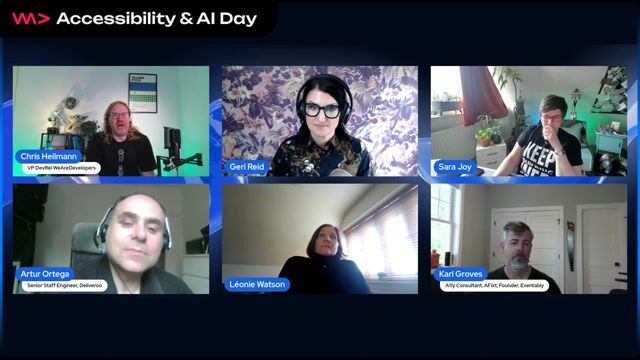
Rethinking Intelligence: AI, Accessibility, and the Future of Inclusive Work - Artur Ortega
Accessibility isn't an obstacle for technology; it's the driver. See how AI can build more humane systems that work for everyone.
#1about 4 minutes
Putting people at the center of AI systems
AI systems should be built with human-centric values to avoid bias and serve the real needs of all users, especially disabled people.
#2about 2 minutes
Introducing vibe coding for natural language programming
Vibe coding allows developers to use natural language to express intent and emotion, removing the cognitive load of syntax and making coding more accessible.
#3about 4 minutes
How accessibility needs have historically driven innovation
Many mainstream technologies like transistors and gesture controls originated as solutions for disabled people, proving accessibility is a catalyst for good technology.
#4about 4 minutes
Using AI for human impact, not just productivity
The true value of AI is not just replacing jobs or increasing output, but solving real human problems and creating a positive impact on people's lives.
#5about 4 minutes
Leveraging AI to experiment and improve code quality
AI enables developers to quickly generate multiple versions of a feature, facilitating A/B testing and shifting the focus from production to curation and creating more intuitive solutions.
#6about 4 minutes
The shift from graphical UIs to agentic AI
Agentic AI and protocols like MCP are replacing traditional click-based interfaces, allowing users to automate tasks and interact with systems using natural language.
#7about 5 minutes
Creating accessible architecture diagrams with AI and Mermaid
AI can translate visual architecture diagrams from tools like Lucidchart into textual formats like Mermaid, making them accessible, version-controllable, and easier to maintain.
#8about 6 minutes
AI as a control plane for delegating complex work
AI is evolving into a control plane that understands natural language, allowing professionals to delegate tasks like coding and analysis while they focus on supervision and strategy.
#9about 6 minutes
Adopting the social model of disability in tech
Technology should be used to fix inaccessible systems and processes rather than attempting to "fix" disabled people, aligning with the social model of disability.
#10about 3 minutes
How diversity and inclusion create resilient systems
Diversity, equality, and inclusion are not regulatory burdens but essential components for building less fragile, more resilient teams and systems through varied perspectives and psychological safety.
#11about 9 minutes
Why disabled people are innovation's hardcore users
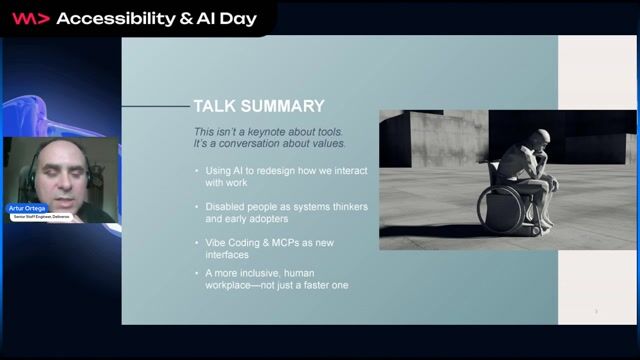
Disabled people are not edge cases but are often early adopters and power users whose needs drive innovation, making their inclusion essential for shaping a useful AI future.
Related jobs
Jobs that call for the skills explored in this talk.

With AIs wide open - WeAreDevelopers at All Things Open 2025Last week our VP of Developer Relations, Chris Heilmann, flew to Raleigh, North Carolina to present at All Things Open . An excellent event he had spoken at a few times in the past and this being the “Lucky 13” edition, he didn’t hesitate to come and...
Daniel Cranney
Panel Discussion: Responsible AI in Practice - Real-World Examples and ChallengesIntroductionIn the ever-evolving landscape of artificial intelligence, the concept of "responsible AI" has emerged as a cornerstone for ethical and practical AI implementation. During the WWC24 Panel discussion, three eminent experts—Mina, Bjorn Brin...
Daniel Cranney
Dev Digest 213: Petrol Prices, Agentic Workflows, AI Skills and CODE100!Inside last week’s Dev Digest 213 .
🤫 Don’t tell your LLM that it is an expert
👻 AI generated code is invisible
🔄 Learn about agentic workflows
🛡️ Linux Foundation sponsors fight against AI slop
🦠 1M users infected by Chrome extension
🫃 The why of J...
From learning to earning
Jobs that call for the skills explored in this talk.