





How Web AI Can Power the Agentic Web - Jason Mayes (Google)
Imagine an AI that orchestrates tasks across multiple sites, right from your browser. Learn how on-device AI is building a more powerful and private agentic web.
#1about 3 minutes
Running agentic AI models directly in the browser
A hybrid approach combining client-side models for privacy and latency with cloud fallbacks addresses current hardware limitations.
#2about 2 minutes
Solving the UX challenge of large model downloads
Using built-in browser AI or fine-tuning with smaller LoRA weights can avoid forcing users to download gigabytes of data.
#3about 2 minutes
Community innovations and W3C standardization efforts
Community projects are exploring peer-to-peer GPU sharing while the W3C works on standards like WebNL and WebMCP for a stable foundation.
#4about 4 minutes
How the browser can become a central agentic hub
The WebMCP standard allows websites to expose their functionality as tools, enabling agents to perform complex tasks across multiple services.
#5about 4 minutes
The technical foundations enabling modern web AI
Technologies like WebGPU and the upcoming WebNN provide the necessary hardware acceleration for running complex models efficiently in the browser.
#6about 3 minutes
Comparing web AI runtimes and implementation approaches
Developers can choose between built-in browser AI or more flexible "bring your own model" approaches using runtimes like TensorFlow.js and ONNX.
#7about 2 minutes
A call to action for JavaScript developers
JavaScript developers are encouraged to explore Web AI to build privacy-focused applications and reduce long-term costs by shifting computation to the client.
Related jobs
Jobs that call for the skills explored in this talk.

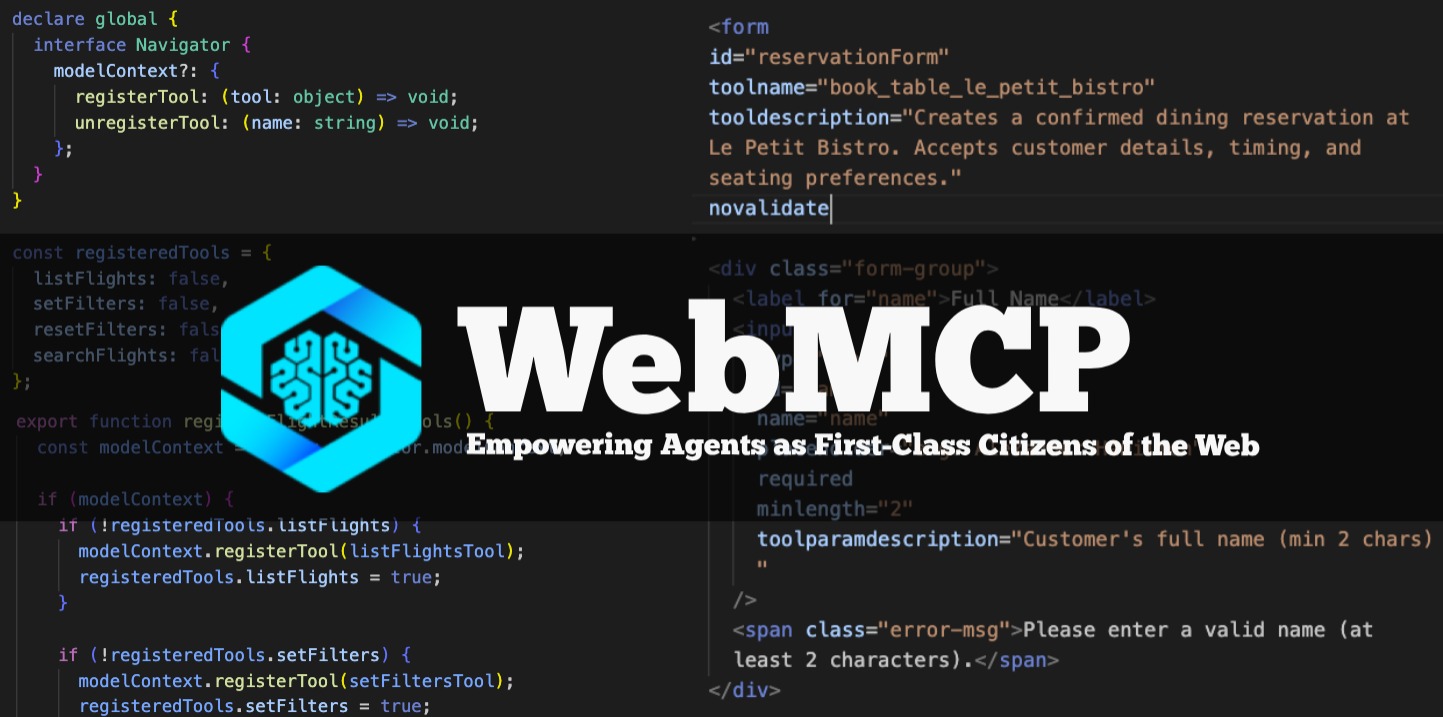
WebMCP: Empowering Agents as First-Class Citizens of the WebWebMCP is an exciting W3C proposal that just landed in Chrome Canary to try out . The idea is that you can use some HTML attributes on a form or register JavaScript tool methods to give agents direct access to content. This gives us as content prov...
Chris Heilmann
The Web We Broke (And Why AI Agents Are Paying the Price) - AgentCon BerlinThis is the accompanying post to the talk Chris Heilmann gave at AgentCon in Berlin on 19/05/2026, you can also see the slides and listen to it in this screencast:
Thirty years of developer shortcuts, bloated JavaScript, and inaccessible HTML have l...
Daniel Cranney, Chris Heilmann
Dev Digest 215: Agent Memory, JS2026, Googlebot Analysis & Canvas❤️HTMLInside last week’s Dev Digest 215 .
🗿 Make AI talk like a caveman
🧠 A guide to context engineering for LLMs
🤖 Simon Willison on agentic engineering
🔐 Axios supply chain attack post mortem
🛡️ Designing AI agents to resist prompt injection
🎨 HTML in c...
Daniel Cranney
The State of WebDev AI 2025 Results: What Can We Learn?Introduction
The 2025 edition of The State of WebDev AI offers a detailed snapshot of how developers are using AI today, which tools have gained the most traction over the past year, and what these trends suggest about the future of the industry.
In...
From learning to earning
Jobs that call for the skills explored in this talk.