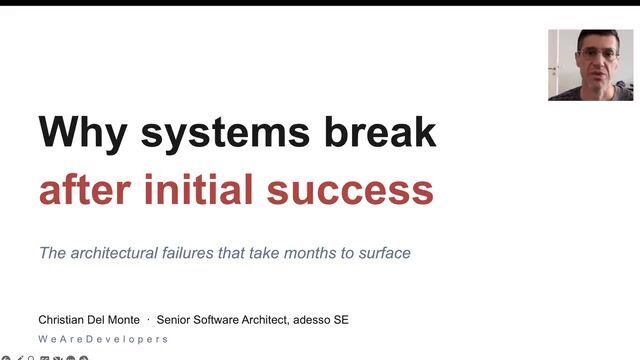
Christian Del Monte

Why Systems Break After Initial Success: The Architectural Failures That Take Months to Surface

Your system isn't failing because of a bug. It’s failing because an architectural assumption you made quietly stopped being true at scale.

Why Systems Break After Initial Success: The Architectural Failures That Take Months to Surface
#1about 3 minutes

Why successful systems fail months after launch

Systems often fail not at launch but after initial success when early architectural assumptions break under sustained growth.

#2about 5 minutes

How database connection pools cause performance collapse

Increasing database connection pool size can paradoxically decrease throughput due to context switching, following a non-monotonic inverted U-curve.

#3about 5 minutes

The hidden cost of merge operations in data lakes

The `MERGE INTO` operation in copy-on-write data lakes causes write amplification, where performance scales with files rewritten, not rows changed.

#4about 8 minutes

Thin events and the problem of hidden read amplification

In event-driven microservices, using thin events creates hidden read amplification as consumers make synchronous callbacks, compounding load on the producer.

#5about 2 minutes

The common shape of scale-triggered system failures

Failures often share a pattern where a surface abstraction hides a physical cost, leading to a scale-triggered failure after a delayed feedback loop.

#6about 2 minutes

Three principles for building robust and scalable systems

To survive growth, systems must prioritize visibility of costs, understand how abstractions hide costs, and treat architectural decisions as falsifiable hypotheses.

#7about 2 minutes

Look for the broken assumption, not the bug

When a stable system degrades, the root cause is often a foundational assumption that no longer holds true, not a simple code bug.

Related jobs
Jobs that call for the skills explored in this talk.

Featured Partners

Related Articles

View all articles

From learning to earning

Jobs that call for the skills explored in this talk.