


Dunya Kirkali

Your organization as a Graph

Your org chart is lying to you. Learn to model your organization as a graph to see the hidden network where work actually happens.

Your organization as a Graph
#1about 2 minutes

Why model your organization as a graph

Traditional org charts fail to capture how work actually gets done, but graph models can reveal the hidden network of collaboration.

#2about 2 minutes

Establishing a baseline with reporting lines

The initial graph is built from the formal org chart, mapping out the direct reporting structure of a sample company.

#3about 4 minutes

Visualizing communication flows to uncover how work gets done

Augment the org chart with communication data from tools like Slack or surveys to identify bottlenecks and cross-departmental interactions.

#4about 4 minutes

Mapping service ownership to reveal dependencies and boundaries

Adding service ownership data from tools like Backstage helps visualize team workload balance, dependencies, and informs architectural decisions via Conway's Law.

#5about 3 minutes

Analyzing pull requests to understand code contribution patterns

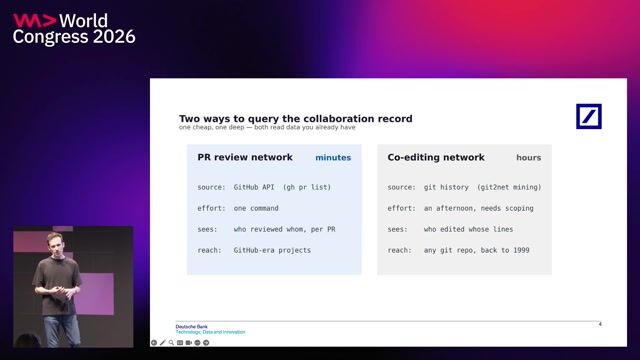
Parsing pull request data from source control reveals actual code ownership, technical bridges between teams, and domain experts.

#6about 1 minute

Exploring other data sources like trust and documentation

Further enrich the organizational graph by incorporating data from trust surveys, documentation tools like Notion, and work item trackers like Jira.

#7about 2 minutes

Using the Leiden algorithm to detect hidden communities

Apply the Leiden community detection algorithm to find densely connected clusters of people or services, revealing hidden teams or monolith decomposition paths.

#8about 2 minutes

Identifying organizational bridges and bottlenecks with betweenness centrality

The betweenness centrality algorithm identifies nodes that connect different parts of the graph, highlighting key individuals who act as either crucial bridges or bottlenecks.

#9about 2 minutes

Applying the PageRank algorithm to find influential nodes

Use the PageRank algorithm to rank the influence of people or services based on their incoming connections, pinpointing critical points in the system.

#10about 2 minutes

Leveraging LLMs to ask complex questions about the organization

Connect an LLM to the graph database to ask high-level, natural language questions about risks, bottlenecks, and optimal team composition for projects.

#11about 5 minutes

A practical guide to building your own organizational graph

Follow a step-by-step process for implementing this analysis, from forming a hypothesis and collecting data to importing it into Neo4j and experimenting.

#12about 5 minutes

Navigating the ethical considerations of organizational analysis

This data should be used to understand system dynamics, not for performance evaluation, requiring strict confidentiality and careful expectation management.

Related jobs
Jobs that call for the skills explored in this talk.

Featured Partners

Related Articles

View all articles

From learning to earning

Jobs that call for the skills explored in this talk.