Alex Timashov

Semi-Supervised Learning. How to overcome the lack of labels

What if you could achieve 95% accuracy with only a handful of labeled examples? Discover how semi-supervised learning makes it possible.

Semi-Supervised Learning. How to overcome the lack of labels
#1about 4 minutes

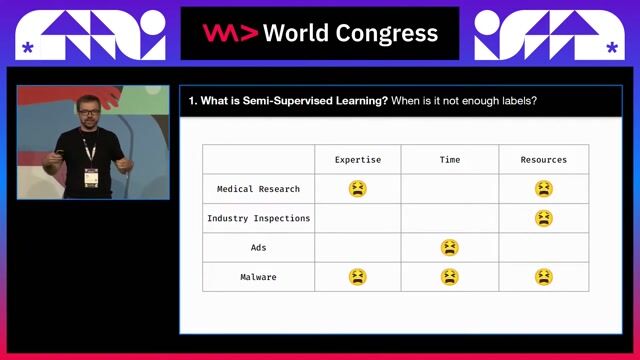
Understanding the high cost of data labeling

The need for semi-supervised learning arises from the significant expertise, time, and resources required to label data for medical research, malware detection, and industrial inspection.

#2about 5 minutes

Locating semi-supervised learning in the ML landscape

Semi-supervised learning bridges the gap between supervised and unsupervised methods by leveraging a small amount of labeled data alongside a large pool of unlabeled data.

#3about 2 minutes

Using entropy minimization and pseudo-labeling techniques

Initial approaches involve training a classifier to be confident in its predictions by minimizing entropy or by iteratively using the model's own high-confidence predictions as new labels.

#4about 6 minutes

Applying consistency training with data augmentation

A core technique involves applying augmentations like rotation or back-translation and training the model to produce consistent predictions for the original and augmented data.

#5about 1 minute

Improving model robustness with virtual adversarial training

Virtual Adversarial Training (VAT) improves consistency by finding and training against small, adversarial perturbations that are most likely to change the model's prediction.

#6about 2 minutes

Leveraging generative models to understand data structure

Generative models can learn the underlying structure of unlabeled data, which helps create more accurate decision boundaries when combined with a few labeled examples.

#7about 4 minutes

Implementing semi-supervised learning with variational autoencoders

A variational autoencoder (VAE) can be adapted for semi-supervised classification by adding a classification loss term, significantly boosting accuracy with unlabeled data.

#8about 1 minute

Recapping the core principles of semi-supervised learning

The main idea is to combine a standard supervised loss on labeled data with an additional loss function that leverages the structure of unlabeled data.

Related jobs
Jobs that call for the skills explored in this talk.

Featured Partners

Related Articles

View all articles
Chris Heilmann
All the videos of Halfstack London 2024!
Last month was Halfstack London, a conference about the web, JavaScript and half a dozen other things. We were there to deliver a talk, but also to record all the sessions and we're happy to share them with you. It took a bit as we had to wait for th...
All the videos of Halfstack London 2024!
Chris Heilmann
WWC24 Talk - Scott Hanselman - AI: Superhero or Supervillain?
Join Scott Hanselman at WWC24 to explore AI's role as a superhero or supervillain. Scott shares his 32 years of experience in software engineering, discusses AI myths, ethical dilemmas, and tech advancements. Engage with his live demos and insights o...
WWC24 Talk - Scott Hanselman - AI: Superhero or Supervillain?
Luis Minvielle
What Are Large Language Models?
Developers and writers can finally agree on one thing: Large Language Models, the subset of AIs that drive ChatGPT and its competitors, are stunning tech creations. Developers enjoying the likes of GitHub Copilot know the feeling: this new kind of te...
What Are Large Language Models?

From learning to earning

Jobs that call for the skills explored in this talk.