
Appled AI Engineer

Virginia Surgery Center, LLC
New York, NY, United States
16 days ago

Role details

Contract type
Permanent contract
Employment type
Full-time (> 32 hours)
Compensation
$90,000.0 - $260,000.0
Working hours
Regular working hours
Job source

Tech stack

Application Programming Interfaces (APIs) Artificial Intelligence Amazon Web Services Amazon S3 Automated Storage and Retrieval Systems Microsoft Azure Data Stores Cursor (Graphical User Interface Elements) Software Debugging Monitoring of Systems Python (Programming Language) PostgreSQL
+17 more
Parsing SQLAlchemy Systems Integration TypeScript Web Applications Large Language Models Indexer Backend Fastapi Data Layers Build Management AI Platforms Kubernetes Celery Terraform Data Pipelines Api Management

Job description

The scope is wide and deep. Wide across delivery surfaces: the web app UI, the public APIs, and MCP. Deep through every layer beneath them: the AI services, the agent workflows and the search layer they run on, and the data pipeline underneath, from connectors and ingestion through parsing and indexing. An Applied AI Engineer owns that whole stack for the customers they’re responsible for, and goes as far down as the problem requires.

Examples of the work

A global broker. Onboarded their full research catalog, building the connector and ingestion pipeline end to end. Developed the search layer over it within our agentic system, covering entity resolution, filtering, and source citation. Expanded the product into an entirely new data domain, built for reuse across other clients.

A European asset manager. Onboarded their internal research data and built a custom connector giving the agent access to their licensed third-party data. Shipped new product features on request, stood up dedicated regional infrastructure for data residency, and drove reliability and latency work as usage scaled.

A global asset manager. Own the API powering their internal research search. Integrated a new content type into the pipeline, reworking document processing and indexing at scale. Delivered a major search latency reduction, and built the front-end citation viewer for source visibility.

A multi-asset family office. Integrated their portfolio systems as data sources for the agent. Developed a portfolio analytics agent over client holdings and built new interactive dashboards on top. Expanded data coverage through new vendor partnerships to close gaps in the existing sources.

Our API platform. Designed and built the public search and analytics APIs, along with the data pipeline underneath. Continue to expand what the core product exposes to customers building on top of it.

What you’ll do

  • Own a customer problem from definition through production. Work directly with the customer to define the problem space, R&D the solution, build it, ship it, and keep it running.
  • Build on the core product, and extend the core product itself. Solving a customer problem often requires a capability the product doesn’t have yet, and building that is part of the work.
  • Generalize what you build. Take what starts as one client’s solution and turn it into a core capability other clients can use, rather than accumulating one-offs.
  • Design and build agentic systems. Prompts, tools, and multi-step agent workflows, along with the search and retrieval layer feeding them. Agents are the primary consumer of what you build, so search gets designed around how they actually plan and read.
  • Own the data layer underneath. Connectors and ingestion, parsing, chunking, metadata extraction, entity resolution, and indexing across OpenSearch and PostgreSQL. How documents become retrievable determines the ceiling on answer quality.
  • Own it after it ships. Debug production issues, trace real usage to find where quality is breaking, and fix root causes rather than patching. That includes existing systems, not just what you build.
  • Turn the core product into APIs. Harden the internal skill and tool systems and expose them in forms external systems can build on.
  • Make improvements measurable. Search precision and recall against labeled query sets, extraction quality evals, LLM-as-judge, and citation grounding checks. For financial answers, source attribution is a hard requirement.
  • Go down the stack when the problem is there. External integrations, backend services, data pipelines, and the runtime they execute on. Everything is infrastructure as code, so you make those changes yourself.
  • Develop with coding agents as a core practice. Claude Code, Cursor, Codex, used to multiply your own throughput.

Who we’re looking for

  • You’ve owned a system from the data layer through search to the surface it’s served on. Ingestion, pipeline, retrieval, and the API or UI on top, rather than a single layer of it.
  • You’ve built agentic or LLM systems in production, at scale. Not a prototype or an internal MVP, but systems running against real data volume and real users, where you handled the failure modes that come with it.
  • You think in agentic retrieval, not just traditional RAG. You understand why an agent scoping and iterating its own search behaves differently from a fixed retrieval pipeline, and you design for that consumer.
  • You’re comfortable with document processing at scale. Ingestion, parsing, chunking, metadata extraction, entity resolution, and indexing that feeds a production search product.
  • You adapt quickly when the architecture stops fitting. This space changes every few months, and requirements shift with it. We look for people who will redesign a system when that happens rather than defend the existing one.

Requirements

  • You’re hands-on and applied rather than research-oriented. Backend engineering in Python or TypeScript, with a track record of delivered systems.
  • You structure ambiguous problems yourself and move without waiting for a spec.
  • You’ve used coding agents deeply (Claude Code, Cursor, or equivalent) as a core part of how you work.
  • You can communicate with teams globally, and work directly with customers, domain experts, and our Seoul team.

Nice to have

  • Interest in finance and markets, and genuine enjoyment of digging into data.
  • Experience with search and retrieval systems: ranking, hybrid retrieval, re-ranking, relevance evaluation.
  • Experience building evaluation and monitoring systems, especially citation and source grounding verification.
  • Experience with external system integration, connectors, and data pipelines.
  • Experience designing and serving B2B products directly to financial institution customers.
  • Hands-on cloud experience (AWS, Azure, or GCP), Kubernetes, GitOps, and IaC, plus a view on how to combine them with agents.
  • NLP, ML, or statistics background.

Tech stack

You don’t need all of this on day one. The essentials are Python, one search or data store, and a willingness to go down the stack.

  • Python: FastAPI, Pydantic, SQLAlchemy/SQLModel, asyncio, Celery for orchestration
  • TypeScript: the MCP tool server exposing search and data tools to agents
  • AI layer: multi-model chains (OpenAI, Anthropic, Gemini) with structured outputs, fallback policies, and cost accounting; embeddings for vector search; LLM-as-judge and scoring harnesses
  • Data and search: OpenSearch (BM25 and vectors), PostgreSQL, S3
  • Infra: Kubernetes, Terraform, Helm, ArgoCD on AWS

Benefits & conditions

  • Flexible start times (8 to 10 am)
  • Self-development support (books, courses, seminars)
  • Lunch and dinner provided
  • Free snack bar and beverages
  • Latest MacBook and monitor
  • Outstanding colleagues who are top experts in their fields.

Because our teams span New York and Seoul, the New York team syncs with Seoul in the evening ET.

Hiring process

Application * Introductory Interview * Technical Round Intro * Technical Assessment * Follow-up Technical Interview * Culture-Fit Interview * Offer

Pay: $90,000.00 - $260,000.00 per year

Application Question(s):

  • Are you U.S. Citizen or Permanent Resident?

About the company

We are a fintech company building AI agent products for institutional investors: hedge funds, asset managers, insurers, brokers, and family offices. Analysts and portfolio managers at institutions in the US, Asia, and Europe use us every day for real research work, including single-name analysis, earnings and filings interpretation, due diligence, portfolio analytics, and market briefings.

Our core teams are in New York and Seoul, with members in the UK, Singapore, and Hong Kong. We work alongside in-house finance domain experts, including former buy-side and sell-side analysts.

What this team does

The Applied AI Engineering team sits between our customers and our core product.

We work directly with customers to define their problem space, then R&D and build the solution on top of the core product, extending the core product itself where needed. From there we generalize it into a reusable core capability rather than leaving it as a one-off.

Apply for this position

This job is hosted externally. Click below to view the full posting and apply.

Apply on www.indeed.com

Good distractions

Talks and stories from around this role — technically off-topic, practically not.

1:37 min

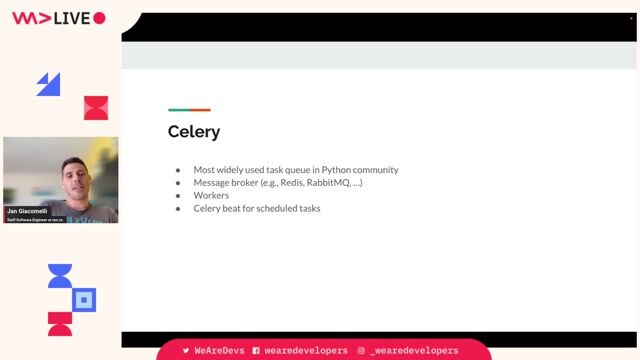
Core concepts of Celery and message broker integration

Jan Giacomelli · LIVE

1:52 min

Structuring and scaling the backend engineering team

Stefan Lingler Stefan Lingler +1 · Coffee With Developers

2:36 min

Analyzing limitations with PostgreSQL bitmap heap scans

Dharin Shah Dharin Shah · WWC 2025

2:14 min

Exploring internal AI product initiatives and global engineering roles

Maria Apazoglou · Coffee With Developers

2:10 min

Exploiting python celery dependencies for internal container access

Vandana Verma · LIVE

1:31 min

Essential AI and human skills for future teams

Alexander Weißhaupt Alexander Weißhaupt +1 · WWC 2025

Videos

See all

Related articles

See all