
Data Scientist - Classical Machine Learning (Equipment Manufacturing)

adesso SE
Germany
13 days ago

Role details

Contract type
Permanent contract
Employment type
Full-time (> 32 hours)
Experience level
Expert
Experience required
7 years minimum
Working hours
Regular working hours

Tech stack

Amazon Web Services Data Analysis Microsoft Azure Cluster Analysis Computer Programming Data Validation Data Cleansing Data Integration Extract Transform Load (ETL) Data Reduction Supervisory Control and Data Acquisition (SCADA) Statistical Hypothesis Testing
+30 more
Python (Programming Language) Linear Regression Logistic Regression Machine Learning Regression Analysis NumPy Operational Data Store Principal Component Analysis Reliability Engineering SciPy SQL Databases Data Streaming Support Vector Machine Reinforcement Learning Digital Twin Enterprise Software Applications Feature Engineering Prophet Random Forest Model Validation Naive Bayes Matplotlib Scikit Learn Statistics Packages Optimization Algorithms Data Analytics Xgboost Machine Learning Operations K Means Docker

Job description

We are seeking a Data Scientist with strong expertise in classical machine learning and predictive analytics to develop custom models for equipment manufacturing and industrial environments. The ideal candidate will have hands-on experience building machine learning models from the ground up, selecting the most suitable algorithms based on business needs, and transforming manufacturing data into actionable insights.

This role focuses on addressing real-world industrial challenges, including equipment failure prediction, quality forecasting, demand forecasting, process optimization, predictive maintenance, and production efficiency enhancement., * Develop predictive models using classical machine learning techniques.

  • Design, train, validate, and deploy machine learning models using manufacturing and operational data.
  • Analyze structured and time-series data from production equipment, sensors, ERP systems, MES platforms, and quality management systems.
  • Perform feature engineering, data exploration, and statistical analysis.
  • Build scalable data preprocessing, model training, and validation pipelines.
  • Evaluate multiple algorithms and identify the most effective solutions based on business objectives and performance metrics.
  • Interpret model outputs and communicate insights to engineering, operations, and business stakeholders.
  • Collaborate with manufacturing, process engineering, quality assurance, and maintenance teams to understand operational challenges and identify opportunities for data-driven improvements.
  • Deploy machine learning models into production environments and monitor model performance.
  • Continuously improve model accuracy, reliability, and scalability., * pandas
  • NumPy
  • scikit-learn
  • SciPy
  • statsmodels
  • XGBoost
  • LightGBM
  • CatBoost
  • Matplotlib
  • Seaborn

Requirements

Strong understanding and practical experience with classical machine learning algorithms, including:

  • Linear Regression
  • Logistic Regression
  • Decision Trees
  • Random Forest
  • Gradient Boosting
  • XGBoost
  • LightGBM
  • CatBoost
  • Support Vector Machines (SVM)
  • K-Nearest Neighbors (KNN)
  • Naïve Bayes
  • Clustering Techniques (K-Means, DBSCAN, Hierarchical Clustering)
  • Principal Component Analysis (PCA) and Dimensionality Reduction
  • Time Series Forecasting (ARIMA, SARIMA, Prophet)
  • Ensemble Learning Methods
  • Anomaly Detection Techniques, * Hypothesis Testing
  • Probability
  • Experimental Design
  • Statistical Modeling
  • Regression Analysis
  • Sampling Techniques
  • Confidence Intervals
  • Time Series Analysis

Programming

  • Python
  • SQL, * Data Cleaning
  • Feature Engineering
  • Data Integration
  • ETL Pipelines
  • Handling Missing Values
  • Data Validation

Manufacturing Domain Knowledge (Preferred) Experience with:

  • Industrial Manufacturing
  • Equipment Manufacturing
  • Automotive
  • Heavy Engineering
  • Process Manufacturing
  • Factory Automation

Understanding of:

  • Production KPIs
  • OEE
  • Downtime Analysis
  • Root Cause Analysis
  • MES
  • ERP
  • SCADA
  • PLC Data
  • Sensor Data
  • IIoT

Model Development Expectations Candidates should demonstrate the ability to:

  • Select appropriate algorithms based on business problems.
  • Build machine learning models from scratch using Python.
  • Engineer meaningful features from manufacturing datasets.
  • Optimize hyperparameters.
  • Evaluate models using appropriate metrics.
  • Explain model decisions using interpretable techniques.
  • Deploy models into production.

Experience with AutoML tools alone is not sufficient., * Strong problem-solving and analytical skills.

  • Experience working with structured industrial datasets.
  • Excellent communication and stakeholder management skills., * Experience in predictive maintenance projects.
  • Experience with manufacturing analytics.
  • Knowledge of MLOps practices.
  • Familiarity with Docker and cloud platforms (AWS, Azure, or GCP).
  • Exposure to edge analytics or IoT-based machine learning.
  • Experience integrating ML models into enterprise applications.

Nice to Have

  • Knowledge of optimization techniques.
  • Survival Analysis and Remaining Useful Life (RUL) modeling.
  • Reinforcement Learning (basic understanding).
  • Digital Twin concepts.
  • Knowledge of reliability engineering.
  • Experience working with streaming data.

Success Measures Within the first 6-12 months, the successful candidate should be able to:

  • Develop production-ready predictive models for equipment health, quality, or process optimization.
  • Improve prediction accuracy through feature engineering and model tuning.
  • Collaborate effectively with manufacturing and engineering teams to deliver measurable business outcomes.
  • Deploy and monitor machine learning solutions that support operational decision-making.

Apply for this position

This job is hosted externally. Click below to view the full posting and apply.

Apply on jobs.adesso-group.com

Good distractions

Talks and stories from around this role — technically off-topic, practically not.

4:54 min

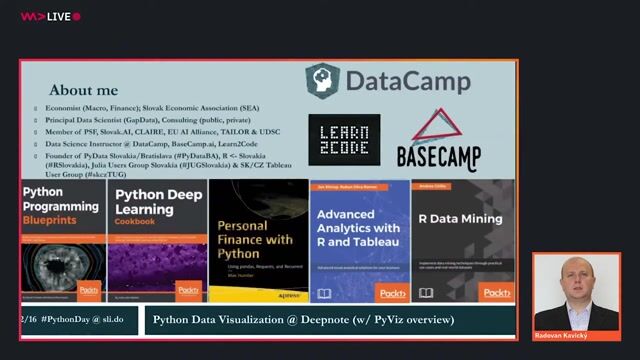
Development history of scientific computation libraries and PyViz tools

Radovan Kavický · LIVE

2:07 min

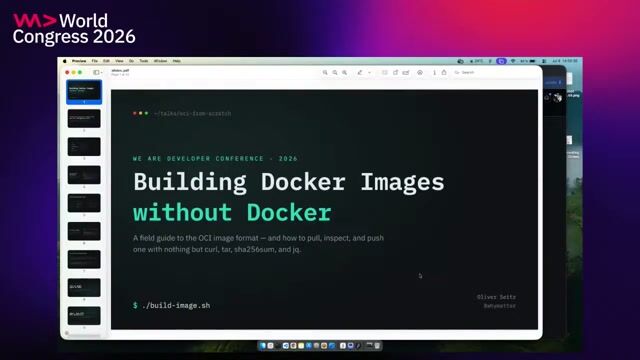
Inspecting default bridge architectures and custom Docker networks

Oliver Seitz Oliver Seitz · WWC 2025

2:34 min

Maximizing execution memory effectively via python numpy broadcasting

Jodie Burchell · LIVE

1:34 min

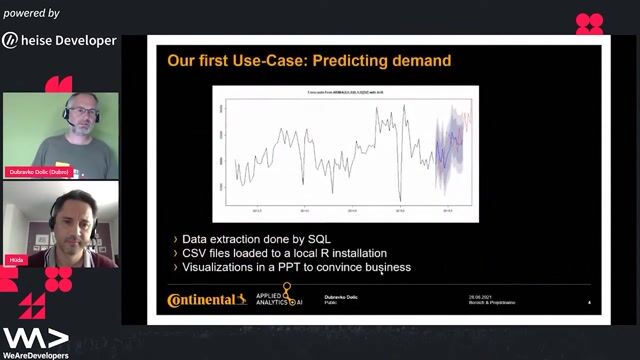
Bringing diverse skills to industrial data science roles

Katja Träumner

2:34 min

Docker sandbox architecture and microVM environment integration

Manuel de la Peña Manuel de la Peña · WWC Europe 2026

1:25 min

Replacing NumPy with cuPy for straightforward GPU acceleration

Paul Graham Paul Graham · WWC 2025

Videos

See all

Related articles

See all