
Senior Data Engineer

General Motors
Austin, TX, United States
1 day ago
Apply on generalmotors.wd5.myworkdayjobs.com
Prepare application

Role details

Contract type
Permanent contract
Employment type
Full-time (> 32 hours)
Experience level
Expert
Experience required
5 years minimum
Compensation
$119,200.0 - $175,450.0
Working hours
Regular working hours

Tech stack

Application Programming Interfaces (APIs) Artificial Intelligence Amazon Web Services Business Analytics Applications Data Analysis Application Frameworks Automation of Tests Microsoft Azure Cloud Database Continuous Integration Data as a Services Information Engineering
+36 more
Data Governance Data Integration Extract Transform Load (ETL) Data Stores Data Systems Distributed Computing Environment Distributed Systems JSON Python (Programming Language) Machine Learning Meta-Data Management Metadata Repositories NoSQL DataOps Azure Data Lake Software Engineering Data Streaming Workflow Management Systems Extensible Markup Language (XML) Parquet Cloud Platform System Feature Engineering Sql Optimization Retrieval-Augmented Generation Apache Spark Generative AI Data Layers Data Lakes Kubernetes Infrastructure Automation Frameworks Information Technology Collibra Avro Azure AKS Amazon Elastic Mapreduce (EMR) Databricks

Job description

We’re looking for a hands-on Senior Data Engineer to build the next generation of telematics data products that power analytics, artificial intelligence, and decision-making across the enterprise.

This role is about creating trusted, reusable, analytics-ready data products that make complex telemetry data easier to discover, understand, and use at scale. You’ll help move the organization from custom analytics and duplicated logic toward standardized, reusable data products that deliver consistent value across teams.

You’ll help define foundational datasets, shared metrics, and curated data products that enable teams across engineering, product, quality, safety, and operations to unlock the value of connected vehicle data.

Your work will help establish a trusted, common data foundation for connected vehicle insights. By replacing duplicated analytical logic with reusable, governed data products, you’ll improve consistency, increase adoption, and accelerate analytics, machine learning, and AI use cases across the enterprise. You’ll make complex telemetry data easier to discover, understand, and use-helping teams move faster from raw signals to confident decisions about product quality, vehicle performance, safety, and operations.

What You’ll Do

  • Design, build, and productionize secure, scalable batch and streaming data pipelines in Azure Databricks and cloud environments.
  • Transform data from multiple source systems into trusted, well-structured datasets for analytics, AI, machine learning, and operational use cases.
  • Develop and optimize ETL/ELT workflows using Apache Spark, Delta Lake, and medallion architecture.
  • Enable self-service analytics and GenAI use cases through governed data products, reusable APIs, semantic layers, and trusted data services.
  • Enable AI and data science workflows through feature-ready and model-ready datasets, curated context for GenAI applications, experimentation support, and repeatable delivery patterns.
  • Implement data quality, lineage, monitoring, validation, access controls, and privacy practices to ensure reliable and compliant data products.
  • Improve engineering processes, automation, delivery patterns, platform performance, scalability, and cost efficiency.
  • Partner with data scientists, analysts, software engineers, product teams, and business stakeholders to deliver measurable business outcomes.
  • Troubleshoot production issues, resolve root causes, and maintain reliable data platform operations.
  • Contribute to engineering standards, reusable frameworks, technical documentation, and a culture of data product thinking.
  • Influence technical direction, mentor engineers, document solutions, and promote strong engineering practices.

Requirements

  • Bachelor’s degree in computer science, software engineering, data science, or a related field, or equivalent experience.
  • 5+ years of relevant experience in data engineering, software engineering, or a related discipline.
  • Experience supporting AI or machine learning through feature engineering, model-ready data, experimentation workflows, or model deployment.
  • Experience building GenAI, retrieval-augmented generation, natural-language analytics, or self-service data tools.
  • Experience with cloud data services such as Azure Data Lake, Azure Kubernetes Service, AWS EMR, or comparable technologies.
  • Experience with workflow orchestration, CI/CD, infrastructure as code, automated testing, and data observability.
  • Strong experience with enterprise data pipelines, data modeling, data integration, and production support.
  • Proficiency in Python or Scala, advanced SQL, and Unix/Linux.
  • Hands-on experience with Databricks, Apache Spark, Delta Lake, and distributed data processing.
  • Experience with relational, key-value, document, or other NoSQL data stores.
  • Experience designing data solutions on Azure; AWS or GCP experience is also applicable.
  • Knowledge of batch and streaming architectures, cloud platforms, Kubernetes, and distributed systems.
  • Experience with data formats such as JSON, Parquet, Avro, and XML.
  • Understanding of data governance, privacy, security, data quality, and responsible AI practices.
  • Ability to work independently, solve complex problems, manage competing priorities, and communicate technical concepts clearly.

What Can Give You a Competitive Advantage (Preferred Qualifications)

  • Master’s degree in computer science, software engineering, data science, or a related field.
  • Experience with data catalogs, metadata management, lineage, and governance platforms such as Atlan, Collibra, or Alation.
  • Demonstrated technical leadership, mentoring, cross-functional collaboration, and process improvement impact.

Benefits & conditions

  • The expected base compensation for this role is: $119,200 - $175,450. Actual base compensation within the identified range will vary based on factors relevant to the position.
  • Bonus Potential: An incentive pay program offers payouts based on company performance, job level, and individual performance.
  • Benefits: GM offers a variety of health and wellbeing benefit programs. Benefit options include medical, dental, vision, Health Savings Account, Flexible Spending Accounts, retirement savings plan, sickness and accident benefits, life insurance, paid vacation & holidays, tuition assistance programs, employee assistance program, GM vehicle discounts and more.

About the company

This role is categorized as hybrid. This means the successful candidate is expected to report to Warren Global Technical Center or Austin Technical Center three times per week, at minimum [or other frequency dictated by the business if more than 3 days]., We believe we all must make a choice every day - individually and collectively - to drive meaningful change through our words, our deeds and our culture. Every day, we want every employee to feel they belong to one General Motors team., General Motors is committed to being a workplace that is not only free of unlawful discrimination, but one that genuinely fosters inclusion and belonging. We strongly believe that providing an inclusive workplace creates an environment in which our employees can thrive and develop better products for our customers.

Apply for this position

This job is hosted externally. Click below to view the full posting and apply.

Apply on generalmotors.wd5.myworkdayjobs.com
Prepare application

Good distractions

Talks and stories from around this role — technically off-topic, practically not.

3:03 min

Career evolution in data engineering and AI platforms

Maria Apazoglou · Coffee With Developers

2:37 min

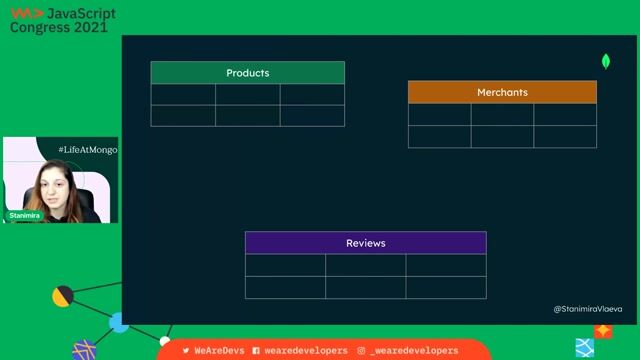
Comparing traditional SQL tables versus NoSQL non-tabular databases

Stanimira Vlaeva · JS Congress

3:47 min

Exploring JSON, CBOR, and JOSE for data serialization

Aaron Russell · LIVE

3:02 min

Audience Q&A on data formats and engine tradeoffs

Matthias Niehoff Matthias Niehoff · World Congress 2026 Europe

3:16 min

Terminology differences between relational and NoSQL databases

Tim Faulkes · LIVE

2:03 min

Distinguishing type definition constructs from data validation routines

Clemens Vasters Clemens Vasters · World Congress 2025

Videos

See all

Related articles

See all