Senior Database Architect

WEX Inc.
Portland, ME, United States
1 day ago
Apply on wexinc.wd5.myworkdayjobs.com
Prepare application

Role details

Contract type
Permanent contract
Employment type
Full-time (> 32 hours)
Experience level
Expert
Experience required
2 years minimum
Working hours
Regular working hours

Tech stack

Query Performance Legacy Database Java (Programming Language) Artificial Intelligence Amazon Web Services Business Logic Application Services Microsoft Azure C Sharp (Programming Language) Mobile Application Development Cloud Database Encodings
+57 more
Computer Programming Databases Command-Query Responsibility Segregation (Software Development) Data Architecture Information Engineering Data Governance Data Infrastructure Extract Transform Load (ETL) Data Security Data Structures Data Systems Cursor (Graphical User Interface Elements) Database Design Database Storage Structures Software Design Patterns Dimensional Modeling Graph Database Python (Programming Language) PostgreSQL Microsoft SQL Server SQL Azure MongoDB Neo4j NoSQL Open Source Technology PCI Data Security Standards Performance Tuning Query Optimization Search Technologies SQL Stored Procedures SQL Databases Data Streaming Transact-SQL Application Enhancement Tool GitHub Copilot Large Language Models Snowflake Database Optimization Change Data Capture Backend Cloudformation Data Layers Knowledge Representation Bicep Real Time Data Apache Kafka Cosmos DB Data Management Data Lakehouse Virtual Agents Event Sourcing Terraform Domain Driven Design Code Restructuring Azure Synapse Analytics Multiplatform Data Pipelines

Job description

We are seeking a Senior Database Architect who combines deep expertise in legacy database systems with forward-looking vision for AI-native data architecture. You’ll lead the decomposition of complex stored procedures while simultaneously designing the vector databases, embedding strategies, and semantic models that power our AI agents and workflows.

This is an AI-first role in two senses: you’ll leverage AI to accelerate your own work (stored procedure analysis, migration generation, schema documentation), and you’ll design the data infrastructure that AI systems depend on. If you’re excited about both solving hard legacy database problems and architecting the data layer for AI-native applications, this role is for you., * Analyze and decompose large SQL Server stored procedures (1,000+ lines) with embedded business logic, creating migration strategies that extract logic into domain services

  • Design patterns for separating business rules from data access, enabling stored procedures to become thin data-access layers while business logic moves to application services
  • Lead refactoring efforts that align database structures with domain-driven design: bounded contexts, aggregates, and domain events
  • Implement event-driven patterns that decouple systems from direct database dependencies: change data capture, outbox patterns, event sourcing where appropriate
  • Optimize query performance, indexing strategies, and execution plans as part of modernization efforts
  • Create migration playbooks and tooling that engineering teams can apply to their own stored procedure modernization, * Design semantic data models that capture domain knowledge in structures optimized for AI retrieval and reasoning
  • Architect vector database solutions for RAG implementations: embedding strategies, chunking approaches, similarity search optimization, and hybrid retrieval patterns
  • Design and implement embedding pipelines that transform domain content into vector representations suitable for AI agent consumption
  • Establish knowledge graph patterns where appropriate: entity relationships, ontologies, and graph-based retrieval for complex domain reasoning
  • Define data architectures for AI agent context: what data agents need, how it’s structured, how freshness and consistency are maintained
  • Design evaluation frameworks for RAG quality: retrieval accuracy, relevance scoring, and feedback loops for continuous improvement, * Design canonical data models and schemas that are flexible, extensible, and aligned with business domain concepts
  • Architect data solutions across multiple platforms: SQL Server, PostgreSQL, MongoDB/Cosmos DB, Snowflake, and vector databases (Pinecone, Weaviate, pgvector, Azure AI Search)
  • Design event-driven data flows: Kafka-based event streaming, materialized views, CQRS patterns, and real-time data synchronization
  • Establish data platform infrastructure patterns: data pipelines, ETL/ELT orchestration, data quality frameworks, and observability
  • Define data residency, partitioning, and multi-region strategies for performance and compliance
  • Create reference architectures for common data patterns that domain teams can adopt, * Leverage AI coding assistants (GitHub Copilot, Cursor, Claude Code) to accelerate stored procedure analysis, refactoring, and migration
  • Build AI-powered tools for database engineering: automated stored procedure analysis, schema documentation generators, migration assistants, and query optimization recommenders
  • Create AI-consumable artifacts: structured documentation, annotated schemas, and context files that enable AI agents to understand and work with database systems
  • Author database architecture skills that encode patterns, constraints, and best practices for AI-assisted development
  • Develop prompts, workflows, and tooling that help engineering teams apply AI effectively to database modernization tasks, * Partner with AI/ML teams to ensure data architecture supports agent and workflow requirements
  • Collaborate with domain teams to understand their data requirements and design solutions aligned with domain ownership
  • Work with application architects to ensure data architecture supports service-oriented and event-driven designs
  • Contribute to Enterprise Architecture Council (EAC) standards for data architecture, modeling conventions, and technology selection
  • Mentor engineers on database design, optimization, semantic modeling, and AI data infrastructure

Requirements

  • 8-12 years in database engineering and architecture, with significant experience in enterprise-scale SQL Server environments
  • Deep SQL Server expertise: T-SQL optimization, stored procedure design and refactoring, query plan analysis, indexing strategies, and performance tuning
  • Hands-on modernization experience: track record of decomposing complex stored procedures and migrating business logic to application services
  • Multi-platform data architecture: experience designing solutions across relational (SQL Server, PostgreSQL), NoSQL (MongoDB, Cosmos DB), and analytical (Snowflake, data lakehouse) platforms
  • Event-driven data patterns: CDC, Kafka, outbox pattern, event sourcing, CQRS-practical experience implementing these in production
  • Data modeling expertise: canonical models, dimensional modeling, schema evolution, and designing for extensibility

AI & Semantic Data Competencies

  • Vector database experience: hands-on with at least one vector DB (Pinecone, Weaviate, Milvus, pgvector, Azure AI Search, or similar)
  • RAG architecture understanding: embedding models, chunking strategies, retrieval optimization, hybrid search, and reranking patterns
  • Semantic modeling: experience designing data structures optimized for AI retrieval-knowledge representation, ontologies, or domain-specific schemas for AI consumption
  • Understanding of embedding pipelines: text preprocessing, embedding generation, vector indexing, and incremental updates
  • Familiarity with LLM context requirements: what data AI agents need, token constraints, context window optimization

AI-Native Engineering Practices

  • 2+ years actively using AI coding assistants for database work; deep understanding of how to prompt effectively for SQL and data engineering tasks
  • Experience building tools, scripts, or automation that leverage AI/LLM capabilities
  • Familiarity with structured artifact creation for AI consumption: documented schemas, annotated procedures, context files
  • Vision for AI-assisted database engineering and ability to build tooling that enables it, * Strong programming skills in at least one backend language (C#, Java, Python) for building migration tooling, embedding pipelines, and services
  • Cloud data services experience: Azure SQL, Cosmos DB, Azure AI Search, Azure Synapse, Snowflake, or AWS equivalents
  • Infrastructure-as-code for data platforms: Terraform, ARM/Bicep, or CloudFormation
  • Understanding of domain-driven design and how data architecture supports bounded contexts
  • Familiarity with data governance, lineage, and compliance requirements (HIPAA, PCI-DSS)

Preferred Experience

  • Background in healthcare, benefits, payments, or similarly regulated industries
  • Experience building RAG systems or AI-powered search/retrieval applications
  • Knowledge graph experience: Neo4j, Amazon Neptune, or similar graph databases
  • Contributions to database tooling, AI/ML data infrastructure, or open-source projects
  • Experience mentoring engineers or leading database/data architecture communities of practice

Apply for this position

This job is hosted externally. Click below to view the full posting and apply.

Apply on wexinc.wd5.myworkdayjobs.com
Prepare application

Good distractions

Talks and stories from around this role — technically off-topic, practically not.

3:03 min

Career evolution in data engineering and AI platforms

Maria Apazoglou · Coffee With Developers

2:56 min

Provisioning a secure container infrastructure with Bicep

Matthias Falkenberg +1 · World Congress 2022

2:24 min

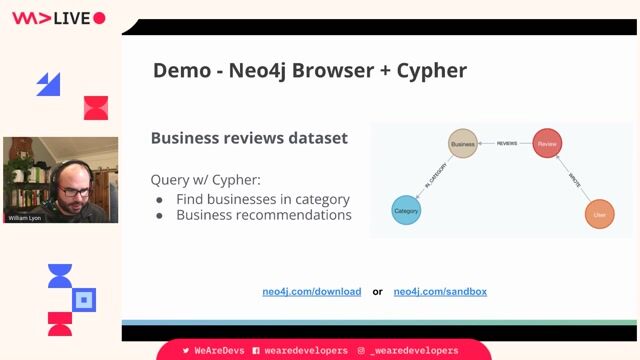
Comparing Neo4j and GraphQL conceptual models

William Lyon · LIVE

2:37 min

Comparing traditional SQL tables versus NoSQL non-tabular databases

Stanimira Vlaeva · JS Congress

4:09 min

Selecting infrastructure tools and determining proper abstraction layers

Alayshia Knighten Alayshia Knighten · World Congress 2024

3:30 min

Introduction to Neo4j and remote developer relations work

Videos

See all

Related articles

See all