




Data and Platform Engineer

NVIDIA Corporation
United States
1 day ago
Apply on nvidia.wd5.myworkdayjobs.com
Prepare application

Role details

Contract type
Permanent contract
Employment type
Full-time (> 32 hours)
Experience level
Expert
Compensation
$200,000.0 - $322,000.0
Working hours
Regular working hours

Tech stack

Application Programming Interfaces (APIs) Amazon Web Services Microsoft Azure Big Data Cloud Computing Computer Clusters Databases Continuous Integration Extract Transform Load (ETL) Software Debugging Distributed Computing Environment Distributed Systems
+24 more
Elasticsearch Apache Hive Information Retrieval Python (Programming Language) Operational Data Store Role-Based Access Control Cloud Services Standard Sql SQL Databases Google Cloud Apache Spark Software Security Backend Data Lakes Pyspark Kubernetes Information Technology Deployment Automation Apache Kafka Data Management Slurm Stream Processing Data Pipelines Databricks

Job description

NVIDIA’s DGX Cloud organization is seeking a Senior Data Engineer to become part of its data team! We develop the reliable data foundation that supports fleet health, capacity, utilization, cost, reliability, and operational decision-making throughout DGX Cloud. Our platform supports engineering, operations, finance, and product teams managing and expanding large GPU fleets across cloud service providers and NVIDIA Cloud Partners. We are looking for a practical engineer and technical lead to take charge of a key part of the Navigator data platform. We develop the systems that transform distributed infrastructure telemetry and operational data into dependable, managed data products that support fleet health, capacity, utilization, cost, and operational decisions.

You will be responsible for the architecture, technical plan, and production results of a major platform area like ingestion and orchestration, data quality and reconciliation, or data serving and consumption. You will clarify requirements with customers, define technical objectives, guide design and development among engineers and partner teams, and stay actively engaged in coding, debugging, and production tasks. Successful candidates have already led complex technical work across team boundaries and delivered improvements that other groups adopted. Our primary implementation environment is Python, SQL, Databricks, and Spark.

What you’ll be doing:

  • You will own a major platform component and its roadmap. For example, define its architecture, interfaces, technical goals, and evolution. Anticipate capacity, compatibility, and operational needs over a multi-year horizon, and translate them into achievable breakthroughs that balance immediate delivery with long-term maintainability.
  • Lead technical delivery across teams. Work with customers and interested parties to clarify vague requirements. Break down design and implementation work for contributing engineers. Establish release turning points and manage dependencies and delivery risks. Guide the work process, revise plans when requirements shift, and keep management and partner teams informed and aligned.
  • Build data pipelines and products. Plan and carry out batch and streaming ingestion, transformation, reconciliation, and serving processes for fleet, capacity, utilization, cost, scheduling, and operational telemetry. Establish data models and agreements that remain stable as sources, consumers, and scale progress.
  • Develop shared platform capabilities. Direct the creation and adoption of libraries, workflow and DAG or comparable experience abstractions, deployment tools, and standard implementation approaches. Partner with related teams to solve shared challenges and evaluate progress in onboarding time, engineering effort, reliability, and cost.
  • Lead complex production investigations. Serve as the technical point of accountability for issues spanning pipelines, applications, SQL engines, Spark, storage, networks, and cloud services. Coordinate investigations across owners, drive resolution of release blockers and critical issues from partners, and implement preventive measures.
  • Define quality, security, and operational expectations. Establish and implement testing, data-quality, reconciliation, lineage, SLO, and release-readiness standards for your platform area. Partner with security and infrastructure teams on trust boundaries, service identities, least privilege, secrets, environment isolation, and auditability, and drive adoption across contributing teams.
  • Make trusted data usable. Deliver well-modeled tables, APIs, automation, dashboards, and focused internal applications. Align with consumers on semantics, access patterns, freshness, compatibility, and ownership so that shared capabilities support dependable operational decisions.
  • Provide technical leadership through others. Guide design reviews, mentor engineers taking on larger ownership, and resolve technical disagreements using evidence and clear tradeoffs. Partner with leadership on priorities and explain how technical investments support DGXC objectives.

Requirements

  • BS or MS in Computer Science, Engineering, or a related field (or equivalent experience), and at least 12+ years of equivalent experience
  • A sustained record of building and operating production software, data platforms, databases, or distributed systems. This includes owning a major component or complex project from requirements and architecture through release and ongoing operation.
  • Proven ability to outline a component’s technical plan, establish objectives for engineers, assign design and implementation tasks, and guide delivery within your team and nearby teams with little supervision.
  • Extensive practical experience in one or more of these areas: distributed processing using Spark or a similar system; relational, distributed, or analytical databases; production ETL, change-data capture, streaming, or event handling; or backend and cloud platforms managing large data volumes. You must grasp the interfaces and failure modes of nearby layers thoroughly to inform solid architectural choices.
  • Strong software-engineering fundamentals and production proficiency in Python or another backend or systems language, with the ability and willingness to work primarily in Python and SQL. Experience designing reusable abstractions, reviewing substantial changes, and personally implementing and debugging critical code paths.
  • Strong SQL and data-modeling skills, with practical depth in query execution, incremental processing, schema evolution, consistency, and analytical consumption. Ability to reason about idempotency, replay, late-arriving data, partial failure, and correctness across system boundaries.
  • Experience leading complex investigations involving multiple components and teams. Ability to use logs, metrics, traces, query plans, profiles, and controlled experiments to establish root cause, coordinate resolution, and prevent recurrence.
  • Demonstrated architectural judgment: evaluating alternatives, anticipating future requirements, and balancing reliability, performance, cost, security, compatibility, and maintainability. Experience leading significant migrations or architectural changes while preserving production service.
  • Experience establishing production quality and operational practices that other engineers adopt, including testing, CI/CD, monitoring, alerting, rollback, incident response, and secure deployment.
  • Proven success in influencing technical decisions without official authority, advising engineers outside your immediate project, and advancing workflow improvements across closely related teams. Ability to simplify complex issues, offer a course of action, and communicate decisions and delivery risks clearly.

Ways to stand out from the crowd:

  • Proven expertise in building, refining, and running Databricks, Apache Spark, PySpark, Spark SQL, Delta Lake, or Unity Catalog workloads along with shared platform features.
  • Experience designing and operating Kafka or comparable streaming systems, including partitioning, consumer behavior, offset management, backpressure, replay, and schema compatibility.
  • Experience scaling, migrating, or tuning relational, distributed, time-series, object-storage, or information retrieval systems, including Elasticsearch or OpenSearch.
  • Background operating compute or GPU clusters, or working with Kubernetes, Slurm, cloud infrastructure, and fleet telemetry across AWS, Azure, GCP, or other providers.
  • Experience building production agentic systems or agent harnesses, including tool integration, context management, evaluation, permissions, observability, and failure recovery. Evidence of measurable improvements in engineering productivity or operational outcomes.

Benefits & conditions

Your base salary will be determined based on your location, experience, and the pay of employees in similar positions. The base salary range is 200,000 USD - 322,000 USD.

Apply for this position

This job is hosted externally. Click below to view the full posting and apply.

Apply on nvidia.wd5.myworkdayjobs.com
Prepare application

Good distractions

Talks and stories from around this role — technically off-topic, practically not.

3:03 min

Career evolution in data engineering and AI platforms

Maria Apazoglou · Coffee With Developers

2:22 min

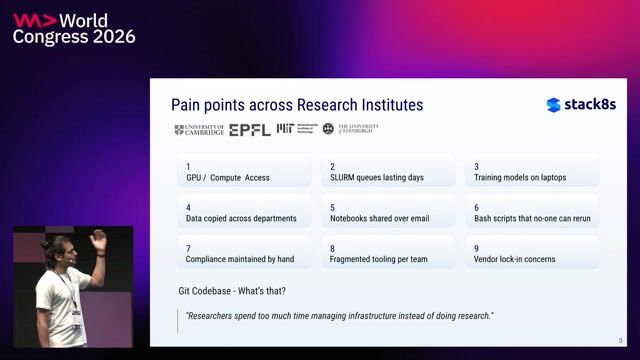
Infrastructure barriers and compliance risks in research

Jeremy Murray Jeremy Murray · World Congress 2026 Europe

1:52 min

Structuring and scaling the backend engineering team

Stefan Lingler Stefan Lingler +1 · Coffee With Developers

4:32 min

Harnessing Spark with Python using PySpark and Py4J

Ayon Roy · LIVE

3:37 min

Scaling machine learning pipelines from prototypes to petabytes

Julian Joseph · LIVE

3:09 min

Balancing data science skillings alongside systems engineering rigor

Nico Schmidt · LIVE

Videos

See all

Related articles

See all