
Trustworthy AI Starts at Deployment: 5 Checks Before You Ship
- Discuss this with your agent
- Open in Claude
- Open in ChatGPT

Trustworthy AI is not a slogan. It is a release standard.
Most AI features do not fail because nobody talked about ethics. They fail because they get shipped like ordinary features, even though they can behave unpredictably, expose sensitive data, or make bad decisions at scale. NIST frames trustworthy AI around characteristics such as validity and reliability, safety, security and resilience, accountability and transparency, explainability, privacy, and fairness in context. For developers, that means trustworthiness has to show up in deployment decisions, not just model demos.
Here are five checks worth completing before an AI feature goes live.
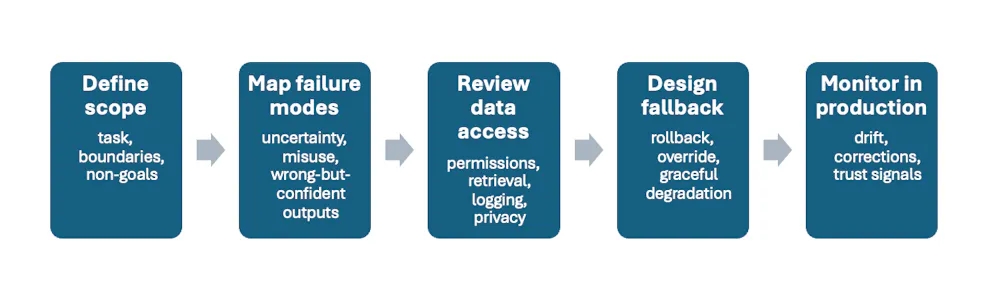
Trustworthy AI starts before launch and continues after deployment.
1. Define the job clearly — and define the boundaries
A feature brief like “help users make better decisions” is not enough. Before launch, write down what the system is supposed to do, what inputs it is expected to handle, what outputs it is allowed to produce, and when it should refuse, escalate, or fall back.
This matters because reliability depends on scope. If the task is fuzzy, evaluation is fuzzy. If the boundaries are missing, failure becomes hard to recognize until users hit it first.
A simple test helps: can the team answer, in one sentence, what the system should never do? If not, the feature is not ready.
2. Review failure modes before users discover them
Teams often spend more time testing whether the model can succeed than how it fails. That is where a lot of trust breaks.
Before release, ask a few direct questions. What happens when the model is uncertain? What happens when the prompt is slightly out of scope? What happens when the answer is wrong but sounds confident? What happens when downstream systems treat that answer as fact?
This review does not need to become a heavyweight governance ritual. A short one-page failure-mode list is enough to improve engineering decisions. The goal is not perfection. The goal is to make failure predictable, bounded, and visible.
A trustworthy feature is not one that never fails. It is one that fails in ways the team anticipated and designed for.
3. Check the data path, not just the model
A lot of AI review gets stuck at the prompt or model layer. In production, many of the real problems come from the surrounding data path.
Before shipping, check what the feature can access, what permissions are enforced before context is retrieved, whether sensitive content could leak through prompts or logs, and whether the system is pulling more context than the task actually needs.
This is where trustworthy AI becomes concrete. Privacy, accountability, and security are not abstract values. They show up in retrieval scope, permission checks, logging choices, retention, and auditability.
If the feature can touch sensitive context, a good demo is not enough evidence.
4. Build the fallback before you need it
One of the fastest ways to lose user trust is to ship an AI feature with only two modes: impressive or broken.
Production systems need a third mode: graceful degradation. That might mean showing source-backed suggestions instead of direct answers, routing low-confidence cases to a human, falling back to a rules-based path, or disabling risky actions while keeping lower-risk help available.
Fallbacks are not a sign that the AI is weak. They are a sign that the product is engineered.
If an AI-assisted workflow has no rollback, no override, and no safe mode, then the system is pushing uncertainty onto the user. That is the opposite of trustworthy behavior.
5. Decide what you will monitor after launch
Trustworthy AI is not something you declare at release time. It is something you continue to observe.
A normal feature might be monitored with latency, availability, and error rate. An AI feature needs more than that. Teams should think about signals like refusal rate, escalation rate, user correction rate, policy-trigger frequency, and whether people are quietly bypassing the feature because they no longer trust it.
This is also where logging discipline matters. You need enough observability to detect drift, failure patterns, and misuse, without casually collecting more sensitive content than you should.
If you do not know what bad looks like in production, you will not know when trust has started to erode.
Closing thought
Trustworthy AI is not a badge for a slide deck. It is a deployment standard.
For developers, that standard starts with a few practical questions. What is this system for? How can it fail? What can it access? How does it fall back? What will we monitor after launch?
If a team can answer those questions clearly, they are already doing more for trustworthy AI than most slogan-heavy roadmaps ever will.
About the Author
Aishi Huang is a software engineer with a background in computer science, computer vision, and applied AI evaluation. Her work spans production-oriented software engineering and research-driven analysis of AI system behavior, with interests in multimodal applications, responsible AI usage, and practical evaluation methods. She contributed to published research in computer vision and have served as a peer reviewer across multiple venues. I’m especially interested in helping teams bridge the gap between promising AI demos and reliable real-world systems. She currently works at Cisco.