World Congress 2026 Europe • Jul 9, 2026 • Session details

TiDB, One Layer at a Time: How Distributed SQL Became an Agentic AI Backbone

Daniël van Eeden , Mattias Jonsson

TiDB originally solved painful database sharding. Now, its decoupled architecture eliminates brittle ETL pipelines to provide a synchronized hybrid search backbone for agentic AI.

Pause
Mute Enter Fullscreen
#1 about 4 min

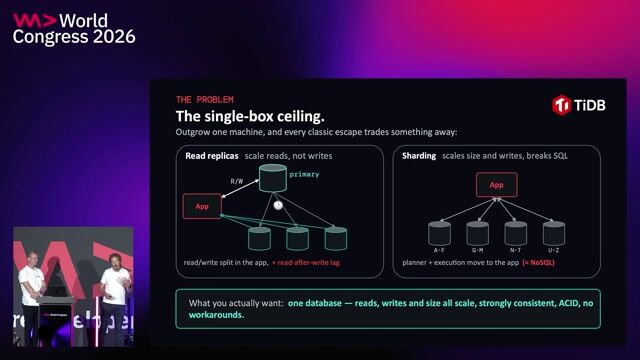
The challenges of scaling single-node database architectures

The transition from single machines to read replicas and sharding introduces application complexity and asynchronous replication delays.

#2 about 2 min

Processing queries with a stateless SQL layer

The processing layer routes reads and writes without storing data locally while maintaining syntax compatibility with MySQL.

#3 about 4 min

Distributing data with key-value storage and placement drivers

A distributed key-value store handles replicated data ranges while a placement driver balances storage capacity and offloads processing.

#4 about 2 min

Executing non-blocking online schema changes in production

Online data definition language execution allows developers to add columns or indexes to massive tables without halting active transactions.

#5 about 3 min

Enabling real-time analytics with columnar storage

A continuously synchronized Raft change stream populates a columnar engine to massively accelerate analytical aggregations and continuous event streaming.

#6 about 3 min

The architectural complexity of AI data stacks

Managing separate relational, document, graph, and vector databases causes brittle ETL pipelines and overwhelming operational burden.

#7 about 3 min

Unifying vector and full-text search in SQL

Integrated vector and full-text indexing empowers developers to execute hybrid semantic distance and exact keyword queries within single statements.

#8 about 3 min

Scaling and branching data with object storage

Backing instances with immutable files via object storage provides rapid scalability and isolated data branching for AI experimentation.

#9 about 3 min

Consolidating workloads through a smart database optimizer

An intelligent sql optimizer automatically routes various query fragments to row, columnar, or vector engines without manual manual intervention.

#10 about 3 min

Distributed SQL properties for agentic AI applications

The fundamental features of distributed databases completely align with what agentic AI backbones need regarding consistency and elastic scale.

#11 about 2 min

Database trade-offs and network latency considerations

Adopting a distributed database introduces additional network jumps that slightly raise baseline latency compared to monolithic single-machine endpoints.

Matching moments

3:25 min

Simplifying architectures through converged database platforms

Wei Hu Wei Hu · World Congress 2025

3:29 min

Practical use cases for unified transactional and analytical databases

Oleksandra Bovkun Oleksandra Bovkun · Europe 2026 Virtual

4:30 min

Introducing data management and the shift to streaming

Mary Grygleski Mary Grygleski · LIVE

1:36 min

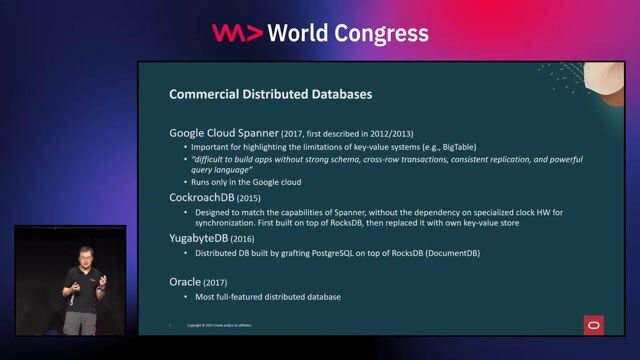
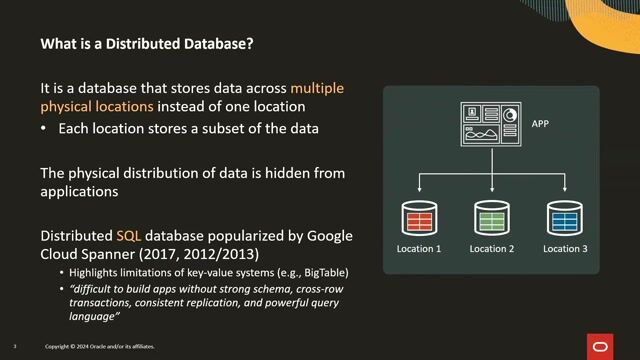
Evolution from key-value stores to distributed SQL

Wei Hu Wei Hu · World Congress 2025

1:21 min

Summary of decoupling analytical compute and storage

Matthias Niehoff Matthias Niehoff · World Congress 2026 Europe

1:52 min

Evolution of distributed SQL database management systems

Akmal Chaudhri Akmal Chaudhri · LIVE