

World Congress 2026 Europe Jul 10, 2026 Session details

One year of the CO2-challenge – insights and lessons learned

Aydin Mir Mohammadi

Aydin reveals that idle test environments emit more carbon than production workloads. Discover how scaling non-production servers to zero instantly cuts your software emissions by half.

Pause
Mute Enter Fullscreen
#1 about 2 min

Evaluating the global digital carbon footprint

The digital sector accounts for four percent of global emissions, surpassing both the aviation and shipping industries.

#2 about 3 min

Launching a local initiative for climate-friendly software

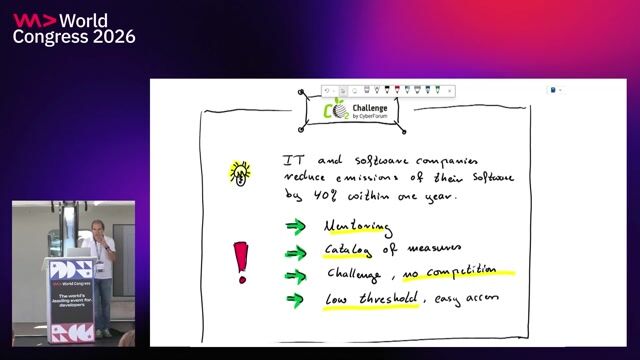
A regional network challenges software companies to reduce their operational carbon footprint by forty percent in a single year.

#3 about 2 min

Tracking company adoption and executive management commitment

Analyzing how executive backing yields a one-third successful execution rate among participating technology organizations.

#4 about 2 min

Understanding the hardware foundations of software emissions

Software indirectly generates carbon through hardware manufacturing processes and continuous electricity consumption across data centers.

#5 about 3 min

Building an implementation strategy for green software

Engineering teams utilize brainstorming and prioritization matrices to identify and act on carbon reduction hotspots.

#6 about 3 min

Overcoming resistance from senior engineering and development leads

Technical leads often block sustainability efforts because they mistakenly equate existing performance efficiency with optimized carbon consumption.

#7 about 2 min

Addressing the carbon waste of fixed hardware provisioning

Replacing static compute allocations with dynamic scaling reduces physical hardware waste and associated carbon footprints.

#8 about 4 min

Mitigating the hidden carbon costs of non-production environments

Shutting down constantly running test and staging systems presents the largest opportunity for immediate carbon savings.

#9 about 2 min

Reviewing real environmental savings from challenge participants

Participating companies significantly reduced their infrastructure footprint by implementing strict operational schedules for non-production environments.

#10 about 3 min

Navigating API limitations in sovereign local data centers

Organizations prioritizing digital sovereignty struggle to dynamically scale infrastructure without access to proprietary hyperscaler APIs.

#11 about 2 min

Reducing network payload for large digital website portfolios

Optimizing simple digital templates across thousands of deployments massively cuts down network-bound carbon emissions.

#12 about 4 min

Implementing carbon-aware computing for asynchronous background tasks

Shifting background jobs to align with high renewable grid energy minimizes the operational footprint using flexible scheduling plugins.

#13 about 3 min

Embedding sustainability advocates within product development groups

Enforcing dedicated sustainability roles within engineering teams ensures that long-term green computing practices genuinely succeed.

Matching moments

1:49 min

Coding for environmental sustainability in software engineering

Ulrich Irnich Ulrich Irnich · World Congress 2023

4:09 min

Implementing architectural best practices for sustainable software systems

Hendrik Lösch Hendrik Lösch · World Congress 2025

2:28 min

Advocating for green tech policies inside modern software companies

Lorenzo Pieri · LIVE

1:54 min

Analyzing the climate impact of the software industry

Pierre-Luc Noel +1 · World Congress 2023

1:57 min

Connecting web performance optimization to ecological sustainability

Andreas Taranetz Andreas Taranetz · World Congress 2024

2:50 min

Optimizing centralized cloud infrastructures for direct energy footprint reductions

Michael Mueller Michael Mueller · World Congress 2024

Upcoming sessions on this topic

Open session

World Congress 2026 North America

September 25, 2026 · 16:50–17:20

Stage 4

Engineering Moneyball: How We Benchmarked Google vs Meta

Jirka Bachel

Co-Founder & CEO

Jirka Bachel
Open session

World Congress 2026 North America

September 25, 2026 · 09:00–09:30

Stage 2

Autonomous Infrastructure: Building AI Agents for Global-Scale Capacity Efficiency

Tommy Tran

Software Engineer at Meta

Tommy Tran
Open session

World Congress 2026 North America

September 25, 2026 · 16:00–16:10

Outdoor Stage

public void saveMoney(AI): The Developer's Guide to Unit Economics

Hrushikesh Pokala

Senior Software Engineer Lead at Equifax

Hrushikesh Pokala
Open session

World Congress 2026 North America

September 24, 2026 · 14:50–15:20

Stage 9

How to generate business value through performance optimizations

Nikolai Sidiropulo

Software Engineer at Meta

Nikolai Sidiropulo
Open session

World Congress 2026 North America

September 25, 2026 · 11:40–12:10

Stage 3

Culture Doesn't Scale Itself: Leading Engineering Teams Through Hypergrowth and the AI Transition

Thanos Baskous

VP of Engineering and Co-founder of Cogent Security

Thanos Baskous
Open session

World Congress 2026 North America

September 24, 2026 · 11:00–11:30

Stage 1

Application-Defined Compute: Rethinking Infrastructure for AI Applications

Anurag Goel

Founder and CEO of Render

Anurag Goel