


DC
Daniel Cranney
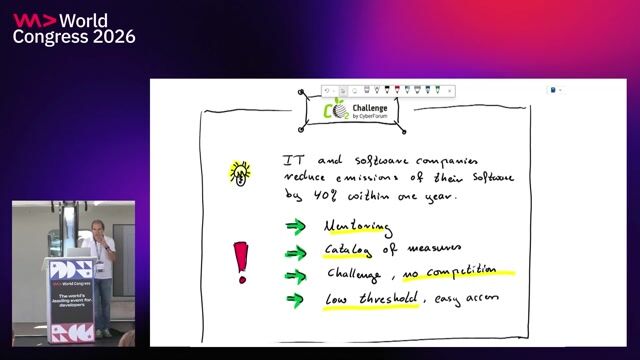
One year of the CO2-challenge – insights and lessons learned
- Discuss this with your agent
- Open in Claude
- Open in ChatGPT
Aydin reveals that idle test environments emit more carbon than production workloads. Discover how scaling non-production servers to zero instantly cuts your software emissions by half.
Matching moments
1:49 min
Coding for environmental sustainability in software engineering
 Ulrich Irnich · World Congress 2023
4:09 min
Implementing architectural best practices for sustainable software systems
 Hendrik Lösch · World Congress 2025
2:28 min
Advocating for green tech policies inside modern software companies
Lorenzo Pieri · LIVE
1:54 min
Analyzing the climate impact of the software industry
Pierre-Luc Noel +1 · World Congress 2023
1:57 min
Connecting web performance optimization to ecological sustainability
 Andreas Taranetz · World Congress 2024
2:50 min
Optimizing centralized cloud infrastructures for direct energy footprint reductions
 Michael Mueller · World Congress 2024
More from World Congress 2026 Europe
Related videos
Related articles

CH
Chris Heilmann

BB
Benedikt Bischof
LM
Luis Minvielle
.webp)
From learning to earning
Jobs that call for the skills explored in this talk.
12 days ago
Cloud Engineer (German)

Stackit
Barcelona, Spain
Git
Okta
OAuth
3 months ago
Senior Software Engineer, Enterprise Products

GitHub
United States
Expert
$124k–329k
Remote
Ruby
Bicep
Golang
about 1 month ago
•
Verified
GPU Cluster Engineer, Systems & Platform

Sciforium
San Francisco, United States
Expert
$150k–220k
Kubernetes
about 1 month ago
Staff Software Engineer, Compute Platform
GitHub
United States
Experienced
Remote
Ruby
Istio
Linux
about 2 months ago
Software Engineer, Infrastructure Platform

Docker, Inc.
Cartagena, Spain
€72k–123k
Remote
Linux
Istio
Docker
6 days ago
•
Verified
IT System Administrator

Sensory-Minds GmbH
Offenbach, Germany
Experienced
Remote
Linux
Docker