World Congress 2026 Europe β€’ Jul 10, 2026 β€’ Session details

From APIs to MCP: Enterprise Governance, Registry, and Controls

Stefan Mesquita

Are unmanaged AI tools fracturing your IT architecture? Stop building parallel governance stacks. Discover how to safely scale Model Context Protocol servers using your existing API infrastructure.

Pause
Mute Enter Fullscreen
#1 about 2 min

The evolution of enterprise system integration

Instead of building custom single-use integrations, standardizing enterprise systems as reusable APIs accelerates development projects.

#2 about 3 min

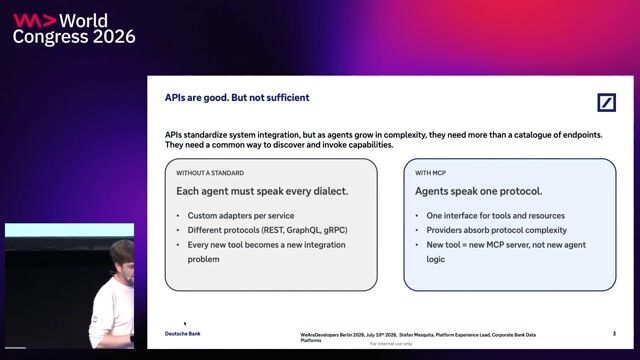
Standardizing agent tool discovery with MCP

Because agents struggle with diverse interface dialects, the Model Context Protocol unifies tool consumption on the provider side.

#3 about 3 min

Identifying enterprise risks in scattered MCP servers

Without proper governance, rogue MCP server deployments lead to duplicated tool capabilities and invisible organizational blind spots.

#4 about 2 min

Implementing an internal MCP registry for enterprise visibility

Deploying a centralized registry provides necessary visibility into server ownership, exposed tools, and critical data classifications.

#5 about 3 min

Securing agent interactions through existing API gateways

Applying gateway policies to agent requests introduces critical threat protection layers against prompt injection and unauthorized tool invocation.

#6 about 2 min

Leveraging existing API blueprints for MCP controls

Routing agent requests through established API platforms natively enables advanced analytics, load balancing, and performance-enhancing caching.

#7 about 3 min

Avoiding the risks of building parallel governance stacks

Operating separate governance stacks for API and MCP versions risks architectural drift and scattered evidence during security audits.

#8 about 2 min

Wrapping established APIs with standardized MCP proxies

Wrapping existing APIs in MCP-compatible proxies allows agents to access data without rebuilding authentication and rate-limiting rules.

#9 about 2 min

Three architecture patterns for adopting MCP capabilities

Organizations can adapt to different developer maturity levels by supporting registration-only, API-wrapped, or fully integrated native MCP architectures.

#10 about 1 min

Structuring a centralized routing layer for AI agents

Routing all agent runtime decisions back through a central enterprise platform guarantees consistent operational observability and authorization.

#11 about 2 min

Treating AI tools as standard governed enterprise capabilities

Applying proven API management disciplines to MCP adoption ensures that emerging tools remain standardized and scalable enterprise assets.

#12 about 3 min

Evaluating business use cases for native MCP endpoints

Rather than blindly rewriting legacy systems, engineering teams should reserve native MCP development for fundamentally new agentic workflows.

Matching moments

2:36 min

Core concepts and advantages of the Model Context Protocol

Rishabh Budhiraja Rishabh Budhiraja +1 Β· World Congress 2026 Europe

5:09 min

Securing AI agents against malicious MCP servers

Gbadebo Bello Gbadebo Bello Β· Europe 2026 Virtual

5:54 min

Standardizing agent interactions with the Web MCP proposal

Chris Heilmann Chris Heilmann +2 Β· LIVE

2:21 min

Integrating Model Context Protocol for non-technical users

Jordan Tigani Jordan Tigani Β· World Congress 2026 Europe

10:46 min

Analyzing the future risks and interoperability of MCPs

Perf + AI

2:08 min

Centralizing tool access and observability with MCP Gateway

Jim Clark Jim Clark +3 Β· World Congress 2025