




WeAreDevelopers LIVE • Feb 3, 2021

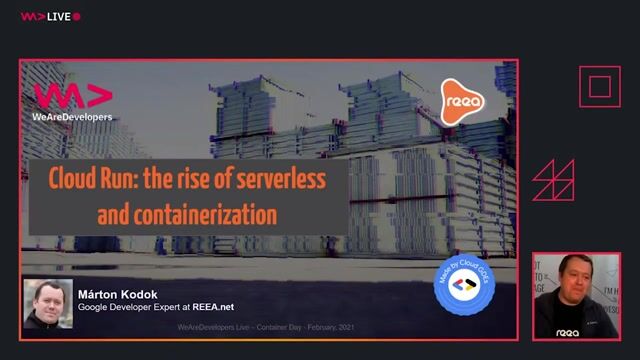
Cloud Run- the rise of serverless and containerization

Marton Kodok

Tired of serverless cold starts and vendor lock-in? Google Cloud Run auto-scales containerized apps, allowing 250 concurrent requests per instance to drastically shrink your cloud bill.

Pause
Mute Enter Fullscreen
#1 about 3 min

Overview of the serverless containerization agenda

Combining operational models and portable containers streamlines modern microservices deployment.

#2 about 2 min

Understanding the operational and programming models

Serverless computing shifts software management from physical infrastructure maintenance to event-driven architectures.

#3 about 2 min

Key pain points in early serverless platforms

Early serverless platforms created development bottlenecks through persistent cold starts and vendor lock-in.

#4 about 1 min

Advantages of cloud run for serverless containers

Deploying fully packaged containers across disparate hosting environments unifies the core developer experience.

#5 about 2 min

Comparing compute options across different platforms

Contrasting native cloud functions with containerized applications reveals optimal execution patterns for HTTP triggers.

#6 about 4 min

Deploying a basic application using the command line

Invoking standard command line utility scripts immediately publishes local node.js binaries directly to scalable cloud networks.

#7 about 1 min

Navigating the cloud run web interface dashboard

Visual dashboards grant immediate operational visibility into active deployment versions and automated integration pipelines.

#8 about 3 min

Exploring environment options and the pricing model

Accounting for ongoing requests rather than active idle duration drastically optimizes baseline cluster costs.

#9 about 6 min

Key technical capabilities of modern deployment setups

Maintaining persistent libraries and automated traffic splits natively bypasses platform lock-in while accelerating safe deployment updates.

#10 about 3 min

Mitigating cold starts using an efficient base image

Selecting minimal underlying operating system structures alongside cached global variables aggressively eliminates cold spin-up latencies.

#11 about 2 min

Managing standby capacity with minimum configured instances

Applying declarative configuration tags programs idle fallback engines to gracefully ingest unpredictable traffic peaks.

#12 about 6 min

Balancing auto-scaling risks with controlled concurrency limits

Regulating simultaneous active listener limits prevents erroneous loop scripts from exponentially driving extreme server overages.

#13 about 3 min

How request concurrency reduces infrastructure overhead bills

Grouping identical asynchronous background tasks into isolated hardware memory blocks drastically reduces mandatory underlying instance counts.

#14 about 2 min

Routing global traffic with automated load balancing

Combining distributed location nodes with dynamic gateway directors effectively neutralizes physical networking delays from global endpoints.

#15 about 4 min

Deploying active websockets using automated build pipelines

Consuming managed buildpacks instantly fulfills structural prerequisites without forcing manual overrides to sustain persistent socket tunnels.

#16 about 4 min

Automating multi-step deployments and remote database connections

Synchronizing remote sequential build declarations injects secure proxy connections seamlessly between exposed services and isolated database layers.

#17 about 2 min

Summary of core capabilities and future container trends

Equipping independent serverless mechanisms with continuous deployment protocols natively establishes highly responsive operational development lifecycles.

Matching moments

4:42 min

Container hosting options available on Google Cloud Platform

Federico Fregosi · WWC 2022

7:46 min

Integrating containers to solve serverless execution limitations

Mete Atamel Mete Atamel · WWC 2022

3:08 min

Comparing containers, cloud architectures, and serverless computing

Dominik Kress · LIVE

1:39 min

Comparing serverless deployment and Kubernetes operational cloud tradeoffs

Markus Kett Markus Kett · WWC 2022

3:28 min

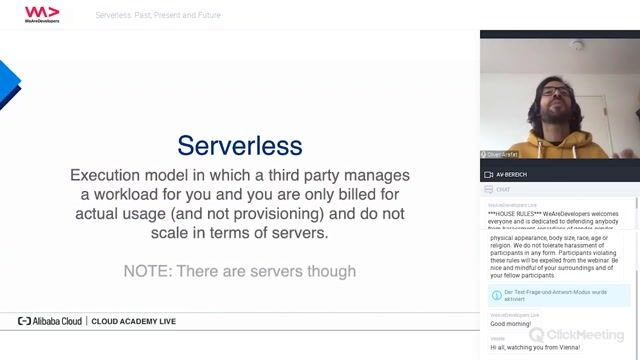
Discussing history and enterprise adoption of serverless

Oliver Arafat · LIVE

3:17 min

Maximizing cloud native capabilities for scaling dynamic AI workloads

Jim Clark Jim Clark +3 · WWC 2025

Upcoming sessions on this topic

Open session

World Congress 2026 North America

From Cloud Native to Multi-Cloud Native: Write Once, Deploy Anywhere

Sandeep Pal

Principal Member of Technical Staff at Salesforce

Sandeep Pal
Open session

World Congress 2026 North America

public void saveMoney(AI): The Developer's Guide to Unit Economics

Hrushikesh Pokala

Senior Software Engineer Lead at Equifax

Hrushikesh Pokala
Open session

World Congress 2026 North America

The $0.15/month Algo-Trader: Architecting High-Performance Serverless Trading Engines

Vishwak Thatikonda

Lead Full Stack Engineer at SDH Systems

Vishwak Thatikonda
Open session

World Congress 2026 North America

Run your agents in Kubernetes: Build once, deploy anywhere. But really?

Michal Salanci

Senior Systems Engineer at ESET Cybersecurity

Michal Salanci
Open session

World Congress 2026 North America

Stop Running Mystery Meat in Production

Jeroen van Erp

Technical Advocate @ SUSE

Jeroen van Erp
Open session

World Congress 2026 North America

Trust, But Verify: Continuous GPU Validation at Scale

Kyle Bell

VP of AI @ TensorWave

Kyle Bell