

WeAreDevelopers LIVE Feb 3, 2021

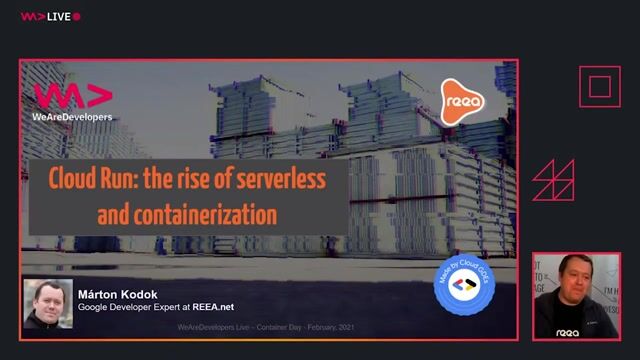
Cloud Run- the rise of serverless and containerization

Marton Kodok

Tired of serverless cold starts and vendor lock-in? Google Cloud Run auto-scales containerized apps, allowing 250 concurrent requests per instance to drastically shrink your cloud bill.

Pause
Mute Enter Fullscreen
#1 about 3 min

Overview of the serverless containerization agenda

Combining operational models and portable containers streamlines modern microservices deployment.

#2 about 2 min

Understanding the operational and programming models

Serverless computing shifts software management from physical infrastructure maintenance to event-driven architectures.

#3 about 2 min

Key pain points in early serverless platforms

Early serverless platforms created development bottlenecks through persistent cold starts and vendor lock-in.

#4 about 1 min

Advantages of cloud run for serverless containers

Deploying fully packaged containers across disparate hosting environments unifies the core developer experience.

#5 about 2 min

Comparing compute options across different platforms

Contrasting native cloud functions with containerized applications reveals optimal execution patterns for HTTP triggers.

#6 about 4 min

Deploying a basic application using the command line

Invoking standard command line utility scripts immediately publishes local node.js binaries directly to scalable cloud networks.

#7 about 1 min

Navigating the cloud run web interface dashboard

Visual dashboards grant immediate operational visibility into active deployment versions and automated integration pipelines.

#8 about 3 min

Exploring environment options and the pricing model

Accounting for ongoing requests rather than active idle duration drastically optimizes baseline cluster costs.

#9 about 6 min

Key technical capabilities of modern deployment setups

Maintaining persistent libraries and automated traffic splits natively bypasses platform lock-in while accelerating safe deployment updates.

#10 about 3 min

Mitigating cold starts using an efficient base image

Selecting minimal underlying operating system structures alongside cached global variables aggressively eliminates cold spin-up latencies.

#11 about 2 min

Managing standby capacity with minimum configured instances

Applying declarative configuration tags programs idle fallback engines to gracefully ingest unpredictable traffic peaks.

#12 about 6 min

Balancing auto-scaling risks with controlled concurrency limits

Regulating simultaneous active listener limits prevents erroneous loop scripts from exponentially driving extreme server overages.

#13 about 3 min

How request concurrency reduces infrastructure overhead bills

Grouping identical asynchronous background tasks into isolated hardware memory blocks drastically reduces mandatory underlying instance counts.

#14 about 2 min

Routing global traffic with automated load balancing

Combining distributed location nodes with dynamic gateway directors effectively neutralizes physical networking delays from global endpoints.

#15 about 4 min

Deploying active websockets using automated build pipelines

Consuming managed buildpacks instantly fulfills structural prerequisites without forcing manual overrides to sustain persistent socket tunnels.

#16 about 4 min

Automating multi-step deployments and remote database connections

Synchronizing remote sequential build declarations injects secure proxy connections seamlessly between exposed services and isolated database layers.

#17 about 2 min

Summary of core capabilities and future container trends

Equipping independent serverless mechanisms with continuous deployment protocols natively establishes highly responsive operational development lifecycles.

Matching moments

4:42 min

Container hosting options available on Google Cloud Platform

Federico Fregosi · World Congress 2022

7:46 min

Integrating containers to solve serverless execution limitations

Mete Atamel Mete Atamel · World Congress 2022

3:08 min

Comparing containers, cloud architectures, and serverless computing

Dominik Kress · LIVE

1:39 min

Comparing serverless deployment and Kubernetes operational cloud tradeoffs

Markus Kett Markus Kett · World Congress 2022

3:28 min

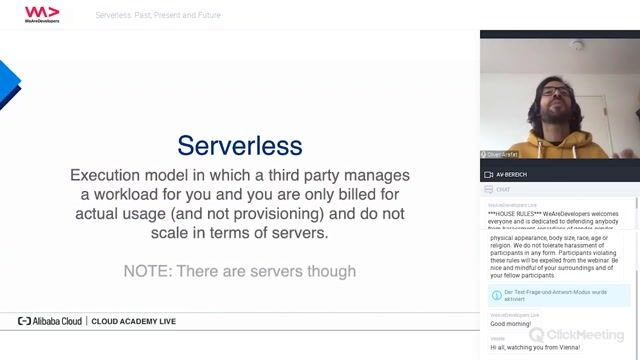
Discussing history and enterprise adoption of serverless

Oliver Arafat · LIVE

3:17 min

Maximizing cloud native capabilities for scaling dynamic AI workloads

Jim Clark Jim Clark +3 · World Congress 2025

Upcoming sessions on this topic

Open session

World Congress 2026 North America

September 25, 2026 · 12:20–12:50

Mainstage

A Computer Is All You Need

Steren Giannini

Director and Founder of Google Cloud Run

Steren Giannini
Open session

World Congress 2026 North America

September 24, 2026 · 11:00–11:30

Stage 1

Application-Defined Compute: Rethinking Infrastructure for AI Applications

Anurag Goel

Founder and CEO of Render

Anurag Goel
Open session

World Congress 2026 North America

September 24, 2026 · 16:10–16:40

Stage 4

From Cloud Native to Multi-Cloud Native: Write Once, Deploy Anywhere

Sandeep Pal

Principal Member of Technical Staff at Salesforce

Sandeep Pal
Open session

World Congress 2026 North America

September 25, 2026 · 16:00–16:10

Outdoor Stage

public void saveMoney(AI): The Developer's Guide to Unit Economics

Hrushikesh Pokala

Senior Software Engineer Lead at Equifax

Hrushikesh Pokala
Open session

World Congress 2026 North America

September 25, 2026 · 14:50–15:20

Stage 7

The $0.15/month Algo-Trader: Architecting High-Performance Serverless Trading Engines

Vishwak Thatikonda

Lead Full Stack Engineer at SDH Systems

Vishwak Thatikonda
Open session

World Congress 2026 North America

September 24, 2026 · 15:30–16:00

Stage 9

Run your agents in Kubernetes: Build once, deploy anywhere. But really?

Michal Salanci

Senior Systems Engineer at ESET Cybersecurity

Michal Salanci