More efficient software for more efficient microchips
What happens when fast-paced agile software development collides with hardware engineering lifecycles that span decades?
#1about 3 minutes
Introduction to software's role at a hardware company
Zeiss provides hardware for various industries, from medical devices to semiconductor manufacturing, where software plays a critical role.
#2about 5 minutes
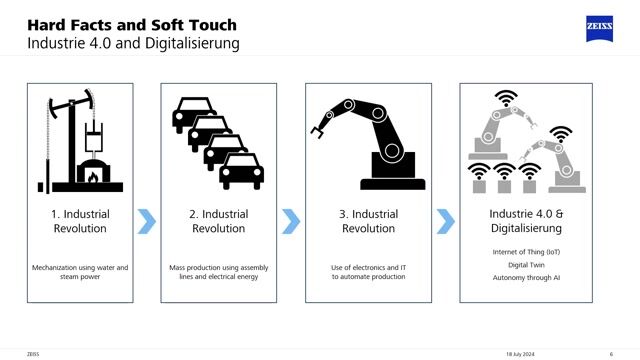
Understanding the shift from Industry 3.0 to 4.0
The transition from automated assembly lines to interconnected systems like IoT and digital twins creates new challenges for accessing data from legacy hardware.
#3about 2 minutes
The cultural clash between hardware engineers and software developers
Hardware engineering's established standards and physical constraints often conflict with the agile, remote-friendly culture of modern software development.
#4about 4 minutes
Contrasting software and hardware development lifecycles
Software's rapid release cycles conflict with hardware's long lifecycles, where products like factories can operate for decades with infrequent updates.
#5about 2 minutes
Finding the source of truth in hardware projects
Unlike software's focus on customer value, hardware-centric projects must treat the hardware itself as the primary source of truth and value.
#6about 3 minutes
Navigating agile methods in a regulated hardware environment
Agile practices must be adapted to meet the strict compliance, documentation, and waterfall-style processes required for regulated industries like medical devices.
#7about 5 minutes
Adapting quality assurance for hardware-dependent software
Testing software for hardware requires moving beyond standard tools to use physical testbeds, certified procedures, and custom-built simulations.
#8about 3 minutes
Solutions for bridging the hardware and software divide
Effective collaboration requires mutual respect, shared quality ownership, adopting modern tools like Git, and proactive communication between engineering and development teams.
#9about 3 minutes
Q&A on virtual commissioning and industry examples
The discussion covers the role of hardware-in-the-loop simulation, the high cost of creating digital twins, and the importance of management buy-in.
Related jobs
Jobs that call for the skills explored in this talk.
Now is the time for industrialized software developmentNow is the time for industrialized software development
Recently, I received a letter from my car’s manufacturer alerting me to a recall. They had discovered a defective part and wanted to replace it.
It was easily fixed, and I might have forgotten a...
Benedikt Bischof
How we Build The Software of TomorrowWelcome to this issue of the WeAreDevelopers Live Talk series. This article recaps an interesting talk by Thomas Dohmke who introduced us to the future of AI – coding.This is how Thomas describes himself:I am the CEO of GitHub and drive the company’s...
Daniel Cranney
How software is steering vehicle technologyThe automotive industry is entering a transformative era, and developers have a unique opportunity to be part of it. Cars are no longer just mechanical machines; they’re sophisticated tech platforms with software at their core. This shift, defined by...
Chris Heilmann
Transforming Software Development: The Role of AI and Developer ToolsIn today's fast-paced tech landscape, AI has begun to play an increasingly significant role, reshaping the way developers create software. As we delve into this transformation, we uncover both opportunities and challenges that AI brings into the worl...
From learning to earning
Jobs that call for the skills explored in this talk.