



WeAreDevelopers LIVE • Nov 27, 2024

Building Blocks of RAG: From Understanding to Implementation

Ashish Sharma

Are AI hallucinations stalling your enterprise production? Learn how to construct a reliable RAG pipeline with LangChain and Python to strictly ground LLM outputs in verified data.

Pause
Mute Enter Fullscreen
#1 about 2 min

Introduction to building blocks of retrieval-augmented generation

Retrieval-augmented generation enhances large language models by connecting them to external data sources.

#2 about 2 min

Technology stack for building retrieval-augmented generation applications

Core technologies used in the stack include Python, the Groq API, LangChain, FAISS, and Streamlit.

#3 about 2 min

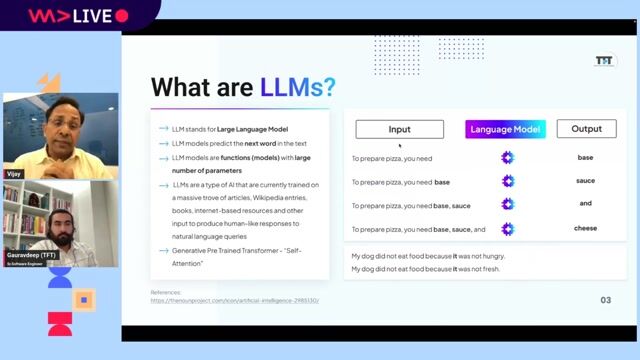
Understanding large language models and their core capabilities

Large deep learning models rely on encoders and decoders to analyze context and generate text.

#4 about 3 min

The rapid growth and enterprise adoption of language models

The evolution of text generation models moves rapidly from experimentation to enterprise production deployments.

#5 about 2 min

Challenges with language models in enterprise production environments

Hallucinations, knowledge cutoffs, and missing source verification present major risks for deploying AI in enterprise environments.

#6 about 2 min

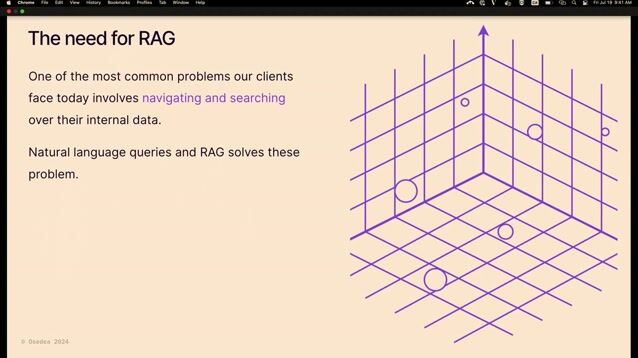
Overcoming language model challenges using retrieval-augmented generation

Providing relevant external information directly to language models successfully mitigates hallucination and drastically improves accuracy.

#7 about 2 min

Processing data with document loaders and text splitters

LangChain document loaders ingest large files while text splitters actively divide them into searchable, manageable chunks.

#8 about 3 min

Converting data chunks into high-dimensional vector embeddings

Text chunks reliably transform into numerical representations using Hugging Face and reside in specialized vector databases.

#9 about 4 min

Combining retrieval algorithms and prompts for accurate generation

Retrieving relevant document chunks based on user queries builds conversational memory and provides critical context for language models.

#10 about 3 min

Visualizing the end-to-end data pipeline and application workflow

A step-by-step architectural breakdown visualizes data ingestion, vector storage, query embedding, and final response generation.

#11 about 5 min

Live demonstration of a retrieval-augmented generation application

Cloning a GitHub repository and configuring a Streamlit interface allows users to reliably query domain-specific documents locally.

#12 about 3 min

Summary of the complete retrieval-augmented generation architecture

A final recap outlines the workflow steps required to transition a proof-of-concept AI application into enterprise production.

Matching moments

1:44 min

Understanding basic retrieval-augmented generation architectures in chatbots

Stan Girard Stan Girard · World Congress 2024

2:05 min

Enhancing language models with retrieval-augmented generation

Mary Grygleski Mary Grygleski · LIVE

1:57 min

Understanding overarching retrieval and generation steps in RAG architectures

Csenge Szabo Csenge Szabo · Europe 2026 Virtual

2:39 min

Baseline architecture of retrieval-augmented generation systems

Joy Joy · World Congress 2024

1:50 min

Simplifying generative AI deployments using the RagStack opinionated framework

David Leconte David Leconte +1 · World Congress 2024

3:50 min

Building local RAG architectures using the Anything LLM tool

Cedric Clyburn Cedric Clyburn +1 · World Congress 2025