


BB
Benedikt Bischof
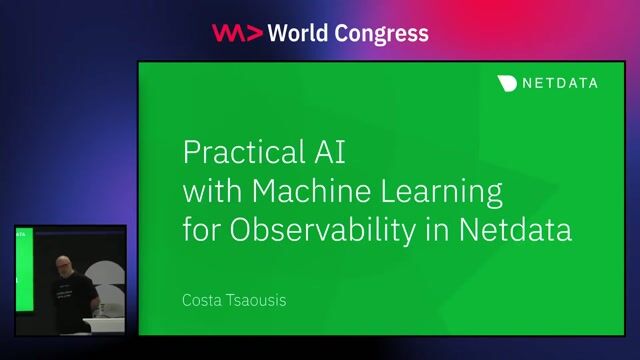
Practical AI with Machine Learning for Observability in Netdata
- Discuss this with your agent
- Open in Claude
- Open in ChatGPT
Are centralized observability models making real-time machine learning prohibitively expensive? Discover how Netdata distributes incredibly lightweight AI directly to the edge to mathematically eliminate false positives.
Matching moments
2:21 min
Using AI for incident summaries and root cause analysis
 Jemiah Sius +1 · World Congress 2026 Europe
1:48 min
Adapting observability strategies for long-running enterprise AI agents
 Christian Heilmann +3 · World Congress 2026 Europe
1:05 min
Implementing monitoring and observability for AI software deployments
 Alejandro Saucedo · World Congress 2025
1:13 min
Monitoring enterprise AI workloads for continuous observability
 Maxim Salnikov · World Congress 2025
1:41 min
Implementing semi-automated anomaly detection with human oversight
Katja Träumner
1:21 min
Leveraging generative AI for application observability and security
 Jemiah Sius · World Congress 2023
More from World Congress 2025
Related videos
Related articles
.gif)
BB
Benedikt Bischof
.gif)
BB
Benedikt Bischof
.gif)
MH
Michael Hunger
N
Neo4j

From learning to earning
Jobs that call for the skills explored in this talk.
about 1 month ago
•
Verified
Senior AI/ML Engineer

PagerDuty
Lisbon, Portugal
Expert
Remote
AI Frameworks
AI-assisted coding tools
27 days ago
Founding Data Scientist

Almedia
Berlin, Germany
€90k–170k
SQL Databases
Data Pipelines
Language Modeling
about 1 month ago
•
Verified
ML Engineer

Docker, Inc.
Seattle, United States
Expert
Remote
Go
about 1 month ago
•
Verified
Staff ML Engineer
Docker, Inc.
Seattle, United States
Expert
Remote
Go
27 days ago
Data Scientist
Almedia
Berlin, Germany
Airflow
Terraform
Kubernetes
21 days ago
Principal Software Engineer, AI Compute Infrastructure

ARM
Seattle, WA, United States
Expert
$262k
Linux
Grafana
Pytorch