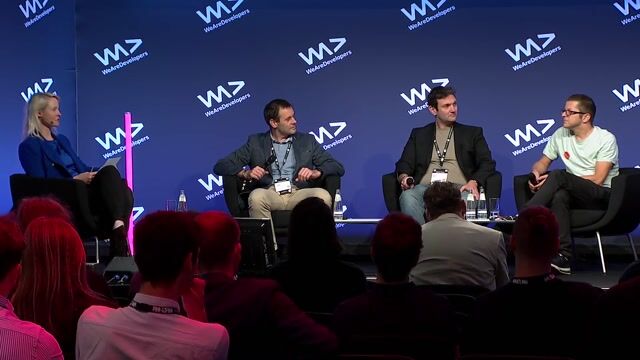
World Congress 2025 Aug 20, 2025 Session details

Optimizing Discovery: PostgreSQL's Role in Transforming GetYourGuide's Search

Dharin Shah

Can PostgreSQL outperform specialized search engines? Discover how GetYourGuide migrated from OpenSearch, deeply tuning TOAST tables and JSONB structures to slash API latency by 40%.

Pause
Mute Enter Fullscreen
#1 about 2 min

Overview of the GetYourGuide event-based marketplace

An overview of the event marketplace and the business need for a highly responsive discovery system.

#2 about 2 min

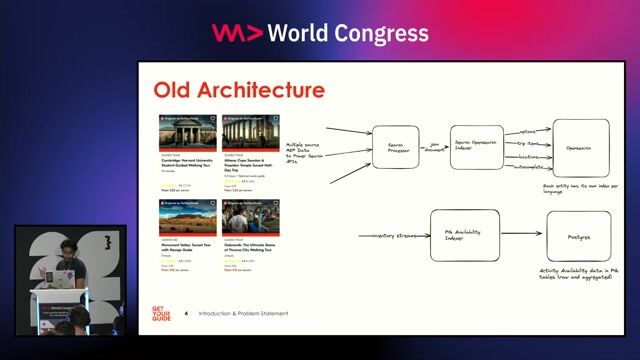
Reviewing the legacy search architecture using OpenSearch

The previous search system combined data processing pipelines, OpenSearch for document indexing, and PostgreSQL for availability handling.

#3 about 2 min

API flow for frontend team search queries

Custom domain-specific languages handle frontend filtering rules before requests reach the ranking and ML services.

#4 about 2 min

Technical challenges driving the OpenSearch database migration

A lack of relational joins, complex query structures, and frequent latency spikes limited product flexibility and required high maintenance.

#5 about 2 min

Advantages of migrating search infrastructure to PostgreSQL

Leveraging a mature relational model with flexible JSON support significantly reduces operational complexity and underlying infrastructure costs.

#6 about 3 min

Analyzing limitations with PostgreSQL bitmap heap scans

Running memory-resident TID bitmaps creates additional performance steps compared to faster index-only execution plans.

#7 about 4 min

Evaluating aggregations and memory usage of roaring bitmaps

Native PostgreSQL row-oriented storage struggles with high-cardinality data compared to OpenSearch's highly compressed memory-efficient roaring bitmaps.

#8 about 2 min

Implementing denormalized schemas with GIN indexes in Postgres

Combining array-based columns with GIN indexes perfectly maps to previously denormalized OpenSearch document structure dependencies.

#9 about 2 min

Retrieving custom API payloads using a single query

Executing common table expressions produces a unified JSON result format instead of receiving multiple tabular relational results.

#10 about 2 min

Performance impacts and search data cardinality evaluation

Evaluating search patterns confirms that query caching limits performance degradation when dealing with high-cardinality Postgres filter states.

#11 about 2 min

Generating dynamic database queries using the JOOQ library

Implementing JOOQ provides clean and compile-time validated SQL generation code for handling complex dynamical client search criteria.

#12 about 2 min

Managing infrastructure limitations with managed Amazon Aurora databases

Adopting managed database clusters simplifies replica deployment but restricts usage of specialized real-time aggregation extensions.

#13 about 2 min

Optimizing TOAST configurations for large JSON metadata blobs

Increasing the tuple target size alongside lz4 compression radically reduces row amplification when saving multi-language localization metadata.

#14 about 2 min

Preventing replication conflicts from database vacuum operations

Disabling truncation commands during vacuum runs safely prevents exclusive locks blocking access to standby read replica pages.

#15 about 3 min

Postgres migration performance results and future semantic search

The search layer transition successfully reduced overall latency and cleared a unified roadmap for robust vector-based semantic search.

Matching moments

2:18 min

Comparing PostgreSQL and DynamoDB for read-heavy storage

George Asafev · World Congress 2023

3:00 min

Benchmarking SearchOLAP against existing database engines

Andrey Abramov Andrey Abramov · World Congress 2026 Europe

2:01 min

Migrating existing applications from MongoDB to Postgres

Nikita Shamgunov Nikita Shamgunov · World Congress 2024

3:46 min

Navigating enterprise adoption, search optimization, and platform scaling concerns

Fabian Hedin Fabian Hedin · World Congress 2026 Europe

5:53 min

Choosing relational databases over NoSQL for most workloads

Josip Stuhli Josip Stuhli · World Congress 2026 Europe

1:02 min

Migrating from local JSON storage to relational databases

Noam Honig · World Congress 2023

Upcoming sessions on this topic

Open session

World Congress 2026 North America

September 25, 2026 · 16:50–17:20

Stage 4

Engineering Moneyball: How We Benchmarked Google vs Meta

Jirka Bachel

Co-Founder & CEO

Jirka Bachel
Open session

World Congress 2026 North America

September 24, 2026 · 17:30–18:00

Stage 3

Scaling Distributed Queues for AI workloads

Jasmit Kaur Saluja

Software Engineer at Meta Platforms Inc

Jasmit Kaur Saluja
Open session

World Congress 2026 North America

September 24, 2026 · 17:30–18:00

Stage 4

Boring Failover: Predictable Region Recovery Across 5,000 Microservices

Garvit Kataria, Sahil Sabharwal

Garvit Kataria
Sahil Sabharwal
Open session

World Congress 2026 North America

September 24, 2026 · 14:10–14:40

Stage 3

Real-Time Data Platforms at Trillion-Event Scale

Diptamay Sanyal

Principal Engineer | Data, AI & Cybersecurity Platforms

Diptamay Sanyal
Open session

World Congress 2026 North America

September 24, 2026 · 11:00–13:00

Stage 8

Optimizing Coffee Stand Locations with Gemma 4 and BigQuery

Speaker TBA

Open session

World Congress 2026 North America

September 24, 2026 · 11:40–12:10

Stage 4

Taming Rogue Agents: Observability-Driven Evaluation for Production Reliability

Anagha Rumade, Anjana Umapathy, Apoorva Jaiswal

Anagha Rumade
Anjana Umapathy
Apoorva Jaiswal