



CH
Chris Heilmann
- Discuss this with your agent
- Open in Claude
- Open in ChatGPT
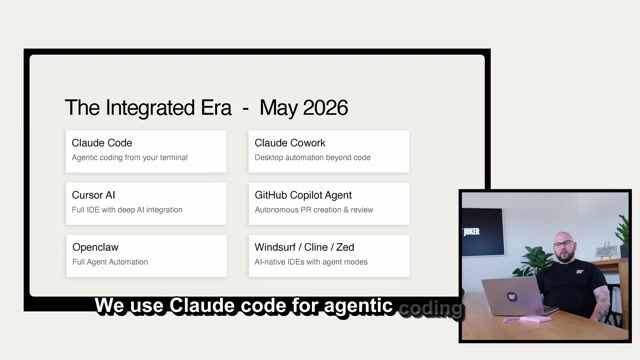
Lee Faus argues that AI is killing traditional DevOps. Discover why the future of engineering relies on critical code review and using LLMs as architectural sparring partners.
Matching moments
1:55 min
Shifting developer workloads and realistic AI productivity gains
 Chris Heilmann +2 · LIVE
2:34 min
Balancing developer autonomy with the adoption of coding agents
 Clemens Wasner +4 · World Congress 2026 Europe
3:06 min
Addressing the gap between coding assistants and complex workflows
 Julia Kordick · World Congress 2026 Europe
4:08 min
Transitioning software engineering teams to AI-native development workflows
 Florian Deter +4 · World Congress 2026 Europe
3:42 min
The promise and risk of AI coding agents
 May Walter · World Congress 2026 Europe
5:30 min
Developer role changes in the AI era
 Zaak Chalal · World Congress 2026 Europe
More from Coffee With Developers
Related videos
Related articles
DC
Daniel Cranney

CH
Chris Heilmann

BB
Benedikt Bischof
.gif)
From learning to earning
Jobs that call for the skills explored in this talk.
16 days ago
Senior AI Developer

PwC
United States
Expert
Remote
Docker
Github
Fastapi
about 1 month ago
•
Verified
Senior AI/ML Engineer

PagerDuty
Lisbon, Portugal
Expert
Remote
AI Frameworks
AI-assisted coding tools
about 1 month ago
•
Verified
Partner Sales Director - AI Alliances - Model Providers

Dynatrace
San Francisco, United States
Expert
Remote
DevOps
AI Frameworks
Machine Learning
2 months ago
•
Verified
AI Software Engineer (Germany)

Sunhat
Berlin, Germany
Expert
€70k–100k
Remote
REST
TypeScript
AI Frameworks
about 2 months ago
MLOps AI Engineer

TeamViewer Germany GmbH,
Austin, TX, United States
Expert
Caching
Routing
Standard Sql
18 days ago
•
Verified
Head of Agentic AI / Lead AI Engineer

1st solution consulting gmbh
Barcelona, Spain
Expert
€70k–80k
Python
OpenAI API
AI Frameworks