Perfomance & AI Day Nov 27, 2025

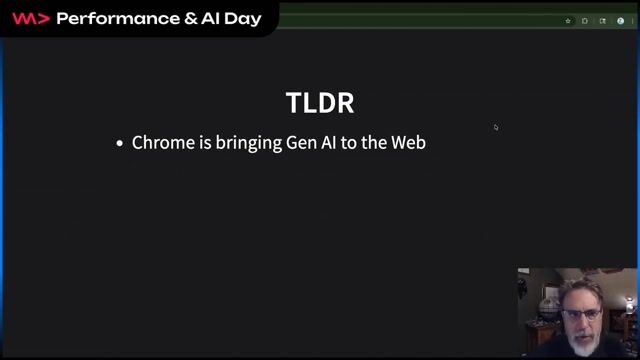
Generate AI in the Browser with Chrome AI - Raymond Camden

Raymond Camden

Raymond Camden proves you can run generative AI natively in the browser without server-side APIs. Discover how to leverage Chrome AI for privacy-first, edge-computed web applications.

Pause
Mute Enter Fullscreen
#1 about 4 min

Introducing generative browser capabilities using JavaScript

Running models natively within the browser circumvents server-side processing dependencies while utilizing existing JavaScript knowledge.

#2 about 3 min

Leveraging Chrome AI and nano models for web applications

Downloading a highly optimized local AI model directly to the client device enables offline and privacy-focused generative features.

#3 about 3 min

Evaluating release statuses for local translation and prompting interfaces

Reviewing available browser features reveals limitations around multimodal parsing and clarifies the difference between extensions and regular browser execution.

#4 about 3 min

Implementing local text translation and language detection interfaces

Translating text strings and detecting spoken languages relies on local language packs triggered securely by user gestures.

#5 about 3 min

Generating custom text summaries with tailored formatting options

Passing specific length constraints and style parameters into the summarization utility dynamically yields structured outputs like markdown strings or isolated bullet points.

#6 about 4 min

Modifying text utilizing the Rewriter and Proofreader interfaces

Transforming source text through variable tone adjustments and identifying raw grammatical errors often requires active origin-trial flags during early release phases.

#7 about 1 min

Building flexible AI interactions via the general Prompt API

Utilizing explicit system instructions alongside structured output capabilities unlocks complex conversational workflows and foundational image interpretation mechanics.

#8 about 7 min

Writing asynchronous JavaScript to instantiate and download local models

Verifying initial model availability and exposing internal file download progress demands careful handling of unresolved promise states within the application logic.

#9 about 2 min

Implementing asynchronous translation routines with user interface updates

Constructing dedicated translator instances and binding loading logs prevents application blocking during substantial text conversions.

#10 about 3 min

Testing output lengths and styles via text summarization

Overriding default API specifications allows developers to test nuanced summaries emphasizing quick teasing or comprehensive extraction parameters.

#11 about 1 min

Adjusting generated text tone through the Rewriter interface

Modifying text length requirements and formality presets repeatedly condenses extensive historical documents into extremely brief casual conversational formats.

#12 about 3 min

Extracting image context by querying local language models

Submitting binary image contents alongside direct descriptive instructions initiates deep local analysis recognizing internal objects and overall visual scenes.

#13 about 3 min

Improving image analysis prompts with external geocoding data

Connecting dynamic geographical metadata coordinates into existing analysis prompts significantly expands the localized reasoning powers of the native AI assessment sequence.

#14 about 3 min

Accessing interactive playgrounds and data summarization examples

Experimentally testing browser models within specialized sandbox environments streamlines prompt evaluation before integrating calls directly into product source logic.

Matching moments

5:47 min

Integrating native generative artificial intelligence APIs into browser engines

Chris Heilmann +9 · LIVE

4:41 min

Exploring agentic browsers and artificial intelligence generation

Chris Heilmann +2 · LIVE

2:46 min

Enhancing native browser experiences with on-device generative AI

Chris Heilmann +2 · LIVE

2:01 min

Utilizing built-in AI models for browser mediation

Christian Liebel Christian Liebel · WWC Europe 2026

2:46 min

The case for native AI in web browsers

Maxim Salnikov Maxim Salnikov · WWC 2025

50 sec

Building agentic artificial intelligence applications using Node.js

Julián Duque Julián Duque · WWC 2025

Upcoming sessions on this topic

Open session

World Congress 2026 North America

Small LLM in your Browser: Huge Opportunities for Web Applications

Daniel Ostrovsky

UI/UX Architect at Payoneer | AI Architect | Full Cycle Development Expert | Public Speaker | Open Source Contributor |

Daniel Ostrovsky
Open session

World Congress 2026 North America

Building Stuff with GenAI - The Open Minded Workshop beyond OpenAI

Andreas Erben

CTO for Applied AI and Metaverse at daenet

Andreas Erben
Open session

World Congress 2026 North America

Beyond Vibe Coding: Using CLI Tools as Your AI Counterpart in Pair Programming

Ron Veen

Java enthusiast and Special agent for Team Rockstars IT

Ron Veen
Open session

World Congress 2026 North America

From Software Agents to Physical Devices: Inside the Agentic Hardware Stack

Michael Yuan, Vivian Hu

Michael Yuan
Vivian Hu
Open session

World Congress 2026 North America

AI-Driven API Design

Mike Amundsen

Author, Adviser, Trainer

Mike Amundsen
Open session

World Congress 2026 North America

From Idea to Production with AI: Agentic Development in Practice

Daniel Ostrovsky

UI/UX Architect at Payoneer | AI Architect | Full Cycle Development Expert | Public Speaker | Open Source Contributor |

Daniel Ostrovsky