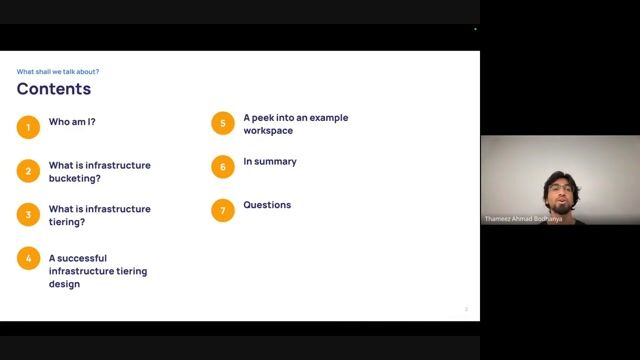
Thameez Bodhanya

Why segmenting your infrastructure into tiers makes your infrastructure design better

Stop passing complex modules between infrastructure teams. A tiered design with clear contracts reduces blast radius and improves deployment speed.

Why segmenting your infrastructure into tiers makes your infrastructure design better
#1about 4 minutes

The problem with current infrastructure bucketing practices

Unintentional infrastructure organization leads to either a fragile monolith or fragmented workspaces with fuzzy dependencies.

#2about 3 minutes

Defining infrastructure tiering and clear ownership

Infrastructure tiering is the intentional bucketing of resources into independently deployable layers with explicit contracts via flat inputs and outputs.

#3about 3 minutes

A practical three-tier infrastructure design model

A successful model consists of Tier 0 for foundational resources, Tier 1 for the shared platform, and Tier 2 for application-specific resources.

#4about 2 minutes

Assigning common cloud resources to each tier

Foundational resources like VPCs belong in Tier 0, shared platforms like EKS clusters in Tier 1, and application-specific resources like S3 buckets in Tier 2.

#5about 8 minutes

Real-world examples of multi-cloud tiering implementations

Tiered designs can be implemented using different tools like Terraform and AWS CDK, passing outputs between tiers using remote state or SSM Parameter Store.

#6about 5 minutes

The key benefits of adopting infrastructure tiering

Adopting a tiered approach reduces the blast radius of changes, speeds up deployments, clarifies ownership, and increases tooling flexibility.

Related jobs
Jobs that call for the skills explored in this talk.

Featured Partners

Related Articles

View all articles

From learning to earning

Jobs that call for the skills explored in this talk.