Michele Giacobazzi

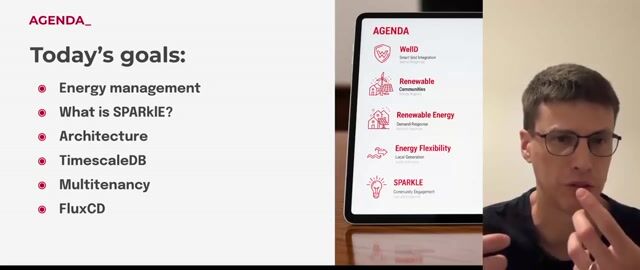
Flex your Energy: Building a Cloud-Native Platform for Renewable Energy Communities

Instead of expensive grid upgrades, communities can share renewable energy. We built the cloud-native platform on Kubernetes and PostgreSQL to make it happen.

Flex your Energy: Building a Cloud-Native Platform for Renewable Energy Communities
#1about 3 minutes

Understanding the challenge of peak energy demand on the grid

Growing energy consumption creates costly demand peaks that can be managed by shifting usage rather than only upgrading infrastructure.

#2about 4 minutes

Sharing energy through renewable energy communities (RECs)

Renewable energy communities (RECs) enable members to virtually share locally generated energy, maximizing self-consumption and earning incentives.

#3about 6 minutes

Introducing the Sparkle platform for energy communities

The Sparkle platform helps renewable energy communities optimize incentives and participate in the energy flexibility market through advanced algorithms.

#4about 5 minutes

Simulating energy flexibility in the Sparkle platform demo

A live demo shows how to simulate flexibility requests, using batteries and solar panel output to meet grid demands and earn incentives.

#5about 3 minutes

Building a cloud-native microservice architecture for energy data

The platform uses a Kubernetes-based microservice architecture with Java and Python services to ingest heterogeneous device data via an MQTT broker.

#6about 3 minutes

Using TimescaleDB for efficient time-series data management

TimescaleDB is used as a PostgreSQL extension to handle high-volume, time-based energy data, enabling efficient writes and queries.

#7about 3 minutes

Implementing secure multi-tenancy with row-level security

Multi-tenancy is enforced at the database layer using PostgreSQL's row-level security policies, isolating data for each energy community.

#8about 4 minutes

Automating Kubernetes deployments with GitOps and Flux CD

A GitOps workflow with Flux CD automates application deployment by reconciling the Kubernetes cluster state with configurations in a Git repository.

#9about 2 minutes

Reviewing the project roadmap and future platform features

The project timeline covers the pilot phase, the first real-world implementation, and the planned product launch with enhanced monitoring features.

Related jobs
Jobs that call for the skills explored in this talk.

Featured Partners

Related Articles

View all articles

From learning to earning

Jobs that call for the skills explored in this talk.