
World Congress 2026 Europe - Virtual Stage Jul 2, 2026 Session details

Optimizing Land-Based Fish Feeding with Node-RED

Øivind Heggland

Triggering industrial hardware is easy, but engineering when not to act is the real challenge. Discover how an edge-first Node-RED architecture brings resilient, self-healing orchestration to legacy systems.

Pause
Mute Enter Fullscreen
#1 about 1 min

Land-based fish farming standalone feeder overview

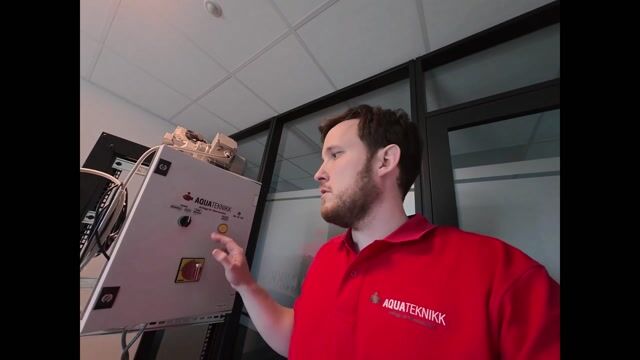
The physical feeder automates continuous feeding without user input using tables and temperature parameters.

#2 about 2 min

Hardware components of the automated fish feeder

The system integrates a Yaskawa frequency driver, UPS card, and a Raspberry Pi to manage motor speed and power fluctuations.

#3 about 2 min

Raspberry Pi and Modbus for feeder control

A Raspberry Pi calculates feed rates and controls the Yaskawa driver over Modbus using a dedicated USB Ethernet connection.

#4 about 3 min

Replacing the legacy PLC with Node-RED

A legacy proprietary PLC was replaced with remote I/O modules and logic ported into Node-RED to regain control over the system.

#5 about 3 min

Scaling hardware to overcome resource constraints

Upgrading from underpowered Raspberry Pis to Lenovo mini PCs and IOThings 4510 modules provided the necessary resources for complex logistics.

#6 about 3 min

Physical logistics of transporting fish feed pellets

Feed is moved from silos to weighing stations and transported via chain conveyors out to individual tank hoppers.

#7 about 3 min

Separating responsibilities between feeder and master roles

The system splits duties between calculating individual feed rates at the tank and managing bulk feed transport logistics centrally.

#8 about 2 min

Network topology for distributed fish feeding nodes

A layered network using managed switches and RSTP provides resilient connectivity across multiple physical feed rings.

#9 about 3 min

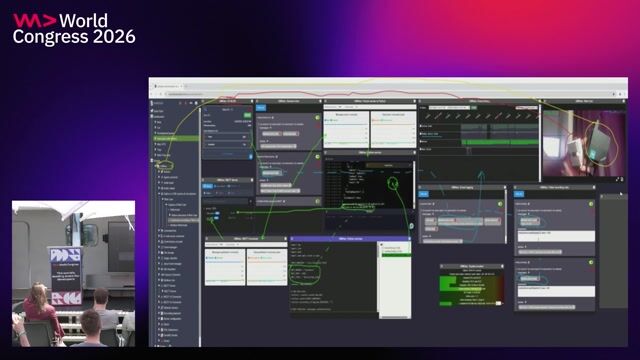
Using Node-RED flows and debug nodes

Core feeding logic is packed into a JSON flow where debug nodes simplify monitoring payload messages in real time.

#10 about 3 min

Automating hardware recovery after SD card failures

A dedicated provisioning flow automatically retrieves configuration from the master when operators swap corrupted SD cards.

#11 about 2 min

Interval logic and abstracting GPIO via MQTT

Containerized Node-RED communicates with GPIO pins through an MQTT service to maintain compatibility across different Raspberry Pi versions.

#12 about 5 min

Managing logistics queues with Node-RED subflows

The core Aquamaster relies on numerous flows and an internal MQTT broker to route commands between the UI and automated weights.

#13 about 3 min

Developing with containers and a hardware simulator

Developing inside Node-RED containers alongside a .NET simulator ensures seamless integration testing before deploying updates via Azure DevOps.

#14 about 3 min

Evaluating Node-RED for industrial production environments

While providing visual programming and instant deployments, scaling Node-RED across large teams may require enterprise wrappers like Flowfuse.

#15 about 3 min

Overcoming challenges with fleet updates and testing

As facilities scale up, manual SD card swaps are being replaced by automated fleet updates and container-based remote deployments.

#16 about 4 min

Key lessons for building edge control systems

Putting control logic at the edge and standardizing hardware deployments ensures systems can gracefully fall back to manual operation during failures.

Matching moments

3:47 min

Transitioning from rigid hardware devices to flexible edge containers

Thomas Weinschenk Thomas Weinschenk · WWC Europe 2026

1:47 min

Building a homegrown industrial IoT nervous system

Lukas Alber Lukas Alber · Europe 2026 Virtual

1:44 min

Navigating hardware constraints and edge computing challenges

Thomas Tomow Thomas Tomow · WWC 2025

1:31 min

Visual orchestration for industrial sensing and home automation

Irina Terekhova Irina Terekhova · WWC Europe 2026

1:37 min

Optimizing latency and cost with free open source software

Rahima Yakoob · WWC 2023

2:40 min

Decoupling industrial functionality from physical control hardware

Thomas Weinschenk Thomas Weinschenk · WWC Europe 2026

Upcoming sessions on this topic

Open session

World Congress 2026 North America

Offloading IoT State: Solving the Memory Crisis on Legacy Hardware

Pravin Nagare

Senior Software Engineer, Roku

Pravin Nagare
Open session

World Congress 2026 North America

Boring Failover: Predictable Region Recovery Across 5,000 Microservices

Sahil Sabharwal, Garvit Kataria

Sahil Sabharwal
Garvit Kataria
Open session

World Congress 2026 North America

You Can’t Re-Run Sunlight: Designing ML Data Architectures for Physical AI

An Phan

Senior Data Infrastructure Engineer @ Hippo Harvest

An Phan
Open session

World Congress 2026 North America

From Software Agents to Physical Devices: Inside the Agentic Hardware Stack

Vivian Hu, Michael Yuan

Vivian Hu
Michael Yuan
Open session

World Congress 2026 North America

Autonomous Infrastructure: Building AI Agents for Global-Scale Capacity Efficiency

Tommy Tran, Gregoire Colin

Tommy Tran
Gregoire Colin
Open session

World Congress 2026 North America

Trust, But Verify: Continuous GPU Validation at Scale

Kyle Bell

VP of AI @ TensorWave

Kyle Bell