





CH
Chris Heilmann
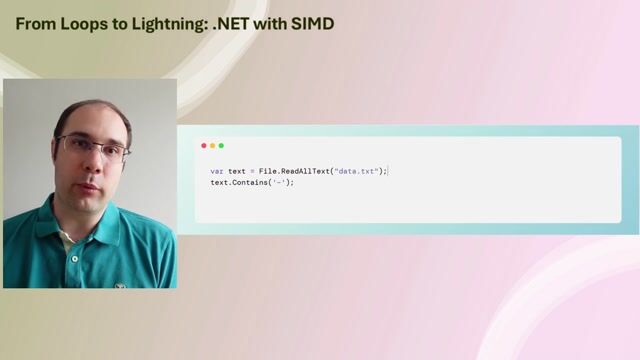
From Loops to Lightning: .NET with SIMD
- Discuss this with your agent
- Open in Claude
- Open in ChatGPT
Why settle for slow sequential loops when you can process data in parallel? Discover how to leverage SIMD vectorization in .NET to triple your execution speed.
Matching moments
3:31 min
Evaluating WebAssembly use cases and SIMD performance benchmarking
 Paweł Aniszewski · Europe 2026 Virtual
4:30 min
Implementing high-speed vector operations for independent data hashing
 Szymon Kulec · World Congress 2026 Europe
2:33 min
Introduction to speeding up code with vector operations
Jodie Burchell · LIVE
3:49 min
Leveraging WebAssembly SIMD and 64-bit memory architectures
 Chris Heilmann +3 · LIVE
3:19 min
Performance differences between for and foreach loops
Paweł Łukaszuk · LIVE
36 sec
Optimizing math calculations with the vector API
 Ron Veen · World Congress 2025
More from World Congress 2026 Europe - Virtual Stage
Related videos
Related articles

CH
Chris Heilmann

CH
Chris Heilmann

CH
Chris Heilmann

From learning to earning
Jobs that call for the skills explored in this talk.
15 days ago
Principal Software Engineer, AI Inference Runtime

ARM
Seattle, WA, United States
Expert
$262k
Compilers
Low Latency
Concurrency
about 2 months ago
System Performance Analysis Engineer
ARM
Valbonne, France
Expert
Git
Ruby
Verilog
about 2 months ago
Staff SoC Performance Architect - Next-Generation Server Platforms
ARM
San Diego, CA, United States
Expert
$198k–268k
SystemC
Profiling
InfiniBand
5 days ago
Staff SoC Performance Architect - Next-Generation Server Platforms
ARM
Austin, TX, United States
Expert
$198k–268k
SystemC
Profiling
InfiniBand
5 days ago
Principal SoC Performance Architect - Next-Generation Server Platforms
ARM
San Jose, CA, United States
Expert
$262k
SystemC
Profiling
InfiniBand
13 days ago
Staff SoC Integration and Performance Lead
ARM
Austin, TX, United States
Expert
$198k–268k
Git
Verilog
Firmware