

World Congress 2026 Europe - Virtual Stage • Jul 2, 2026 • Session details

Exploring the Power of gRPC-Gateway for Writing RESTful Services

Rajiv Ranjan Singh

Maintaining parallel gRPC and REST APIs guarantees duplicated effort and code drift. Learn how gRPC-Gateway auto-generates a synchronized reverse proxy from a single Protocol Buffer definition.

Pause
Mute Enter Fullscreen
#1 about 4 min

Solving the duplicate API implementation problem with gRPC-Gateway

Generating a single protocol buffer definition eliminates the need to maintain separate gRPC and REST APIs.

#2 about 3 min

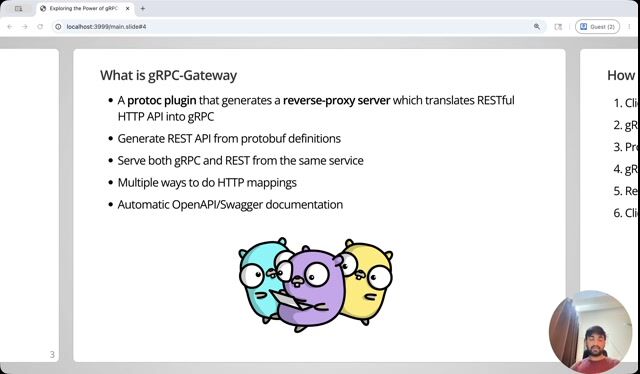
Generating a reverse proxy server from proto definitions

The gRPC-Gateway plugin reads service definitions to create a proxy that translates HTTP JSON requests into gRPC calls.

#3 about 1 min

Request flow architecture in the gRPC-Gateway proxy

The reverse proxy intercepts incoming REST API requests and translates them into corresponding gRPC service calls.

#4 about 3 min

Using inline annotations for HTTP route mapping

Adding HTTP annotations directly inside RPC method definitions maps specific endpoints to protocol buffer messages.

#5 about 2 min

Managing HTTP mappings with external YAML configuration

Defining routing rules in an external YAML file keeps the original proto files pure and unmodified.

#6 about 1 min

Auto-generating REST endpoints without manual annotations

The compiler can automatically generate default HTTP endpoints based on service and method naming conventions.

#7 about 2 min

Exposing gRPC methods through multiple HTTP bindings

Additional bindings allow a single gRPC method to respond to multiple REST endpoints for API versioning.

#8 about 3 min

Defining a proto service with inline HTTP annotations

Importing Google API annotations enables the routing of standard HTTP requests directly to gRPC methods.

#9 about 3 min

Configuring the Buf tool for code generation

The Buf configuration manages remote plugins and dependencies to compile protocol buffers and gateway code.

#10 about 2 min

Implementing a modular gRPC server in Go

Embedding an unimplemented server interface ensures future protocol additions will not break existing Go code.

#11 about 2 min

Starting the gRPC-Gateway REST reverse proxy server

Registering the generated service handler forwards incoming HTTP connections to the underlying gRPC server.

#12 about 2 min

Testing concurrent gRPC and REST API endpoints

Sending identical payloads via grpcurl and standard curl demonstrates the unified execution of business logic.

#13 about 2 min

Extracting path parameters using custom HTTP mapping

Custom configurations extract variables directly from the URL path to follow standard REST best practices.

#14 about 2 min

Streaming real-time JSON updates to REST clients

Server-side streaming RPCs automatically flush continuous JSON lines to accommodate HTTP 1.1 protocol limitations.

#15 about 2 min

Translating gRPC error codes to HTTP statuses

The gateway automatically converts internal gRPC status codes into the appropriate HTTP status representation.

#16 about 3 min

Summarizing the architectural benefits of gRPC-Gateway development

Adopting a single source of truth for APIs prevents drift and simplifies documentation generation.

Matching moments

2:31 min

Implementing native gRPC and synchronizing with REST APIs

Sakshi Nasha Sakshi Nasha · Europe 2026 Virtual

1:28 min

Understanding the architectural drivers of gRPC performance gains

Sakshi Nasha Sakshi Nasha · Europe 2026 Virtual

1:13 min

Choosing between gRPC and REST for specific use cases

Sakshi Nasha Sakshi Nasha · Europe 2026 Virtual

1:10 min

Motivation for using gRPC APIs over RESTful JSON

Bastian Eicher · World Congress 2023

1:11 min

Evaluating architectural trade-offs between REST and gRPC

Sakshi Nasha Sakshi Nasha · Europe 2026 Virtual

2:41 min

High performance communication protocols using gRPC

Simon Auer Simon Auer · World Congress 2025