

World Congress 2026 Europe - Virtual Stage Jul 2, 2026 Session details

Exploring the Power of gRPC-Gateway for Writing RESTful Services

Rajiv Ranjan Singh

Maintaining parallel gRPC and REST APIs guarantees duplicated effort and code drift. Learn how gRPC-Gateway auto-generates a synchronized reverse proxy from a single Protocol Buffer definition.

Pause
Mute Enter Fullscreen
#1 about 4 min

Solving the duplicate API implementation problem with gRPC-Gateway

Generating a single protocol buffer definition eliminates the need to maintain separate gRPC and REST APIs.

#2 about 3 min

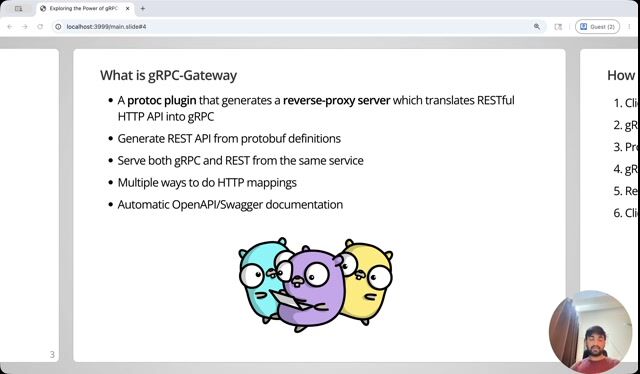
Generating a reverse proxy server from proto definitions

The gRPC-Gateway plugin reads service definitions to create a proxy that translates HTTP JSON requests into gRPC calls.

#3 about 1 min

Request flow architecture in the gRPC-Gateway proxy

The reverse proxy intercepts incoming REST API requests and translates them into corresponding gRPC service calls.

#4 about 3 min

Using inline annotations for HTTP route mapping

Adding HTTP annotations directly inside RPC method definitions maps specific endpoints to protocol buffer messages.

#5 about 2 min

Managing HTTP mappings with external YAML configuration

Defining routing rules in an external YAML file keeps the original proto files pure and unmodified.

#6 about 1 min

Auto-generating REST endpoints without manual annotations

The compiler can automatically generate default HTTP endpoints based on service and method naming conventions.

#7 about 2 min

Exposing gRPC methods through multiple HTTP bindings

Additional bindings allow a single gRPC method to respond to multiple REST endpoints for API versioning.

#8 about 3 min

Defining a proto service with inline HTTP annotations

Importing Google API annotations enables the routing of standard HTTP requests directly to gRPC methods.

#9 about 3 min

Configuring the Buf tool for code generation

The Buf configuration manages remote plugins and dependencies to compile protocol buffers and gateway code.

#10 about 2 min

Implementing a modular gRPC server in Go

Embedding an unimplemented server interface ensures future protocol additions will not break existing Go code.

#11 about 2 min

Starting the gRPC-Gateway REST reverse proxy server

Registering the generated service handler forwards incoming HTTP connections to the underlying gRPC server.

#12 about 2 min

Testing concurrent gRPC and REST API endpoints

Sending identical payloads via grpcurl and standard curl demonstrates the unified execution of business logic.

#13 about 2 min

Extracting path parameters using custom HTTP mapping

Custom configurations extract variables directly from the URL path to follow standard REST best practices.

#14 about 2 min

Streaming real-time JSON updates to REST clients

Server-side streaming RPCs automatically flush continuous JSON lines to accommodate HTTP 1.1 protocol limitations.

#15 about 2 min

Translating gRPC error codes to HTTP statuses

The gateway automatically converts internal gRPC status codes into the appropriate HTTP status representation.

#16 about 3 min

Summarizing the architectural benefits of gRPC-Gateway development

Adopting a single source of truth for APIs prevents drift and simplifies documentation generation.

Matching moments

2:31 min

Implementing native gRPC and synchronizing with REST APIs

Sakshi Nasha Sakshi Nasha · Europe 2026 Virtual

1:28 min

Understanding the architectural drivers of gRPC performance gains

Sakshi Nasha Sakshi Nasha · Europe 2026 Virtual

1:13 min

Choosing between gRPC and REST for specific use cases

Sakshi Nasha Sakshi Nasha · Europe 2026 Virtual

1:10 min

Motivation for using gRPC APIs over RESTful JSON

Bastian Eicher · WWC 2023

1:11 min

Evaluating architectural trade-offs between REST and gRPC

Sakshi Nasha Sakshi Nasha · Europe 2026 Virtual

2:41 min

High performance communication protocols using gRPC

Simon Auer Simon Auer · WWC 2025

Upcoming sessions on this topic

Open session

World Congress 2026 North America

API = Some REST and HTTP, right? RIGHT?!

Rustam Mehmandarov

Passionate computer scientist

Rustam Mehmandarov
Open session

World Congress 2026 North America

One Repo, One Strategy: Scalable Full-Stack Testing in a Monorepo World

Bartosz Leczycki, Paweł Matynia

Bartosz Leczycki
Paweł Matynia
Open session

World Congress 2026 North America

MicroAgents: The Microservices of the Agentic Era

Ashish Shubham

Runs the show bussiness at ThoughtSpot

Ashish Shubham
Open session

World Congress 2026 North America

Boring Failover: Predictable Region Recovery Across 5,000 Microservices

Garvit Kataria, Sahil Sabharwal

Garvit Kataria
Sahil Sabharwal
Open session

World Congress 2026 North America

Designing APIs That Survive AI Agents at Scale

Phani Pendurthi

Mastercard, Principal Software Engineer

Phani Pendurthi
Open session

World Congress 2026 North America

From Guesswork to Governance: Data Contracts Bring API Discipline to Apache Kafka

Sandon Jacobs

Senior Developer Advocate at IBM

Sandon Jacobs