
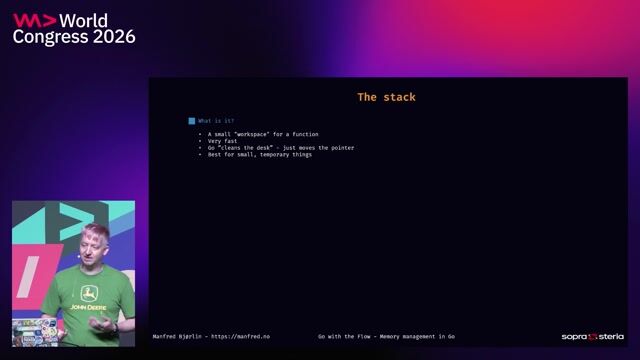
World Congress 2026 Europe - Virtual Stage Jul 2, 2026 Session details

Scoring 2000 Products per Request: Performance Pitfalls in Golang

Ivan Sinitsin

Pushing Golang to 50K RPS requires abandoning idiomatic code for data-oriented design. Discover how flattening structures into contiguous arrays eliminated 600 million allocations per second.

Pause
Mute Enter Fullscreen
#1 about 3 min

Identifying Go runtime overhead in high-throughput systems

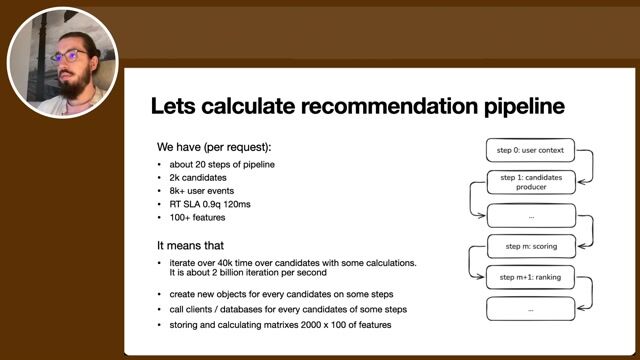
Analyzing why a system with optimal metrics breaches latency SLAs due to inefficient runtime and hardware interactions.

#2 about 3 min

Architectural mismatch of enterprise design under high load

Abstract enterprise structures that work well at low scale cause massive garbage collection overhead during extreme load.

#3 about 5 min

Optimizing memory layout by replacing pointers with primitives

Replacing complex nested structures with flat primitive types eliminates transient objects and reduces pointer chasing overhead.

#4 about 4 min

Transitioning from object models to offset-based memory matrices

Flattening polymorphic structures into strict arrays of primitives provides the CPU with perfectly linear contiguous memory chunks.

#5 about 7 min

Leveraging hardware prefetchers and cache lines for speed

Shifting from random heap access to sequential data reading allows the hardware prefetcher to eliminate costly memory stalls.

#6 about 8 min

Eliminating reflection overhead with static Protobuf serialization

Generating statically typed serialization paths with vtprotobuf bypasses reflection and enables safe memory reuse via automated pools.

#7 about 6 min

Bypassing the Go runtime with custom bump allocators

Implementing an arena allocator to grab monolithic memory chunks allows instantaneous struct allocation via pointer arithmetic without runtime locks.

#8 about 4 min

Avoiding atomic operations via zero synchronization architectures

Removing atomic counters prevents cache invalidation and hardware bus locks by adopting a share-nothing execution model.

Matching moments

48 sec

Key takeaways on Go container performance optimization

Rick Rackow Rick Rackow · World Congress 2026 Europe

1:40 min

Introduction to the speaker and software development philosophy

Aliaksandr Valialkin Aliaksandr Valialkin · World Congress 2026 Europe

4:24 min

Leveraging the Go programming language for scalable infrastructure

Natalie Pistunovich · LIVE

2:10 min

Evaluating design trade-offs in the Go-based server

Erik Koci Erik Koci · Europe 2026 Virtual

4:47 min

Final performance results and key architectural takeaways

Yedidya Schwartz · LIVE

1:28 min

Understanding the architectural drivers of gRPC performance gains

Sakshi Nasha Sakshi Nasha · Europe 2026 Virtual

Upcoming sessions on this topic

Open session

World Congress 2026 North America

September 25, 2026 · 15:30–15:40

Outdoor Stage

Offloading IoT State: Solving the Memory Crisis on Legacy Hardware

Pravin Nagare

Senior Software Engineer, Roku

Pravin Nagare
Open session

World Congress 2026 North America

September 25, 2026 · 16:50–17:20

Stage 4

Engineering Moneyball: How We Benchmarked Google vs Meta

Jirka Bachel

Co-Founder & CEO

Jirka Bachel
Open session

World Congress 2026 North America

September 24, 2026 · 14:50–15:20

Stage 9

How to generate business value through performance optimizations

Nikolai Sidiropulo

Software Engineer at Meta

Nikolai Sidiropulo
Open session

World Congress 2026 North America

September 24, 2026 · 14:10–14:40

Stage 1

Anatomy of an AI Request: Where Latency and Cost Are Really Born

Dan Fu

VP of Kernels at Together AI

Dan Fu
Open session

World Congress 2026 North America

September 24, 2026 · 15:30–16:00

Stage 1

KV Cache Is Not About Speed: It's About Surviving Inference Costs

David vonThenen

AI/ML Leader | Keynote Speaker | OSS Engineer & Developer Advocate | Agentic AI, Deep Learning, Production AI | Python, Go, C++

David vonThenen
Open session

World Congress 2026 North America

September 25, 2026 · 16:00–16:10

Outdoor Stage

public void saveMoney(AI): The Developer's Guide to Unit Economics

Hrushikesh Pokala

Senior Software Engineer Lead at Equifax

Hrushikesh Pokala