


World Congress 2026 Europe - Virtual Stage Jul 2, 2026 Session details

Scoring 2000 Products per Request: Performance Pitfalls in Golang

Ivan Sinitsin

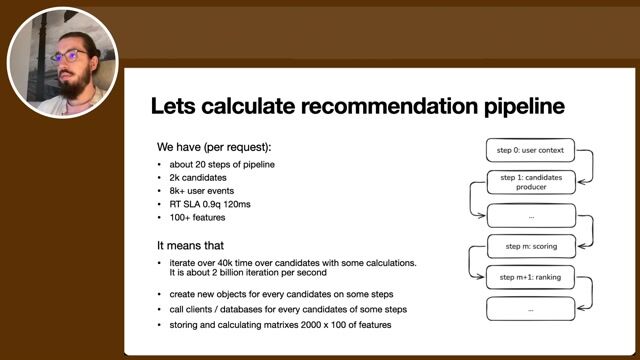
Pushing Golang to 50K RPS requires abandoning idiomatic code for data-oriented design. Discover how flattening structures into contiguous arrays eliminated 600 million allocations per second.

Pause
Mute Enter Fullscreen
#1 about 3 min

Identifying Go runtime overhead in high-throughput systems

Analyzing why a system with optimal metrics breaches latency SLAs due to inefficient runtime and hardware interactions.

#2 about 3 min

Architectural mismatch of enterprise design under high load

Abstract enterprise structures that work well at low scale cause massive garbage collection overhead during extreme load.

#3 about 5 min

Optimizing memory layout by replacing pointers with primitives

Replacing complex nested structures with flat primitive types eliminates transient objects and reduces pointer chasing overhead.

#4 about 4 min

Transitioning from object models to offset-based memory matrices

Flattening polymorphic structures into strict arrays of primitives provides the CPU with perfectly linear contiguous memory chunks.

#5 about 7 min

Leveraging hardware prefetchers and cache lines for speed

Shifting from random heap access to sequential data reading allows the hardware prefetcher to eliminate costly memory stalls.

#6 about 8 min

Eliminating reflection overhead with static Protobuf serialization

Generating statically typed serialization paths with vtprotobuf bypasses reflection and enables safe memory reuse via automated pools.

#7 about 6 min

Bypassing the Go runtime with custom bump allocators

Implementing an arena allocator to grab monolithic memory chunks allows instantaneous struct allocation via pointer arithmetic without runtime locks.

#8 about 4 min

Avoiding atomic operations via zero synchronization architectures

Removing atomic counters prevents cache invalidation and hardware bus locks by adopting a share-nothing execution model.

Matching moments

48 sec

Key takeaways on Go container performance optimization

Rick Rackow Rick Rackow · World Congress 2026 Europe

1:40 min

Introduction to the speaker and software development philosophy

Aliaksandr Valialkin Aliaksandr Valialkin · World Congress 2026 Europe

4:24 min

Leveraging the Go programming language for scalable infrastructure

Natalie Pistunovich · LIVE

2:10 min

Evaluating design trade-offs in the Go-based server

Erik Koci Erik Koci · Europe 2026 Virtual

4:47 min

Final performance results and key architectural takeaways

Yedidya Schwartz · LIVE

1:28 min

Understanding the architectural drivers of gRPC performance gains

Sakshi Nasha Sakshi Nasha · Europe 2026 Virtual

Upcoming sessions on this topic

Open session

World Congress 2026 North America

Offloading IoT State: Solving the Memory Crisis on Legacy Hardware

Pravin Nagare

Senior Software Engineer, Roku

Pravin Nagare
Open session

World Congress 2026 North America

How to generate business value through performance optimizations

Nikolai Sidiropulo

Software Engineer at Meta

Nikolai Sidiropulo
Open session

World Congress 2026 North America

KV Cache Is Not About Speed: It's About Surviving Inference Costs

David vonThenen

AI/ML Leader | Keynote Speaker | OSS Engineer & Developer Advocate | Agentic AI, Deep Learning, Production AI | Python, Go, C++

David vonThenen
Open session

World Congress 2026 North America

public void saveMoney(AI): The Developer's Guide to Unit Economics

Hrushikesh Pokala

Senior Software Engineer Lead at Equifax

Hrushikesh Pokala
Open session

World Congress 2026 North America

Honey, look! I vibe-coded an OS!

Ian Smith

CTO, LYOS

Ian Smith
Open session

World Congress 2026 North America

When Humans Stop Writing Code: Rethinking Languages, Compilers, and Responsibility

Simon Auer

Organizer of flutter vienna meetup and CEO of marqably

Simon Auer