Using non-functional testing to guide user interface, backend services, voice interface, and media development
How do you prevent your app from getting slower with every new feature? Use non-functional testing to build a data-driven safety net against performance regressions.
#1about 3 minutes
Understanding non-functional vs functional testing
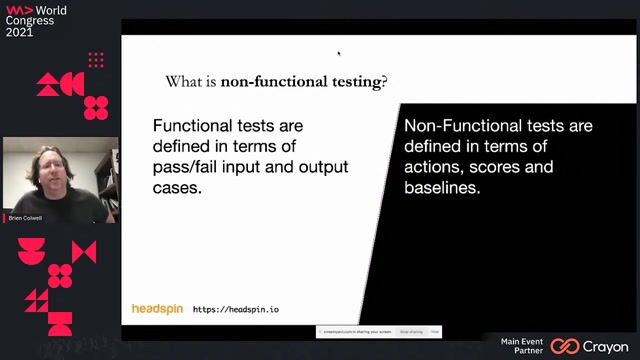
Non-functional testing measures performance, quality, and usability against baselines, moving beyond simple pass/fail criteria to create a five-star user experience.
#2about 7 minutes
Building a data-driven regression safety net
Establish a framework to catch non-functional regressions by collecting data, identifying hotspots, measuring against baselines, and fixing performance drops.
#3about 7 minutes
Methods for collecting raw performance data
Collect raw data for analysis by either instrumenting the application with code bookends or by instrumenting the test environment to capture video, network, and system stats.
#4about 9 minutes
Analyzing raw data to create useful metrics
Transform raw data from instrumented environments into actionable metrics like page load time by defining a region of interest and applying visual analytics.
#5about 3 minutes
Structuring a cross-functional testing team
Integrate non-functional testing into project teams by combining the skills of product engineering, data analysis, and testing to drive improvements.
#6about 4 minutes
Applying non-functional testing to gaming performance
Use non-functional testing in game development to set and track baselines for CPU usage and frames per second (FPS) across different devices.
#7about 3 minutes
Testing the responsiveness of voice interfaces
Measure and improve the time-to-respond for voice inputs by setting a baseline, such as 500 milliseconds, and testing across various locales and devices.
#8about 4 minutes
Ensuring quality in streaming media applications
Monitor streaming media performance by tracking loading animations, buffering events, resolution switches, and perceptual quality factors like blockiness and blurriness.
#9about 9 minutes
Q&A on tools, frameworks, and implementation
Discussion covers recommended tools like Appium, integrating tests into CI/CD pipelines, and the benefits of instrumenting the test environment over the application.
Related jobs
Jobs that call for the skills explored in this talk.
Benefits of Using JMeter For Performance TestingEver since we got exposure to the web and the Internet, things have never been the same. Be it business operations or the way we approach any services, even if it is purchasing groceries or booking a flight. Thanks to the introduction of advanced sof...
Christina Schaireiter
Why Attend a Developer Event?Modern software engineering moves too fast for documentation alone. Attending a world-class event is about shifting from tactical execution to strategic leadership.
Skill Diversification: Break out of your specific tech stack to see how the industry...
5 Reasons Why Attending Conferences in 2026 Matters More Than You ThinkIt’s 2026, and the “remote vs. office” debate has finally settled into a high-tech hybrid reality. While we’ve perfected the art of shipping production-grade code from decentralized hubs and home setups, something shifted. We realized that while AI c...
From learning to earning
Jobs that call for the skills explored in this talk.