
JavaScript Congress Nov 23, 2021

Micro-frontends anti-patterns

Luca Mezzalira

Are your micro-frontends actually a distributed monolith? Uncover the architectural anti-patterns that bloat technical debt, and learn how to enforce team autonomy without triggering dependency hell.

Pause
Mute Enter Fullscreen
#1 about 4 min

History and evolution of micro-frontends

The shift from early experiments at companies like Zalando to widespread industry adoption.

#2 about 4 min

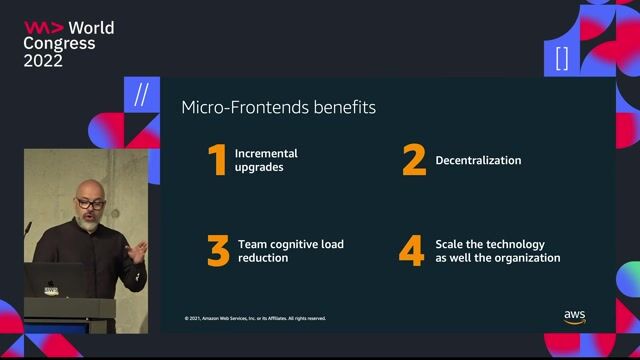
Primary benefits of micro-frontend architectures

How independent deployments and decentralized decision-making accelerate delivery and empower engineering teams.

#3 about 5 min

Distinguishing between micro-frontends and ui components

Micro-frontends encapsulate entire business subdomains independently whereas components rely entirely on contextual property injection.

#4 about 3 min

Avoiding the multi-framework micro-frontend approach

Mixing UI frameworks inside a single page application should remain a temporary workaround for legacy migrations or acquisitions.

#5 about 4 min

Isolating legacy code with anti-corruption layers

Using sandboxing boundaries like iframes prevents dependency clashes when adopting modern micro-frontend orchestrators.

#6 about 5 min

Managing shared dependencies across isolated teams

Relying on extensive core libraries creates tight governance bottlenecks and cascades breaking changes across loosely coupled features.

#7 about 4 min

Implementing unidirectional data flows across boundaries

Bidirectional data sharing between application parts complicates debugging and encourages brittle integrations between modules.

#8 about 4 min

Preventing organizational coupling via global state

Sharing global state across disparate modules forces continuous cross-team synchronization during development and test automation pipelines.

#9 about 5 min

Optimizing backend calls to prevent self-ddos

Multiple independent frontends calling identical APIs forces redundant authorization checks and unnecessary backend scaling pressure.

#10 about 14 min

Answering questions on micro-frontend adoption and tooling

Strategies for monolithic code extraction, evaluating module federation versus SystemJS, and valid iframe use cases.

Matching moments

4:51 min

Differentiating domain-aware micro-frontends from UI components

Luca Mezzalira Luca Mezzalira · WWC 2022

3:55 min

Introduction to micro frontends and architectural consequences

Manfred Steyer Manfred Steyer · WWC 2021

1:26 min

Introduction to micro frontends and platform architecture

Florian Rappl · LIVE

1:31 min

Recapping frontend scaling patterns and distributed UI techniques

Josh Goldberg · WWC 2021

2:13 min

Transitioning monolithic page structures to distributed front-end architectures

Luca Mezzalira Luca Mezzalira · WWC 2024

4:28 min

Understanding the engineering benefits of micro-frontend architectures

Luca Mezzalira Luca Mezzalira · WWC 2022

Upcoming sessions on this topic

Open session

World Congress 2026 North America

MicroAgents: The Microservices of the Agentic Era

Ashish Shubham

Runs the show bussiness at ThoughtSpot

Ashish Shubham
Open session

World Congress 2026 North America

Designing APIs That Survive AI Agents at Scale

Phani Pendurthi

Mastercard, Principal Software Engineer

Phani Pendurthi
Open session

World Congress 2026 North America

It’s Alive! Taming the MLOps Franken-Stack: Write, Run, and Serve with Michelangelo

Eric Wang, Paul Zimmerman

Eric Wang
Paul Zimmerman
Open session

World Congress 2026 North America

One Repo, One Strategy: Scalable Full-Stack Testing in a Monorepo World

Bartosz Leczycki, Paweł Matynia

Bartosz Leczycki
Paweł Matynia
Open session

World Congress 2026 North America

Offloading IoT State: Solving the Memory Crisis on Legacy Hardware

Pravin Nagare

Senior Software Engineer, Roku

Pravin Nagare
Open session

World Congress 2026 North America

Architecting AI in Angular: WebMCP, A2UI, and the Agent Experience

Ankita Sood

Sr. Principal Engineer @ Secureworks | Angular GDE

Ankita Sood