JavaScript Congress Nov 24, 2021

Differential Loading

Sani Yusuf

Why penalize modern browsers with bloated legacy polyfills? Learn how Angular’s differential loading automatically serves optimized evergreen bundles while keeping older environments completely supported.

Pause
Mute Enter Fullscreen
#1 about 2 min

Understanding differential loading in modern web development

How modern web development balances browser support dynamically to improve client network speeds.

#2 about 4 min

Why developers choose to adopt the Angular framework

Adopting a mature and typed JavaScript architecture standardizes logic for scaling enterprise teams.

#3 about 5 min

Utilizing advanced configuration and component inheritance in Angular

Leveraging specific environment definitions and object inheritance pipelines eliminates redundant HTTP logic constraints.

#4 about 3 min

Optimizing single page applications with dedicated lazy loading

Segmenting template partials via native routing functions reduces upfront rendering bottlenecks for users.

#5 about 5 min

Addressing the high network cost of underlying browser polyfills

Supporting deprecated internet environments exponentially inflates generic code footprints and impairs execution latency.

#6 about 4 min

Implementing differential loading with modern HTML module tags

Differentiating modern syntax from fallback logic enables evergreen browser pipelines to consume only necessary resources.

#7 about 3 min

Managing dynamic state with integrated reactive Angular forms

Replacing procedural input checks with robust observable data streams streamlines localized error detection functionality.

#8 about 3 min

Applying differential loading principles in legacy healthcare applications

Providing dual runtime configurations facilitates faster user access without abandoning critical legacy environments.

#9 about 5 min

Evaluating the long-term trajectory of the Angular framework

Relying on structural predictability secures extended viability for heavily regulated corporate engineering resources.

#10 about 3 min

Testing client logic across disparate differential web bundles

Verifying fallback artifacts individually contradicts deterministic isolation principles and produces redundant end-to-end evaluation burdens.

#11 about 4 min

Directing browser dependencies without explicit user agent evaluation

Decoupling core build strategies from unreliable agent analytics delegates proper code parsing directly to the client runtime.

#12 about 4 min

Managing future standards via declarative HTML feature checking

Bypassing prolonged emulation libraries will eventually depend on natively integrating feature attributes to validate isolated browser support.

Matching moments

5:27 min

Optimizing bundle sizes with differential loading strategies

Sani Yusuf · World Congress 2021

3:16 min

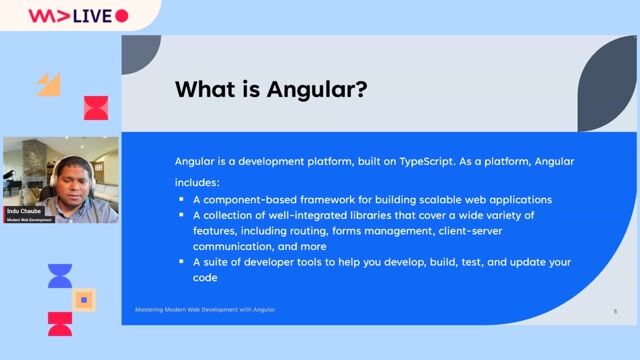
Compiling Angular applications dynamically and statically

Indu Chaube · LIVE

2:06 min

Addressing browser support for legacy capabilities and modern frameworks

Peter Kröner Peter Kröner · World Congress 2023

3:52 min

Optimizing browser performance using modern island architecture

Florian Rappl · LIVE

8:34 min

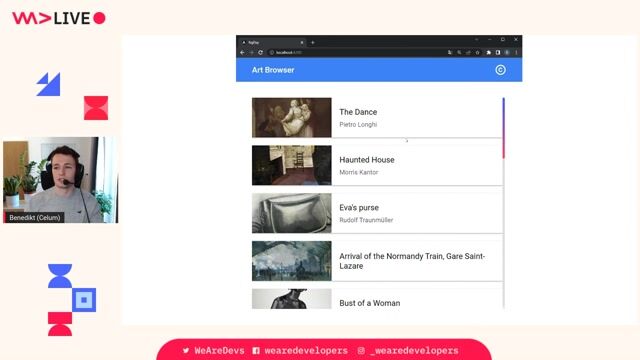
Exploring Angular component patterns and upcoming framework updates

Benedikt Starzengruber · LIVE

3:46 min

The rise of modern component-based frameworks and modular architecture

Sasha Shynkevich · LIVE

Upcoming sessions on this topic

Open session

World Congress 2026 North America

September 24, 2026 · 12:50–13:20

Stage 7

Architecting Agentic Apps: WebMCP, A2UI, and Agent Experience

Ankita Sood

Sr. Principal Engineer @ Secureworks | Angular GDE

Ankita Sood
Open session

World Congress 2026 North America

September 24, 2026 · 14:50–15:20

Stage 9

How to generate business value through performance optimizations

Nikolai Sidiropulo

Software Engineer at Meta

Nikolai Sidiropulo
Open session

World Congress 2026 North America

September 25, 2026 · 15:30–16:00

Stage 6

Small LLM in your Browser: Huge Opportunities for Web Applications

Daniel Ostrovsky

UI/UX Architect at Payoneer | AI Architect | Full Cycle Development Expert | Public Speaker | Open Source Contributor |

Daniel Ostrovsky
Open session

World Congress 2026 North America

September 25, 2026 · 09:40–10:10

Stage 3

Still on 4.8 or lower? A Practical Guide to Moving Your "Un-Migratable" .NET Apps

Isaac Levin

Developer Advocate

Isaac Levin
Open session

World Congress 2026 North America

September 24, 2026 · 10:20–10:50

Stage 3

Reading the Mind of Your NGINX Fleet: A Hybrid Rule + ML Pipeline for NGINX Config Intelligence

Brandon LEE

AI Architect Lead at F5

Brandon LEE
Open session

World Congress 2026 North America

September 24, 2026 · 10:20–10:50

Stage 1

The Browser Is Becoming an AI Runtime

Ajit Varma, Will Bryk

Ajit Varma
Will Bryk