


BB
Benedikt Bischof
WeAreDevelopers LIVE
•
Feb 1, 2022
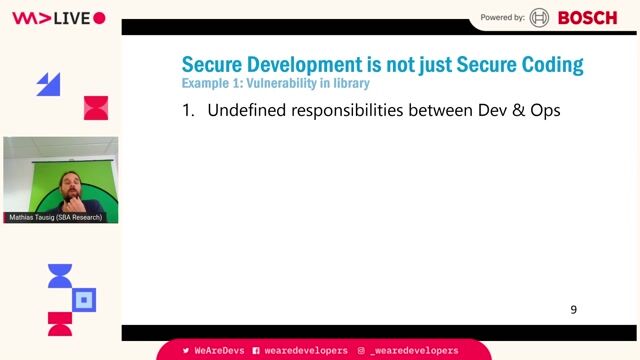
Maturity assessment for technicians or how I learned to love OWASP SAMM
Mathias Tausig
- Discuss this with your agent
- Open in Claude
- Open in ChatGPT
Are you still waiting for late-stage penetration tests to catch critical vulnerabilities? Discover how OWASP SAMM empowers developers to shift security left directly into the IDE.
Matching moments
13:13 min
Answering audience questions on practical application security
Thomas Konrad · World Congress 2021
1:53 min
Transitioning toward DevSecOps with dynamic scanning and secrets management
Christoph Ruggenthaler · LIVE
5:25 min
Shifting left and creating internal security champion programs
Vandana Verma Sehgal · LIVE
5:30 min
Identifying non-coding software vulnerabilities and organizational risks
Tino Sokic · World Congress 2023
26:47 min
Exploring pathways to application security careers and research workflows
Vandana Verma Sehgal · LIVE
2:33 min
Introduction to security advocacy and automation testing
 Chris Heilmann +2 · LIVE
More from WeAreDevelopers LIVE
Related videos
Related articles
.gif)
DC
Daniel Cranney

DC
Daniel Cranney

AB
Andre Braun, GitLab

From learning to earning
Jobs that call for the skills explored in this talk.
about 2 months ago
Staff Developer Advocate, GitHub Security Lab

GitHub
United States
Experienced
$121k–323k
Remote
Git
Github
Databases
27 days ago
•
Verified
Manager, Engineering, Secure Build and SCS Services

Docker, Inc.
Expert
Remote
Team Leadership
27 days ago
•
Verified
Senior Supply Chain Security Engineer
Docker, Inc.
Expert
Remote
Linux
Kubernetes
about 2 months ago
Staff Hardware Security Engineer

Arm
München, Germany
€131k
U-Boot
Firmware
System on a…
23 days ago
•
Verified
SoC Offensive Security Staff Engineer
Arm
Austin, United States
Experienced
$198k–268k
Remote
Network Security
27 days ago
•
Verified
Senior Principal Software Engineer, Docker and Ecosystem
Docker, Inc.
Seattle, United States
Expert
Remote
Cloud (AWS/Google/Azure)