





WeAreDevelopers LIVE Apr 18, 2023

Sustainable me. A tale of good design.

Lorenzo Pieri

The internet's carbon emissions now rival global aviation. Learn how strategic frontend optimizations, from tree shaking to efficient rendering, can drastically cut your web application's hidden energy drain.

Pause
Mute Enter Fullscreen
#1 about 4 min

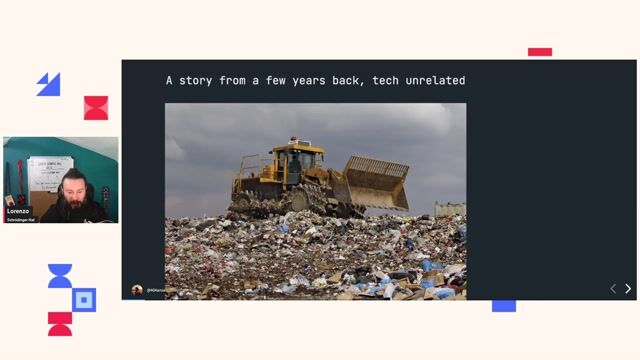
Front-end versus back-end illusions in waste recycling

How a visual facade of partitioned waste obscures actual combined trash collection systems.

#2 about 5 min

Internet traffic growth and website carbon footprint

Analyzing the massive rise in web page resource weights alongside greenhouse gas emissions.

#3 about 4 min

Comparing carbon footprints across different popular websites

Benchmarking personal text blogs against major media platforms highlights the massive variations in daily digital emissions.

#4 about 3 min

Screen technologies and the actual energy savings of dark mode

Turning on dark themes only conserves battery power for devices that physically turn off pixels.

#5 about 3 min

Measuring digital carbon footprint with developer tools

Specific tools and code libraries calculate the precise ambient footprint caused by domain hosting and script execution.

#6 about 4 min

Applying principles of good design to modern software

Adopting minimalist system configurations directly prevents unnecessary processing requests and unneeded storage variables.

#7 about 4 min

Optimizing cascading style sheets for environmental sustainability

Minifying code files and reducing complex layout repaints lower client-side battery resource strain.

#8 about 5 min

Reducing JavaScript bundle sizes for multiplied carbon savings

Tree shaking unused framework modules dramatically cuts bandwidth usage across thousands of daily user sessions.

#9 about 4 min

Optimizing digital assets through image formats and variable fonts

Modern compression formats prevent unneeded pixel generation and excessive typography from throttling network bandwidth.

#10 about 2 min

Reducing server load and latency with edge computing architectures

Serving computational logic geographically closer to end users minimizes power-heavy data transfers.

#11 about 4 min

Adopting asynchronous workflows and sustainable cloud infrastructures

Ditching urgent synchronous communication models and selecting green energy data centers continually decreases operational footprint overheads.

#12 about 7 min

Quantifying emissions of emails and video meetings

Minimizing daily virtual corporate meetings and chat traffic curbs compounding server infrastructure requirements.

#13 about 4 min

Discovering programmable logic through early video game modding

Modifying legacy software environments provides an accessible entryway into scripting concepts and logic application design.

#14 about 3 min

Evaluating artificial intelligence usage against structural climate impacts

Measuring excessive server computations tests if language models validate their large energy footprint against objective workflow productivity gains.

#15 about 3 min

Advocating for green tech policies inside modern software companies

Changing rigid hardware dependency cycles directly installs tangible climate awareness within standard corporate decision trees.

#16 about 5 min

Shifting future model inference to local mobile devices

Offloading heavy language processing requests away from centralized data hubs maximizes targeted mobile energy limitations.

#17 about 4 min

Practical adjustments for greener technology consumption

Swapping out overpowered hardware components limits ongoing passive ecological burdens across typical engineering workflows.

#18 about 6 min

Advancing sustainable tech careers through open source communities

Participating in active developer networks constructs public collaboration structures that circumvent unnecessary duplicate engineering overheads.

#19 about 3 min

Finding enduring inspiration in early 3D game engines

Appreciating restrictive legacy rendering capabilities reminds software architects exactly why fundamental algorithmic performance matters today.

Matching moments

2:13 min

The intersection of web performance and sustainability

Ines Akrap Ines Akrap · WWC 2023

1:57 min

Connecting web performance optimization to ecological sustainability

Andreas Taranetz Andreas Taranetz · WWC 2024

4:09 min

Implementing architectural best practices for sustainable software systems

Hendrik Lösch Hendrik Lösch · WWC 2025

4:15 min

Sustainable UX and digital environmental impact

Perf + AI

1:49 min

Coding for environmental sustainability in software engineering

Ulrich Irnich Ulrich Irnich · WWC 2023

1:53 min

Leveraging community resources for sustainable web design

Ines Akrap Ines Akrap · WWC 2023

Upcoming sessions on this topic

Open session

World Congress 2026 North America

Fast by Design: A Masterclass in High-Performance Web Engineering

Aaron Grogg

Senior web developer, committed to improving the user experience by improving web performance

Aaron Grogg
Open session

World Congress 2026 North America

How to generate business value through performance optimizations

Nikolai Sidiropulo

Software Engineer at Meta

Nikolai Sidiropulo
Open session

World Congress 2026 North America

When Humans Stop Writing Code: Rethinking Languages, Compilers, and Responsibility

Simon Auer

Organizer of flutter vienna meetup and CEO of marqably

Simon Auer
Open session

World Congress 2026 North America

Offloading IoT State: Solving the Memory Crisis on Legacy Hardware

Pravin Nagare

Senior Software Engineer, Roku

Pravin Nagare
Open session

World Congress 2026 North America

Architecting AI in Angular: WebMCP, A2UI, and the Agent Experience

Ankita Sood

Sr. Principal Engineer @ Secureworks | Angular GDE

Ankita Sood
Open session

World Congress 2026 North America

public void saveMoney(AI): The Developer's Guide to Unit Economics

Hrushikesh Pokala

Senior Software Engineer Lead at Equifax

Hrushikesh Pokala