



WeAreDevelopers LIVE Nov 17, 2023

What comes after ChatGPT? Vector Databases - the Simple and powerful future of ML?

Erik Bamberg

How do you ground ChatGPT in private enterprise data without hitting strict token limits? Discover how vector databases use deep-learning embeddings to search unstructured content and eliminate AI hallucinations.

Pause
Mute Enter Fullscreen
#1 about 3 min

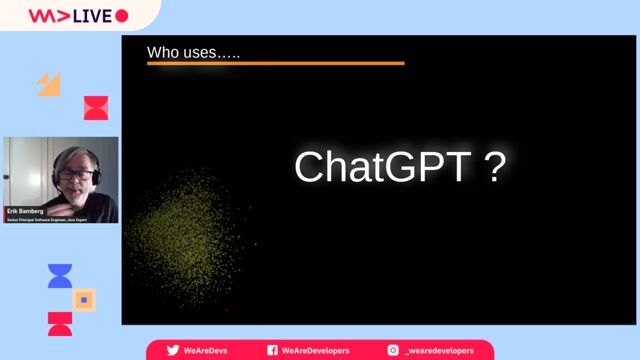
ChatGPT context limitations and the struggle with custom datasets

How maximum token sizes prevent large language models from analyzing extensive custom documents.

#2 about 4 min

Database evolution and the funding behind vector databases

Identifying the shift toward vector databases to handle unstructured data that relational and document stores cannot accommodate.

#3 about 5 min

Challenges of manual metadata tagging for unstructured content

Why categorizing audio, images, and video through human-assigned text tags fails to capture semantic meaning or context.

#4 about 7 min

Translating unstructured data into vector embeddings using ML models

How machine learning models convert text, images, and code into high-dimensional numerical arrays representing conceptual similarity.

#5 about 5 min

Visualizing semantic similarity within a multi-dimensional vector space

Examining an interactive visualization of neural network embeddings to observe how semantic relationships map directly to spatial distances.

#6 about 3 min

Mathematical search techniques for locating similar dataset embeddings

Applying mathematical formulas like cosine similarity and Euclidean distance to calculate the contextual relatedness of search vectors.

#7 about 4 min

Storing and querying multi-dimensional arrays inside vector databases

Leveraging approximate nearest neighbor algorithms to rapidly search unstructured content alongside structured metadata filters.

#8 about 5 min

Evaluating open-source and cloud-based vector database vendors

Comparing deployment options and API architectures among popular semantic data stores like Pinecone, Weaviate, Milvus, and Postgres.

#9 about 4 min

Replacing constant model retraining with database update operations

How anomaly detection and facial recognition systems avoid expensive GPU retraining cycles by updating stored vector records instead.

#10 about 7 min

Architecting a semantic long-term memory system for LLMs

Chunking enterprise information into a vector database to fetch context-specific answers and prevent language model hallucinations.

#11 about 3 min

Alternative domain use cases for vector similarity matching

Expanding application horizons into document deduplication, recommendation engines, and high-frequency time series anomaly tracking.

#12 about 7 min

Managing concurrency and scalability in multi-node vector architectures

How vector stores implement document-based replication techniques to isolate asynchronous operations and seamlessly scale queries across clusters.

#13 about 3 min

Adapting pre-trained embedding models for domain specific terminology

Fine-tuning baseline language models with specialized datasets to accurately reflect niche industry nomenclature and financial semantics.

#14 about 4 min

Substituting traditional classification models with search-based AI architecture

Why vector databases will democratize enterprise machine learning by replacing expensive manual training epochs with rapid embedding lookups.

Matching moments

3:06 min

Storing machine learning data with specialized vector databases

Mary Grygleski Mary Grygleski · LIVE

2:04 min

Storing and querying vector data with native database features

Damir Damir · World Congress 2025

1:36 min

Understanding vector databases and retrieval-augmented generation pipelines

Sandra Ahlgrimm Sandra Ahlgrimm +1 · World Congress 2024

2:29 min

Retrieving semantic context using vector databases

Kevin Klues Kevin Klues

3:37 min

Demonstrating semantic latency reductions using Spring AI configurations

8:02 min

Mitigating language model costs with vector search patterns

Chris Heilmann +3 · LIVE

Upcoming sessions on this topic

Open session

World Congress 2026 North America

From Simulation to Reality: Overcoming the Data Scarcity Crisis in Physical AI

Mitesh Patel

NVIDIA Corporation, Developer Advocate -- Manager

Mitesh Patel
Open session

World Congress 2026 North America

You Can’t Re-Run Sunlight: Designing ML Data Architectures for Physical AI

An Phan

Senior Data Infrastructure Engineer @ Hippo Harvest

An Phan
Open session

World Congress 2026 North America

Vector, Graph, or Key Value? Choosing Your Agent's Memory

Elizabeth Fuentes Leone

AWS - Developer Advocate/SDE, GenAI

Elizabeth Fuentes Leone
Open session

World Congress 2026 North America

Building Stuff with GenAI - The Open Minded Workshop beyond OpenAI

Andreas Erben

CTO for Applied AI and Metaverse at daenet

Andreas Erben
Open session

World Congress 2026 North America

Understanding LLM Architectures: Inside the Design of Modern Models

Jofia Jose Prakash

Director - AI & Governance at Humanity + AI, Inc

Jofia Jose Prakash
Open session

World Congress 2026 North America

Beyond SQL Generation: How to Teach Agents What Your Database Actually Means

Kris Jenkins

Host / Developer Voices

Kris Jenkins