Serverless Observability: where SLOs meet transforms
How do you build reliable SLOs when your serverless data is too massive to query? This talk shows how Elasticsearch transforms are the key.
#1about 3 minutes
Using transforms to solve scaling challenges in serverless
Elasticsearch transforms are used to create summarized indices from large datasets, addressing scaling issues during a serverless migration.
#2about 3 minutes
Understanding core SRE concepts like SLIs and SLOs
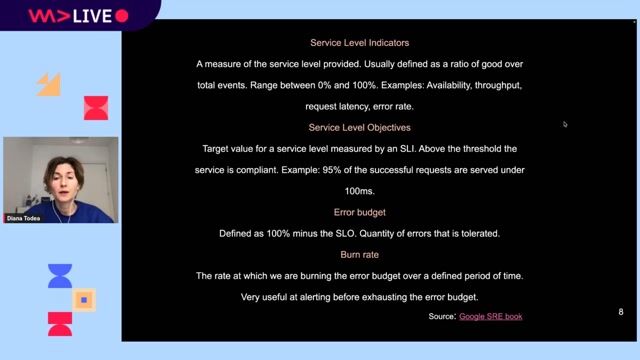
Service Level Indicators (SLIs) measure performance, while Service Level Objectives (SLOs) set targets to meet agreements (SLAs), with error budgets defining tolerance.
#3about 4 minutes
Exploring different SLO indicator types in Elasticsearch
A review of various SLO indicator types like APM availability, APM latency, and custom KQL helps in choosing the right metric for service monitoring.
#4about 3 minutes
How transforms power the underlying SLO architecture
The SLO architecture relies on a multi-layered transform service to roll up source data into summarized, entity-centric indices for efficient querying.
#5about 4 minutes
Creating transforms and setting up health alerts
Learn to create a transform through the Kibana UI and configure a transform health alert to monitor its status and trigger notifications via connectors.
#6about 2 minutes
Implementing burn rate alerting for proactive monitoring
Burn rate alerting uses multiple time windows to track how quickly the error budget is consumed, providing early warnings before an SLO is breached.
#7about 4 minutes
A practical demo of creating SLOs and dashboards
This demonstration walks through creating a transform, defining a custom SLO with a burn rate alert, and visualizing the results in a Kibana dashboard.
#8about 2 minutes
Managing SLOs and transforms with Elasticsearch APIs
Use the Dev Tools console in Kibana to interact with APIs for programmatically managing SLOs and transforms, which is useful for automation and troubleshooting.
#9about 3 minutes
Fostering cross-team collaboration with SLOs
Implementing SLOs is an organizational effort that requires collaboration between SRE, developers, product, and support teams to align on reliability goals.
#10about 5 minutes
Actionable takeaways for SREs on incident management
SREs should focus on understanding user expectations, defining key SLIs, balancing reliability and innovation, and using historical data to inform decisions.
#11about 9 minutes
Q&A on setting realistic SLOs and choosing tools
The discussion covers how to set achievable SLO targets, handle variance in serverless environments, and the benefits of in-house versus open-source monitoring tools.
#12about 7 minutes
Q&A on team alignment and prioritizing SLO work
This section addresses how to align multiple teams on SLOs through regular communication and how to prioritize improvements in the backlog, often driven by incidents or user feedback.
#13about 10 minutes
Q&A on third-party dependencies and new features
The final questions cover strategies for managing SLOs tied to third-party dependencies and balancing the introduction of new features with service reliability.
Related jobs
Jobs that call for the skills explored in this talk.
MLOps – What’s the deal behind it?Welcome to this issue of the WeAreDevelopers Live Talk series. This article recaps an interesting talk by Nico Axtmann who introduced us to MLOpsAbout the speaker:Nico Axtmann is a seasoned machine learning veteran. Starting back in 2014 he observed ...
Benedikt Bischof
MLops – Deploying, Maintaining And Evolving Machine Learning Models in ProductionWelcome to this issue of the WeAreDevelopers Live Talk series. This article recaps an interesting talk by Bas Geerdink who gave advice on MLOps.About the speaker:Bas is a programmer, scientist, and IT manager. At ING, he is responsible for the Fast...
Christina Schaireiter
Why Attend a Developer Event?Modern software engineering moves too fast for documentation alone. Attending a world-class event is about shifting from tactical execution to strategic leadership.
Skill Diversification: Break out of your specific tech stack to see how the industry...
From learning to earning
Jobs that call for the skills explored in this talk.