





WeAreDevelopers LIVE Feb 23, 2024

A beginner’s guide to modern natural language processing

Jodie Burchell

Stop wasting compute on expensive transformers. Basic count vectorization often rivals BERT for simple classification tasks. Discover how to match model complexity to your dataset realities.

Pause
Mute Enter Fullscreen
#1 about 3 min

Introduction to natural language processing challenges

Processing unstructured text requires robust strategies to successfully handle grammatical relationships and contextual ambiguities.

#2 about 3 min

Comparing tabular data and unstructured text inputs

Machine learning algorithms require structured numerical features instead of variable-length raw text strings.

#3 about 3 min

Introduction to fundamental text vectorization concepts

Transforming raw phrases into numeric feature columns allows machine learning architectures to ingest language metrics.

#4 about 4 min

Binary and count vectorization techniques for text

Assuming document meaning directly from raw element frequency provides straightforward rule-based feature extraction.

#5 about 2 min

Word embeddings and dimensional representation of text

Grouping isolated terminology by spatial similarity captures underlying linguistic patterns in multi-dimensional vector space.

#6 about 3 min

Learning representations using Word2Vec skip-gram architectures

Predicting surrounding words across extensive training datasets automatically establishes context-aware numeric associations.

#7 about 6 min

Training a Word2Vec model with Python and Gensim

Preparing cleaned tokens and instantiating an embedding pipeline quickly establishes functional numerical feature matrices.

#8 about 3 min

Converting word embeddings into document-level vectors

Averaging individual element representations produces a single dense footprint encapsulating entire contextual phrases.

#9 about 2 min

Evaluating a basic clickbait classification neural network

Feeding averaged document matrices into dense classification heads rapidly yields high-accuracy predictive capabilities.

#10 about 4 min

Disambiguating text using transformer self-attention mechanisms

Adding positional scoring arrays allows architectural blocks to quantify exact relevance between distant contextual dependencies.

#11 about 4 min

Pre-training language architectures with the BERT model

Iteratively guessing masked parameters and tracking sentence flows develops profound internal linguistic intuition.

#12 about 2 min

Fine-tuning pre-trained pipelines for localized domains

Replacing default generalized inference heads focuses established neural connections onto specially targeted logic goals.

#13 about 6 min

Implementing tokenization using Hugging Face Transformers

Maintaining fixed tensor dimensions via padding offsets and boolean matrices prevents crippling inference disruptions.

#14 about 3 min

Training the DistilBERT sequence classification model

Running a fine-tuning optimizer pass seamlessly adapts powerful connection weights to solve custom categorization constraints.

#15 about 2 min

Selecting ideal text processing methods for complexity

Matching mathematical methods against precise computational budgets improves processing efficiency and prevents heavy over-engineering.

#16 about 14 min

Troubleshooting vector representations and data science pipelines

Addressing testing artifacts and mitigating missing dictionary items bolsters application stability in real-world environments.

Matching moments

2:23 min

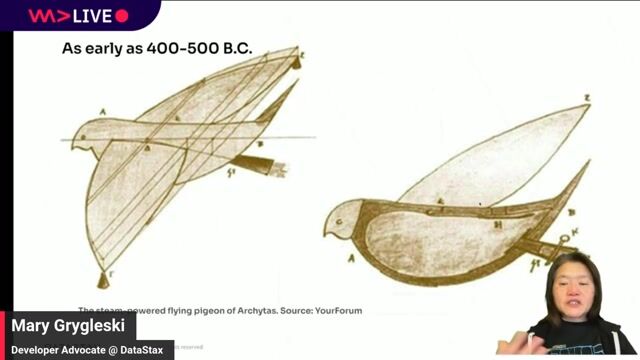
Historical breakthroughs in natural language processing models

Mary Grygleski Mary Grygleski · LIVE

5:11 min

Defining GPT architectures and natural language processing tasks

Mary Grygleski Mary Grygleski · LIVE

1:52 min

Modern natural language processing using Transformers and deep learning

Jan Schweiger · WWC 2022

3:52 min

Evolution of large language models and natural language processing

Natalie Pistunovich · LIVE

2:18 min

Major breakthroughs shaping the artificial intelligence landscape

Nico Axtmann · WWC 2022

5:05 min

Exploring popular generative AI models and applications

Mary Grygleski Mary Grygleski · LIVE

Upcoming sessions on this topic

Open session

World Congress 2026 North America

Understanding LLM Architectures: Inside the Design of Modern Models

Jofia Jose Prakash

Enterprise AI Architect at American Chemical Society

Jofia Jose Prakash
Open session

World Congress 2026 North America

Building Stuff with GenAI - The Open Minded Workshop beyond OpenAI

Andreas Erben

CTO for Applied AI and Metaverse at daenet

Andreas Erben
Open session

World Congress 2026 North America

Fast, Cheap, and Accurate: Optimizing LLM Inference with vLLM and Quantization

Legare Kerrison, Cedric Clyburn

Legare Kerrison
Cedric Clyburn
Open session

World Congress 2026 North America

Compute for your AI model: GPUs, LPUs, TPUs and beyond..

Kushaagra Goyal

Tech Lead at Rubrik, ex-CTO at Gan.AI, ex-Databricks

Kushaagra Goyal
Open session

World Congress 2026 North America

Context Engineering Kung Fu

Carl Lapierre

Tech Lead and AI Engineer at Osedea

Carl Lapierre
Open session

World Congress 2026 North America

You Can’t Re-Run Sunlight: Designing ML Data Architectures for Physical AI

An Phan

Senior Data Infrastructure Engineer @ Hippo Harvest

An Phan