Seven Steps from Monolith to Microservices - Burda Tech Deep Dive

From monoliths to microservices: A Software Architecture Challenge
The transformation from a monolithic software structure to microservices is not always easy, but it has its advantages. The architecture is more flexible, scalable and facilitates the further development of the software.
Sven Sanzenbacher, team lead in the software development area at Valiton, a Burda company, shares how this transformation can succeed step by step.
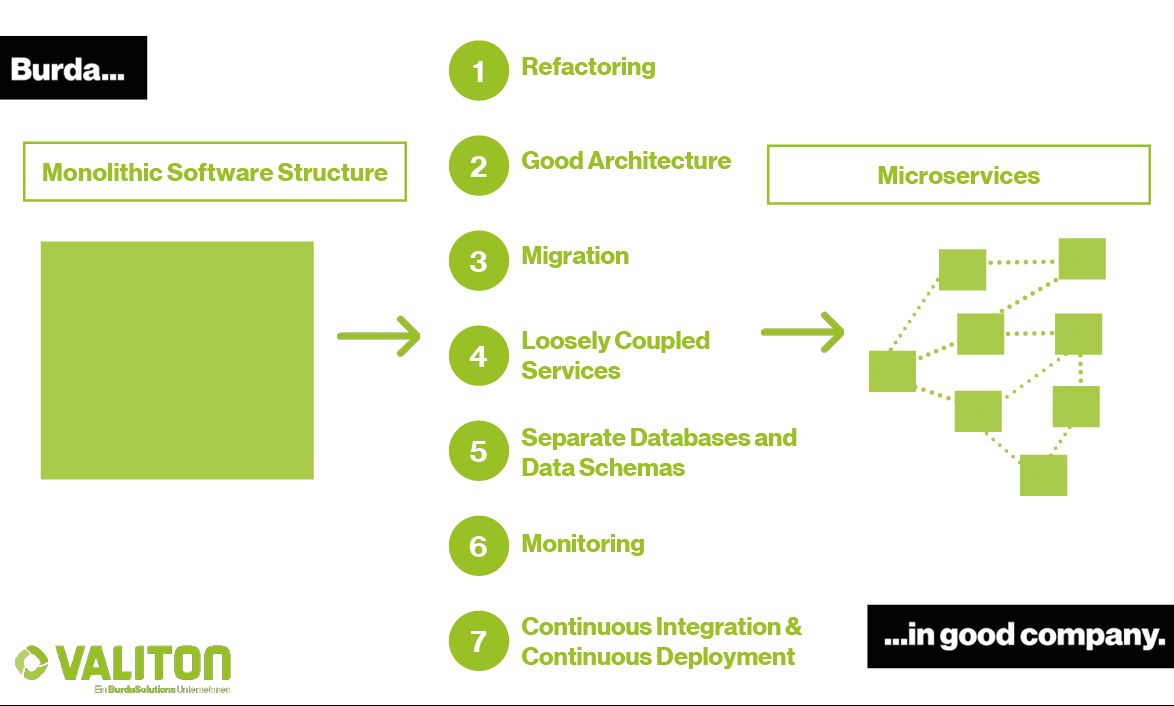
Seven steps from monolith to microservices
- Step-by-step refactoring: It is advisable to refactor the monolith step by step. By applying principles such as “SOLID”, “Domain-Driven Design” and “Clean Architecture”, clear boundaries can be defined between components and individual reusable as well as independent modules can be created.
- Monoliths with good architecture: Monoliths with a good architecture can be broken down into microservices more easily. A well thought-out architecture already lays the foundation for a later migration.
- Step-by-step migration: Instead of breaking down the entire monolith into microservices at once, you should pull out individual services step by step. This enables a controlled and manageable transition.
- Loosely coupled services: A key aspect of microservices is that the services are loosely coupled. This is achieved by using message queues or a message bus, up to an event-driven architecture. This improves the decoupling and flexibility of the services.
- Separate databases and data schemas: each service should have its own database and data schema. This improves the independence and fault tolerance of the individual services.
- Monitoring and troubleshooting: Central log servers and distributed tracing are essential elements for monitoring and troubleshooting in a microservices environment. They enable better tracking of issues and facilitate troubleshooting.
- Continuous integration and continuous deployment (CI/CD): CI/CD are key strategies that make the process of testing and deploying microservices more efficient and reliable. They enable rapid iteration and ensure that changes reach production quickly and safely.
Conclusion
In summary, migrating to microservices is not an easy journey. It requires careful planning, step-by-step refactoring and a clear vision. Nevertheless, microservices offer many advantages, such as increased scalability, flexibility, and the ability to evolve individual services independently.
Anyone interested in software architecture and the challenges of migrating to microservices should keep the presented takeaways in mind. While the path to a microservices architecture requires time and patience, it can lead to more efficient and flexible software development in the long run.
Are you also on a mission to free the software world from monoliths and establish yourself in the tech space? Then Valiton is the right place for you.
Valiton is part of the large Burda family and brings exciting projects in the areas of data science, data engineering and software development in tech and media forward.
Find the job that suits you: https://www.burda.com/en/career/