Staff Researcher - Vehicle Compute Platforms & SoC/MCU Semiconductor Systems
Role details
Job location
Tech stack
Job description
- Lead semiconductor-focused research projects that influence GM's electrical and software architecture roadmaps (central compute, zonal ECUs, domain controllers, edge nodes, infotainment, and automated driving compute platforms).
- Design and implement proof-of-concept prototypes on our R&D lab benches, using evaluation platforms and representative in-vehicle architecture benches to validate concepts before transfer to product teams.
- Represent GM in domestic and international standards bodies and technical meetings (e.g., IEEE 802.3, IEEE 802.1), including approximately 10-15% travel and quickly developing deep expertise in Ethernet-based in-vehicle protocols and IEEE 802 specifications to effectively navigate and influence complex standardization efforts.
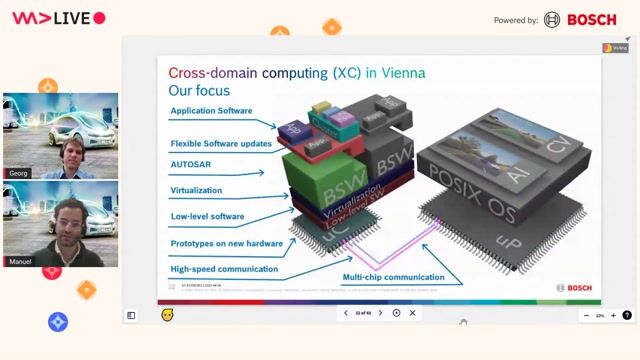
- Evaluate and benchmark SoCs/MCUs and memory technologies (CPU cores, accelerators, interconnects, DDR/LPDDR, flash, NVM, cache hierarchies) for latency, throughput, power, cost, and safety/security trade-offs.
- Explore and prototype new compute and communication concepts using FPGAs, evaluation boards, and custom circuitry to de-risk new architectures and features (e.g., real-time safety-critical functions, mixed-criticality workloads).
- Contribute to ECU and board-level design concepts, working with internal teams and suppliers on power, clocks, reset, high-speed interfaces (PCIe, Ethernet, DDR), and bring-up strategies.
- Drive low-level software concepts around boot flows, board support packages (BSPs), bare-metal or RTOS-based implementations, device drivers, and hardware abstraction needed for SDV architectures.
- Collaborate closely with GM engineering, purchasing, and suppliers to align semiconductor choices with GM's long-term architecture, safety, cybersecurity, and cost objectives.
- Seek out and aggressively pursue technology insertion opportunities at GM, working with product engineering and program teams to move successful research outcomes into production programs, pilots, or platform roadmaps.
- Publish and protect IP through internal reports, patents, and external publications where appropriate, and represent GM R&D at key technical conferences and workshops.
- Mentor researchers and early-career engineers, helping grow GM's internal expertise in semiconductor and compute-platform topics.
Requirements
As part of this role you may represent General Motors in standardization bodies, such as IEEE 802.3 and 802.1 to drive enhancements into Ethernet based standards/hardware. This may require 10 to 15% of domestic and international travel, the ability to quickly acquire an in-depth understanding of Ethernet based in-vehicle based protocols and of the IEEE 802 specifications and a strong ability to navigate and influence standardization efforts!, * M.S. in Computer Engineering, Computer Science, Electrical Engineering, or related field; Ph.D. preferred.
- 8+ years of relevant industrial or research experience (or 5+ with a Ph.D.) in semiconductors, SoC/MCU architecture, or embedded compute platforms.
- Deep understanding of modern SoCs/MCUs, including:
- CPU cores (e.g., Arm, RISC-V), memory hierarchies, interconnects, and on-chip peripherals.
- High-speed interfaces (e.g., PCIe, Ethernet, SerDes, DDR/LPDDR, GDDR, NVMe).
- Knowledge of automotive communication protocols (e.g., Ethernet, Time Sensitive Networking Standards, CAN, LIN, PCIe-based architectures, SOME/IP) and in-vehicle networks.
- Hands-on experience in the use of oscilloscopes, logic analyzers, and JTAG for board bring-up and debug.
- Experience with ECU or embedded system design and low-level software, such as:
- Board support packages, bootloaders, bare-metal or RTOS-based implementations, hardware drivers.
- Integration of low-level software with hardware in lab or bench environments.
- Demonstrated ability to define and execute research projects, from concept and modeling through proof-of-concept implementation and technology transfer to product teams.
- Strong communication and influence skills, including:
- Presenting complex technical content at multiple levels of detail (lab leadership, cross-functional partners, standards bodies).
- Building alignment across internal stakeholders and external partners., * Experience working for or closely with a semiconductor company or Tier-1 supplier, especially on automotive-grade SoCs/MCUs, memory subsystems, or safety-critical controllers.
- Hands-on experience with FPGA or digital hardware development (Verilog/VHDL, synthesis, timing closure, lab validation)
- Direct contributions to standards bodies (e.g., IEEE 802.x, OPEN Alliance, AUTOSAR) or similar consortia, including proposal authorship, editing, or leading technical subgroups.
- Experience with security and safety architectures at the hardware/platform level (e.g., secure boot, key storage, redundancy, fault containment).
- Prior experience leading cross-company or cross-organizational initiatives, navigating complex stakeholder landscapes, and influencing roadmaps without direct authority.
If you are excited by the idea of bridging semiconductor technology, ECU/board design, low-level software, and industry standards to define the next generation of automotive compute platforms, we encourage you to apply.