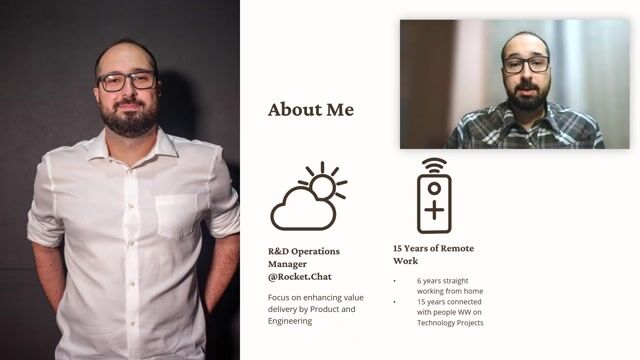
Gabriel Casals

The Async Revolution: Balancing Focus, Alignment, and Agility

Could a shift to extreme asynchronous work actually hurt your team? This talk explores the surprising pitfalls and a balanced path to reclaiming focus.

The Async Revolution: Balancing Focus, Alignment, and Agility
#1about 5 minutes

The hidden cost of excessive synchronous meetings

Sync-heavy rituals in a typical sprint can consume over 20% of an engineer's time, leading to meeting fatigue and constant context switching.

#2about 4 minutes

Protecting focus with the maker versus manager schedule

Applying a manager's fragmented schedule to makers who need long, uninterrupted blocks of time for deep work significantly harms productivity and flow state.

#3about 2 minutes

Assessing your team's readiness for asynchronous work

Before transitioning to async, evaluate if your company culture is flexible, if the team is educated on the right tools, and if the squad profile is suitable for the change.

#4about 2 minutes

A radical experiment to eliminate all synchronous rituals

To maximize the maker schedule, an experiment was conducted to completely eliminate all synchronous sprint rituals and force an async-first mindset.

#5about 3 minutes

Implementing new rules and tools for async collaboration

The new async system relied on specific tools for messaging and task management, redesigned rituals like async dailies, and behavioral changes like prioritizing public communication.

#6about 4 minutes

Evaluating the good, bad, and ugly results

The extreme async experiment boosted focus and productivity but also created negative side effects like endless message threads, team isolation, and superficial retrospectives.

#7about 5 minutes

Finding a balanced hybrid approach to collaboration

A middle path was found by being intentional with sync time, introducing a five-message rule to trigger a call, and using hybrid models for peer reviews and retrospectives.

#8about 3 minutes

A practical guide for implementing async practices

To implement async practices successfully, start by assessing your foundations, coordinating the rules of engagement with the team, and documenting key processes.

#9about 3 minutes

Measuring the impact of your async transition

Track the success of an async transition by monitoring key metrics like ENPS, ticket velocity, and "boomerang work," while gathering qualitative feedback in one-on-ones.

#10about 4 minutes

Where async models thrive and how to maintain them

Asynchronous models are most effective for internal teams across different time zones but require ongoing managerial oversight to maintain productivity and address issues.

Related jobs
Jobs that call for the skills explored in this talk.

Featured Partners

Related Articles

View all articles

From learning to earning

Jobs that call for the skills explored in this talk.