A robust P2P layer is the foundation of a secure blockchain. See how Lisk's library defends against spam, eclipse attacks, and malicious peers.
#1about 4 minutes
Understanding P2P networks versus centralized client-server models
Peer-to-peer networks offer greater user autonomy by distributing data and control, unlike traditional centralized systems governed by a single entity.
#2about 3 minutes
Comparing structured and unstructured P2P network topologies
Structured networks use organized topologies like DHTs for efficient resource lookup, while unstructured networks offer robustness against node churn through random connections.
#3about 5 minutes
How gossip protocol propagates blocks and transactions
The gossip protocol enables rapid and efficient dissemination of new blocks and transactions across the entire blockchain network by having each node forward information to its peers.
#4about 3 minutes
An overview of the Lisk P2P network implementation
The Lisk P2P network uses an unstructured partial mesh topology with distinct incoming and outgoing connections, configurable peer lists, and a peer banning mechanism.
#5about 6 minutes
Exploring security features in the Lisk P2P layer
Lisk P2P enhances security through peer bucketing to prevent spam, dynamic shuffling to mitigate structural attacks, and an internal reputation system to evict malicious peers.
#6about 3 minutes
Using the independent @lisk/lisk-p2p TypeScript library
The @lisk/lisk-p2p library is a generic, customizable TypeScript package that allows developers to easily create and manage P2P network instances for any application.
#7about 4 minutes
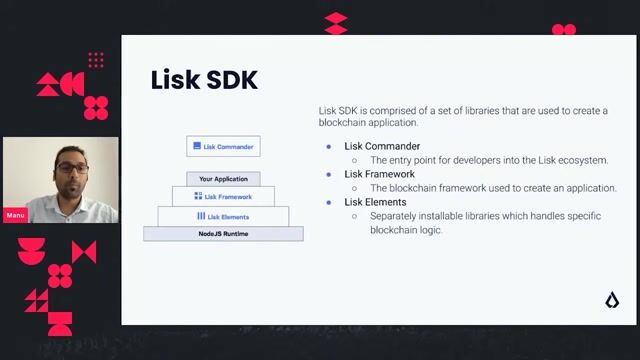
Understanding the Lisk SDK's modular architecture
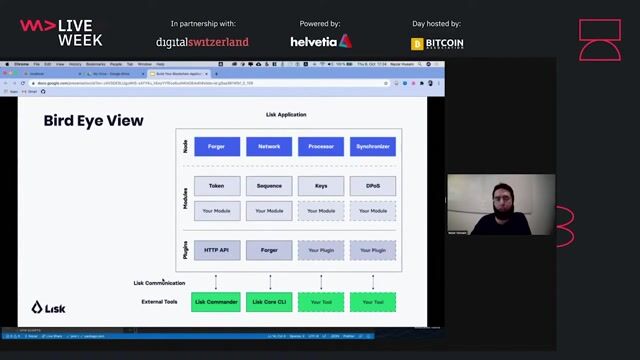
The Lisk SDK separates application logic into on-chain modules for protocol rules and off-chain plugins for extended functionality like APIs or monitoring.
#8about 2 minutes
A look at the default modules and plugins
Lisk SDK includes default modules for core functions like token transfers and DPoS, as well as plugins for an HTTP API, forging, and misbehavior reporting.
#9about 5 minutes
How to bootstrap a blockchain app with Lisk Commander
Lisk Commander is a CLI tool that simplifies development by bootstrapping a complete blockchain application skeleton and generating new modules or plugins with a few commands.
#10about 6 minutes
Building a custom client node with the P2P library
Developers can use the @lisk/lisk-p2p library to build lightweight client nodes for specific utilities like relayers or network monitoring tools.
Related jobs
Jobs that call for the skills explored in this talk.
Why Blockchain? A Developer’s PerspectiveFor many developers, blockchain feels like that one friend who keeps trying to sell you on their side hustle: persistent, occasionally confusing, and often surrounded by hype. But behind the buzzwords and market noise lies a technology with real engi...
Algorand Foundation
From Hype to Code: Real Blockchain Use Cases for DevelopersSo you’ve wrapped your head around why blockchain exists . You’re on board with the concepts: decentralization, immutability, and trust-minimized infrastructure. But now comes the real question:
What can you actually build with it?
This post is for d...
Chris Heilmann
All the videos of Halfstack London 2024!Last month was Halfstack London, a conference about the web, JavaScript and half a dozen other things. We were there to deliver a talk, but also to record all the sessions and we're happy to share them with you. It took a bit as we had to wait for th...










![Blockchain Keynote/Guest Speaker | Technology And Innovation [ESC1X203]](https://wearedevelopers.imgix.net/public/default-job-listing-cover.png?w=400&ar=3.55&fit=crop&crop=entropy&auto=compress,format)
