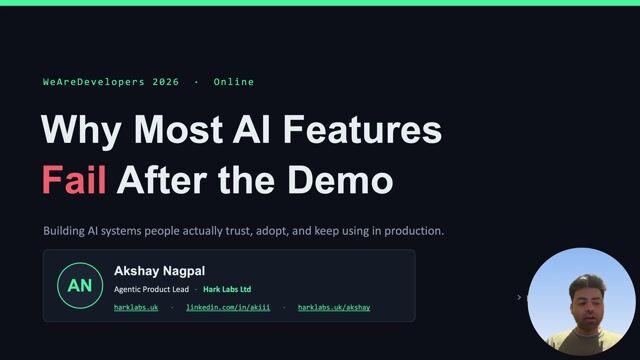
Akshay Nagpal

Why Most AI Features Fail After the Demo

Why do so many impressive AI demos fail in the real world? It’s not the model’s fault.

Why Most AI Features Fail After the Demo
#1about 2 minutes

Why successful AI demos often lead to production failure

AI demos create unrealistic expectations by using curated inputs and showing only happy paths, which does not reflect real-world user interaction.

#2about 3 minutes

The problem is the surrounding system, not the model

User churn is often caused by poor workflow integration and lack of trust, not by the underlying model's quality or performance on benchmarks.

#3about 3 minutes

Failure mode one is creating poor workflow fit

AI features fail when they act as "bolt-on" tools that add steps, instead of being "built-in" to existing user workflows to reduce friction.

#4about 2 minutes

Failure mode two is a fundamental lack of trust

Building user trust requires providing verifiable sources and ensuring that AI mistakes are cheap and easy to revert.

#5about 2 minutes

Failure mode three involves poor handoff design

AI systems must gracefully hand off to humans for ambiguous or out-of-scope requests instead of failing silently or confidently giving wrong answers.

#6about 2 minutes

Failure mode four is a lack of user control

AI features should start by suggesting actions and only move to autonomous acting for low-risk, reversible tasks to maintain user control.

#7about 2 minutes

Failure mode five is a lack of product discipline

Continuously improve AI features by instrumenting user interactions and building an evaluation harness with golden sets and "LLM as a judge" into the CI pipeline.

#8about 4 minutes

Introducing the TRUST framework for building AI products

The TRUST framework (Task fit, Recovery, User control, Signals, Trust calibration) provides a structure for building reliable AI systems.

#9about 2 minutes

Implementing confidence gating and automated evaluation sets

Use confidence scores to gate actions between suggesting and acting, and integrate golden sets with an "LLM as a judge" into your CI pipeline for automated testing.

#10about 5 minutes

Case study of a production-ready automation agent

An automation agent built on Slack uses a multi-step process involving intent gating, user plan confirmation, and a separate execution environment to ensure safety and control.

#11about 2 minutes

A pre-ship checklist and actionable next steps

Use the TRUST framework as a pre-ship checklist and start by creating messy golden cases, implementing a confidence gate, and logging user overrides.

#12about 1 minute

Key takeaways for building durable AI features

The success of an AI feature depends on the system around the model, earning user trust, and designing for long-term, repeated usage.

Related jobs
Jobs that call for the skills explored in this talk.

Featured Partners

Related Articles

View all articles

From learning to earning

Jobs that call for the skills explored in this talk.