Nina Malakhova

Software Rollouts Are a People Problem: Meet the Nine Change Management Monsters

From the quiet 'Disengager' to the endless 'Scope Hydra,' hidden monsters derail software rollouts. Learn to spot these nine people problems before they sink your next project.

Software Rollouts Are a People Problem: Meet the Nine Change Management Monsters
#1about 3 minutes

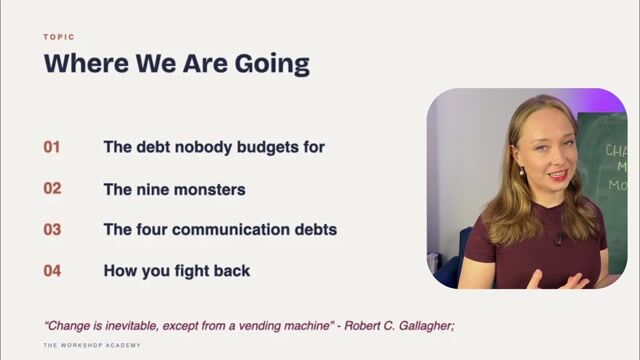
Software rollouts are a people and communication problem

Large-scale software rollouts are treated as a distributed system where people are the nodes, introducing challenges that require managing communication debt and change management issues.

#2about 2 minutes

Dealing with the disengager monster in stakeholders

When stakeholders become unresponsive, use the DACI framework to clarify roles (Driver, Approver, Contributor, Informed) and ensure you are communicating the right "why" to the right person.

#3about 1 minute

Escaping the meeting meteor shower with a single source of truth

Combat the proliferation of meetings by establishing a disciplined, searchable, and written single source of truth for all project decisions, statuses, and responsibilities.

#4about 1 minute

Overcoming the indecisive sludge with the RAPID framework

Break through decision paralysis by using the RAPID framework to explicitly assign roles for recommending, agreeing, performing, providing input, and ultimately deciding.

#5about 2 minutes

Preventing vacation paralysis and project bottlenecks

Avoid project stalls caused by key individuals being unavailable by increasing the team's bus factor through pair programming, task rotation, and thorough documentation.

#6about 1 minute

Winning over the resist-ants with the ADKAR model

Address user resistance not with more information, but by focusing on buy-in using the ADKAR model to build awareness and desire before teaching the "how."

#7about 1 minute

Improving the train-the-trainer model with local champions

Make training more effective by focusing on the 70-20-10 learning principle and empowering respected local champions to mentor peers and provide hands-on support.

#8about 1 minute

Taming the scope hydra with the MoSCoW method

Control scope creep by using the MoSCoW method to prioritize features, paying special attention to the "won't have" category to create clear boundaries and stakeholder alignment.

#9about 1 minute

Retiring the legacy gremlin using the strangler fig pattern

Decommission legacy systems safely by applying the strangler fig pattern to incrementally replace functionality, migrate processes, and set a final sunset date.

#10about 1 minute

Eliminating the duplicator with Gartner's TIME framework

Resolve process duplication caused by multiple tools by using Gartner's TIME framework to strategically decide which applications to tolerate, invest in, migrate, or eliminate.

#11about 3 minutes

Understanding and managing decision debt in projects

Avoid the pitfalls of decision debt, where the "why" behind a choice is lost, by using Architecture Decision Records (ADRs) and understanding Chesterton's Fence.

#12about 3 minutes

Preventing ownership debt and diffusion of responsibility

Combat ownership debt, where responsibility is implied but not assigned, by using frameworks like RACI, DACI, and DRI to explicitly name a single responsible individual.

#13about 3 minutes

Controlling narrative debt with consistent storytelling

Prevent your project's story from becoming distorted by using frameworks like the message house and commander's intent, and by repeating the core narrative at least seven times.

#14about 2 minutes

Addressing structural debt and when to carry debt strategically

Fix structural debt where the system is built to lose information, but also recognize that the goal is not zero debt but rather no surprises, making some debt acceptable.

#15about 2 minutes

How communication debts create change management monsters

Understand the direct link between different types of communication debt and the emergence of specific change management monsters, such as ownership debt causing the disengager.

Related jobs
Jobs that call for the skills explored in this talk.

Featured Partners

Related Articles

View all articles

From learning to earning

Jobs that call for the skills explored in this talk.