Jessica Janiuk

State of Angular

Angular's new Ivy engine cut Google's build resources by 90%. Find out what this fundamental rebuild means for your projects.

State of Angular
#1about 2 minutes

Understanding Angular's foundation and role at Google

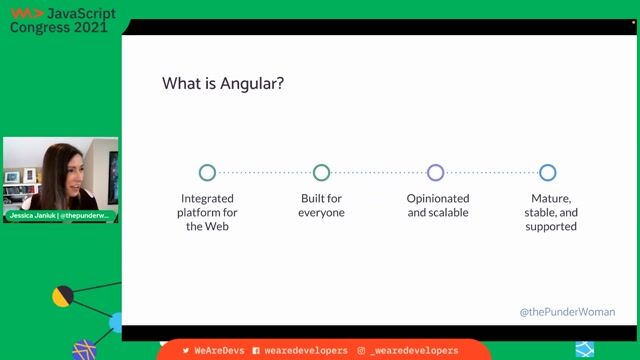
Angular is an opinionated and scalable platform that benefits from deep collaboration, validation, and support within Google.

#2about 3 minutes

How Angular collaborates with other Google teams

Examples of collaboration include AngularFire for Firebase integration and using TensorFlow.js for predictive prefetching to improve performance.

#3about 4 minutes

The multi-year journey and impact of the Ivy renderer

The Ivy rendering engine was a two-year effort that significantly reduced build times and computational resources for applications inside Google.

#4about 2 minutes

Improving debugging with new dev tools and error codes

The new Angular DevTools for Chrome and more specific error codes help developers profile applications and debug issues more effectively.

#5about 5 minutes

Engaging the community via a public roadmap and RFCs

Angular maintains a public roadmap and uses an RFC process to gather community feedback and provide transparency on future direction.

#6about 4 minutes

Exploring the major updates in Angular version 13

Angular v13 officially enables the Ivy renderer, removes IE11 support, modernizes the package format, and improves accessibility in Material components.

#7about 5 minutes

Simplifying the framework with standalone components

The upcoming standalone components feature aims to reduce complexity and lower the learning curve by making NgModules optional.

#8about 4 minutes

Q&A: Competition, stability, and backward compatibility

Competition from frameworks like React is viewed as a positive force, and Angular is committed to backward compatibility to avoid disruptive breaking changes.

#9about 3 minutes

Q&A: The future of end-to-end and unit testing

Protractor is being deprecated in favor of integrations with modern end-to-end testing tools like Cypress, while unit testing tools remain available.

#10about 4 minutes

Q&A: Lazy loading components and making Zone.js optional

Standalone components will support lazy loading, and making Zone.js optional is a long-term goal to give developers more control over change detection.

#11about 6 minutes

Q&A: Component use cases, virtual DOM, and dependencies

Standalone components can be used anywhere a normal component is used, while adopting a virtual DOM is not a short-term plan.

Related jobs
Jobs that call for the skills explored in this talk.
tree-IT GmbH

tree-IT GmbH
Bad Neustadt an der Saale, Germany

54-80K
Intermediate
Senior
Java
TypeScript
+1

Featured Partners

Related Articles

View all articles
Benjamin Ruschin
The HTML Elements That You’re Probably Over-Engineering
As frameworks have become more and more commonplace in the world of web development, so too has the over-engineering of features made possible by our humble old friend, HTML. The mental models that come with using state management in React, Vue and o...
The HTML Elements That You’re Probably Over-Engineering
Daniel Cranney, Chris Heilmann
Dev Digest 215: Agent Memory, JS2026, Googlebot Analysis & Canvas❤️HTML
Inside last week’s Dev Digest 215 . 🗿 Make AI talk like a caveman 🧠 A guide to context engineering for LLMs 🤖 Simon Willison on agentic engineering 🔐 Axios supply chain attack post mortem 🛡️ Designing AI agents to resist prompt injection 🎨 HTML in c...
Dev Digest 215: Agent Memory, JS2026, Googlebot Analysis & Canvas❤️HTML

From learning to earning

Jobs that call for the skills explored in this talk.